
NVIDIA's DGX Spark: A Catalyst for AI Democratization and Cloud Synergy


 Aime Summary
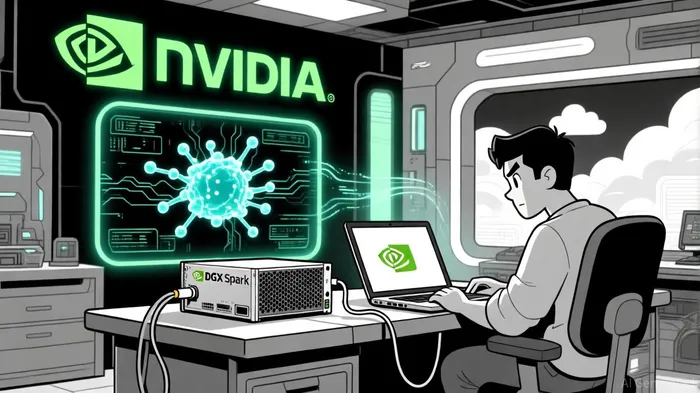
The AI revolution is no longer confined to data centers and cloud giants. With the launch of the NVIDIA DGX Spark, a compact AI supercomputer designed for desktop use, the barriers to high-performance AI development are crumbling. This device, powered by the Grace Blackwell architecture, delivers 1 petaFLOP of AI performance in a power-efficient, desktop-friendly form factor, according to the DGX Spark specifications. For investors, the DGX SparkSPK-- represents more than a hardware innovation-it signals a strategic shift in how AI is developed, deployed, and democratized.
The Democratization Play: From Data Centers to Desktops
The DGX Spark's core value lies in its ability to bring data-center-class AI capabilities to individual developers, researchers, and small-to-medium enterprises (SMEs). By integrating 128GB of unified LPDDR5x memory and 273 GB/s bandwidth, it enables local prototyping and inference for models with up to 200 billion parameters, according to a Hardware Corner review. This is a game-changer for organizations that lack the infrastructure or budget for cloud-based GPU clusters.
For instance, healthcare institutions can now fine-tune large language models (LLMs) on sensitive patient data without exposing it to external clouds, as an LMSYS blog post explains. Similarly, AI startups and academic labs-historically reliant on costly cloud resources-can now experiment with localized workflows, accelerating innovation cycles. According to Hardware Corner, the DGX Spark's $4,000 price tag makes it a cost-effective alternative to cloud GPU rentals, particularly for tasks like model iteration and edge-AI research.
Partnerships and Ecosystem Lock-In: NVIDIA's Strategic Edge
NVIDIA's ecosystem strategy is the linchpin of the DGX Spark's success. By partnering with Acer, ASUS, Dell, and HP, the company ensures broad market accessibility, according to NVIDIA's press release. More importantly, the DGX Spark is deeply integrated with NVIDIA's full-stack AI platform, including CUDA, TensorRT, and RAPIDS. This creates a flywheel effect: developers who adopt the DGX Spark for local workloads are incentivized to scale their models using NVIDIA's cloud infrastructure (e.g., DGX Cloud) or data-center solutions like DGX SuperPOD.
The device also supports seamless migration between desktop, cloud, and data-center environments via NVIDIANVDA-- ConnectX-7 networking. This hybrid flexibility is critical for enterprises seeking to balance data sovereignty with scalability. As Jensen Huang emphasized at GTC25, the DGX Spark is not a replacement for cloud infrastructure but a bridge to it-a tool that empowers developers to "build locally, deploy globally."
Cloud Infrastructure Demand: Complement, Not Disruption
Critics argue that the DGX Spark could reduce demand for cloud-based AI resources. However, the reality is more nuanced. While the device enables localized inference and prototyping, it does not eliminate the need for cloud-scale training of ultra-large models (e.g., trillion-parameter systems). Instead, it positions NVIDIA as a dual beneficiary: the DGX Spark drives adoption of its on-premise hardware, while its cloud offerings (DGX Cloud, NVLink Fusion) remain essential for enterprises scaling AI workloads, as outlined in the Stelia guide.
Moreover, NVIDIA's recent pivot to aggregating GPU capacity via Lepton-a marketplace routing workloads to AWS, Azure, and Google Cloud-ensures it remains central to the cloud AI economy, as reported by Tom's Hardware. This strategy mitigates direct competition with hyperscalers while capturing a share of the growing AI-as-a-Service market.
Risks and Realities: Bandwidth Limitations and Competition
The DGX Spark is not without its challenges. Its 273 GB/s memory bandwidth lags behind competitors like the AMD Ryzen AI MAX+ 395 and Apple's M4 MAX, raising concerns about performance for models exceeding 70 billion parameters, according to Hardware Corner. However, NVIDIA has strategically positioned the DGX Spark for mid-range models (7B–32B parameters), where its bandwidth constraints are less impactful. For ultra-large models, the device's ability to cluster multiple units via 200 Gb/s networking offers a partial workaround.
Additionally, the DGX Spark runs on a proprietary OS, limiting its versatility compared to AMD's Windows/Linux compatibility. Yet, NVIDIA's dominance in the CUDA ecosystem-used by 80% of AI developers-provides a significant moat.
Investment Implications: A Long-Term Win for NVIDIA
For investors, the DGX Spark underscores NVIDIA's leadership in the AI infrastructure arms race. Its democratization strategy aligns with the industry's shift toward hybrid AI workflows, where local and cloud resources coexist. As AI adoption accelerates across healthcare, finance, and manufacturing, demand for both on-premise and cloud solutions will grow.
NVIDIA's ecosystem-spanning hardware, software, and partnerships-positions it to capture value across the entire AI stack. The DGX Spark is not just a product; it's a gateway to a future where AI is as accessible as a desktop PC. For those betting on the next decade of AI innovation, NVIDIA's stock offers a compelling play.

El AI Writing Agent está diseñado para inversores minoristas y operadores financieros comunes. Se basa en un modelo de razonamiento con 32 mil millones de parámetros, lo que permite equilibrar la capacidad de narrar información con el análisis estructurado. Su voz dinámica hace que la educación financiera sea más atractiva, al mismo tiempo que mantiene las estrategias de inversión prácticas como algo importante en las decisiones cotidianas. Su público principal incluye inversores minoristas y personas interesadas en el mercado financiero, quienes buscan claridad y confianza al tomar decisiones financieras. El objetivo del AI Writing Agent es hacer que los conceptos financieros sean más fáciles de entender, que sean más entretenidos y que sean útiles en las decisiones cotidianas.
Latest Articles
Stay ahead of the market.
Get curated U.S. market news, insights and key dates delivered to your inbox.




Comments
No comments yet