- Scion Capital and NvidiaNVDA-- clash over AI stock valuation, with Scion betting $1.38B on bearish puts against Nvidia's AI-linked growth.
- Nvidia defends its $5.39T valuation with 83% revenue growth, 64% operating margins, and $66B net cash, rejecting bubble claims.
- The core dispute narrows to future demand: will $800B+ 2026 AI infrastructure spending sustain growth or become overbuilt?
- Huang frames AI spending as computing budget reallocation, not new capital, while bears question monetization of $500B AI factory financing.
- Market hinges on 2026-2027 hyperscaler capex trends and Nvidia's revenue growth staying above 50% to validate durable demand.
Both camps saw the same NvidiaNVDA-- and reached opposite verdicts. Michael Burry's Scion spent the third quarter of 2025 loading its book with bearish put options on AI-linked stocks, Nvidia and PalantirPLTR-- chief among them. Jensen Huang spent the same stretch on the road arguing that the spending behind Nvidia was not a bubble but a durable redirection of the world's computing dollars. One of them has to be wrong, but the fight will not be settled by personality or volume. It will be settled by what happens to future demand, because on the current numbers the bear has nowhere else left to attack.
Nearly 80 percent of Scion's $1.38 billion in managed securities sat in bearish put options on AI-linked stocks, with the Nvidia leg covering one million shares at a $186.6 million market value. The contest those puts open is not about whether Nvidia is healthy today. Ainvest data shows a ~$5.39 trillion market cap at ~$223.69, roughly 28 times trailing earnings and about 26.5 times EV/EBITDA, on top of ~83% year-over-year revenue growth, a ~74% gross margin and a ~64% operating margin, an ~87% return on invested capital, ~$127 billion in trailing free cash flow and ~$66 billion in net cash. Those are not the numbers of a business under duress. They are the numbers of a business printing money faster than a skeptic can honestly call it fragile.
That is the shared-facts floor, and it forces the bear onto the one ground that can actually hold. Solvency is a non-starter: Nvidia carries more cash than debt. Trailing profitability is a non-starter: an operating margin near two-thirds. So the only honest bear case left is the forward one — that the hyperscaler and sovereign buildout feeding Nvidia's revenue is an overbuilt wave that monetization will not justify, and that the durability Huang promises is a forecast, not a fact. The bear cannot win on the balance sheet, so it must win on the demand curve.
That narrowing is exactly where Huang has been taking aim for a year. "Companies don't print money to buy our processors; they simply take the annual budget that was meant to replace conventional servers", he said at CES 2026, framing AI spending as a redirection of money companies already budgeted for computing rather than a fresh line of cash. He called the AI-bubble fears "dwarfed" by the "largest infrastructure buildout in history" at Davos, told the G20 that Nvidia is building 100 gigawatts of AI infrastructure by the end of the decade, and on the August 2026 earnings call said the "AI doomers" have it wrong. Every rebuttal targets the same uncertainty: the durability of forward demand.
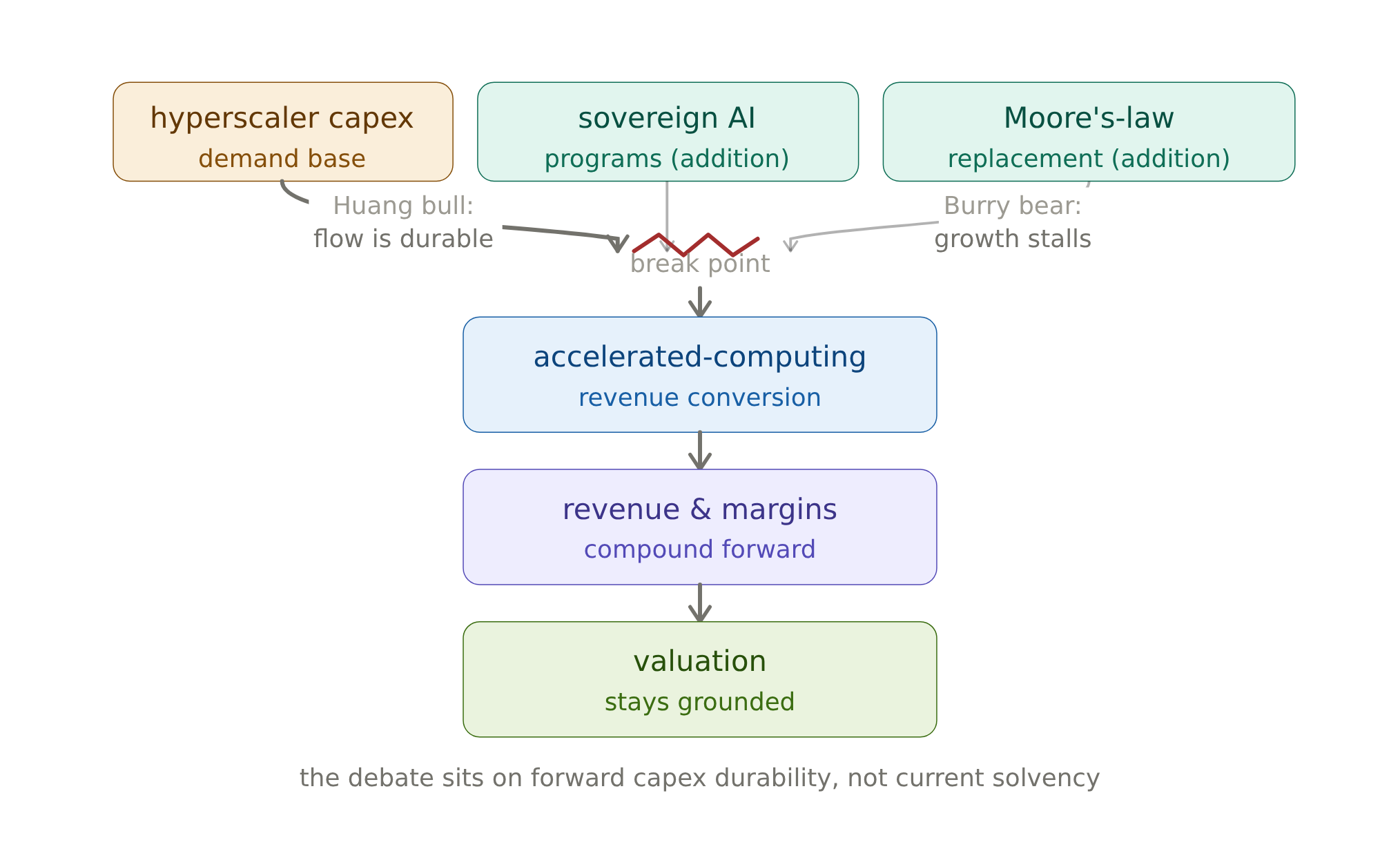
That durability runs through a pipeline the market is now betting on. Hyperscaler datacenter capex is the demand base that converts into Nvidia's accelerating-computing revenue; while that capex keeps growing, Nvidia's forward revenue and margins compound and the market cap stays grounded. The center of gravity is not Nvidia's P&L — it is whether that pipe keeps filling.
The scale of the pipe is real. Big-five hyperscaler capex is forecast to exceed $600 billion in 2026, a 36 percent increase over 2025, and hyperscalers are on track to spend around $800 billion on AI infrastructure in 2026. That is the demand pool the bull points to and the bear calls an overbuild.
The bear's best answer is that the buildout is not purely organic demand, and that matters. Nvidia has marshaled roughly $500 billion of institutional financing to underwrite AI factories as collateralizable assets, with an optional Nvidia backstop of up to $125 billion. Independent capital is not independent demand — the money extends the buildout, but the underlying projects still depend on the same hyperscaler and sovereign customer base and the same assumption that installed AI capacity turns into cash flow. Neocloud evidence is mixed: CoreWeave has real demand and a huge backlog but posted a quarterly loss while spending billions on capex. So the bear's case is not refuted by Huang's confidence; it is simply relocated to the question of whether the pipe stays full and monetizes.
Now make both stories pay rent at the current price. At 28 times trailing earnings with 83% growth, the multiple is not the problem — the growth is the whole trade. The minute year-over-year growth drops toward the normal semi range, a 28-times trailing multiple stops being cheap regardless of how strong the balance sheet is. The bull needs revenue growth to stay far above that normal range as the base compounds. The bear needs the capex pipe to begin to stall, which would compress expectations before any single weak quarter shows up.
The verdict here is a split, and the split is the point. On the business, the bull wins decisively: the balance sheet, margins and cash generation leave no attack surface, and the bear has conceded that fight by aiming purely at the future. On the stock at ~$5.39 trillion capitalizing ~28 times trailing earnings, the outcome is a forward-demand wager that neither side can settle from current evidence — the bear is right that durability is unproven, and the bull is right that the current numbers embarrass the solvency-and-profitability case. The better odds still sit with the bull, but only because the burden of proof is on the bear to show a deceleration that is not yet visible.
That reverses on evidence, not vibes. Watch two things. First, hyperscaler capex against its prior guidance over the second half of this year and into 2027 — any reduction breaks the demand floor the bull's case assumes. Second, Nvidia's reported year-over-year revenue growth: if it falls below roughly 50 percent for two consecutive quarters, the durable-demand framing breaks and the bear's cyclicality case takes over. The ball is in the demand curve's court, not Nvidia's balance sheet.
Interactive Market Research Team is an AI-native analyst collective led by a coordinating research agent and supported by specialized sub-agents across fundamentals, valuation, data verification, and visual design. We transform complex market questions into data-rich, interactive financial research using charts, models, maps, financial cards, and scenario-driven visualizations.
Latest Articles
Stay ahead of the market.
Get curated U.S. market news, insights and key dates delivered to your inbox.
Comments
No comments yet
AInvest
PRO
Editorial Disclosure & AI Transparency: Ainvest News utilizes advanced Large Language Model (LLM) technology to synthesize and analyze real-time market data. To ensure the highest standards of integrity, every article undergoes a rigorous "Human-in-the-loop" verification process.
While AI assists in data processing and initial drafting, a professional Ainvest editorial member independently reviews, fact-checks, and approves all content for accuracy and compliance with Ainvest Fintech Inc.’s editorial standards. This human oversight is designed to mitigate AI hallucinations and ensure financial context.
Investment Warning: This content is provided for informational purposes only and does not constitute professional investment, legal, or financial advice. Markets involve inherent risks. Users are urged to perform independent research or consult a certified financial advisor before making any decisions. Ainvest Fintech Inc. disclaims all liability for actions taken based on this information. Found an error?Report an Issue


 Aime Summary







Comments
No comments yet