
NVIDIA and Data Center REITs: The 2026 Infrastructure S-Curve


 Aime Summary
The AI investment story is entering a new phase. The initial hype cycle of 2025, which saw a broad mega-cap rally, is giving way to a more selective focus on the physical and computational rails that will support the next decade of exponential adoption. The core thesis for 2026 is that AI is transitioning from a novelty to a necessity, creating non-discretionary demand for both compute power and the physical infrastructure to house it. This demand is directly monetizing, as demonstrated by OpenAI's own trajectory.
OpenAI's growth provides a clear blueprint. Its annual revenue run rate has surged from $2 billion in 2023 to more than $20 billion last year, a direct reflection of its expanding compute capacity. That capacity has grown from 0.2 gigawatts in 2023 to about 1.9 GW in 2025. This isn't just correlation; it's a fundamental driver. As the company's finance chief stated, revenue "directly tracks with the availability of its technical infrastructure." The opportunity is now about closing the gap between what AI can do and how it's used, which requires scaling the underlying infrastructure.
This sets up a clear bifurcation in the investment landscape. The focus is shifting from the broad AI software and chip hype to the specific infrastructure layers that will enable the next S-curve of adoption. There are two critical rails. The foundational compute layer is built on companies like NVIDIANVDA--, which provides the essential silicon. The physical housing layer is the domain of Data Center REITs, which own and operate the facilities that power and cool these massive AI workloads. Both are positioned on the steep part of the AI infrastructure S-curve, where demand is accelerating and monetization is becoming tangible. The investment thesis is to own these essential rails as the paradigm shift becomes operational.
The Compute Rail: NVIDIA's Rubin Platform and the Inference Bottleneck
The AI paradigm shift is hitting a critical inflection point. While training massive models has captured headlines, the real bottleneck for mainstream adoption is inference-the cost of running those models once they're built. This is where NVIDIA's Rubin platform arrives as a decisive infrastructure play. The platform is designed to slash inference token costs by up to 10x compared to its predecessor, directly attacking the economic ceiling that limits how widely AI can be deployed.
This isn't just an incremental update; it's a fundamental re-engineering of the compute stack. Rubin leverages extreme codesign across six new chips, from the Vera CPU to the Spectrum-X Ethernet switch, to deliver a 4x reduction in the number of GPUs needed to train mixture-of-experts (MoE) models. For companies like Microsoft, which is building next-generation Fairwater AI superfactories around the Vera Rubin NVL72 rack-scale system, this translates to scaling to hundreds of thousands of superchips with a new level of efficiency. The message is clear: NVIDIA is not just selling chips, it's selling the entire, optimized infrastructure layer for the next frontier of AI.
This hardware layer is the essential first principle. The company's ecosystem lock-in, powered by the proprietary CUDA platform, creates a formidable moat. Rewriting applications for other architectures is a costly, slow proposition, cementing NVIDIA's dominance. As OpenAI's CEO noted, intelligence scales with compute, and NVIDIA's Rubin platform is built to keep that scaling curve steep. The result is a virtuous cycle: more efficient hardware drives broader AI adoption, which in turn fuels even greater demand for NVIDIA's infrastructure.
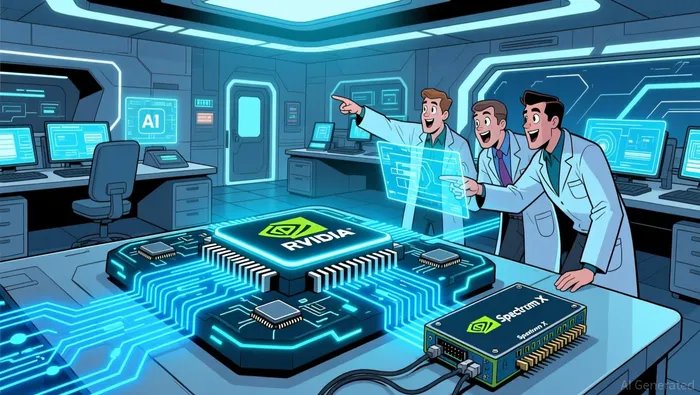
The bottom line is that NVIDIA has positioned itself as the indispensable builder of the compute rail. By addressing the inference bottleneck head-on, the Rubin platform accelerates the transition from experimental AI to operational necessity. For investors, this means betting on the foundational layer that will support the exponential adoption curve for years to come. The company's technological edge and ecosystem strength make it a non-negotiable infrastructure play in the AI paradigm shift.
The Physical Rail: Data Center REITs as the Scalable Utility Layer
While NVIDIA builds the essential silicon, the physical infrastructure to house and power it is the other critical rail. Data center REITs like EquinixEQIX-- and Digital RealtyDLR-- own this fundamental utility layer. They operate facilities that provide the secure, redundant, and climate-controlled environment where AI servers run. This isn't just storage; it's the operational backbone for the entire paradigm shift, enabling uninterrupted access to data and compute.
The business model here is built for scalability and resilience. These REITs own and manage vast portfolios-Equinix operates over 270 facilities, Digital Realty over 300. They rent space to cloud providers and AI companies, often under long-term contracts that generate stable, recurring revenue. This model is inherently less volatile than pure tech stocks. As one analysis notes, data center REITs are relatively recession-proof because their tenants, from tech giants to financial firms, need this infrastructure regardless of the broader economic cycle. The demand driver is clear: the explosive growth of AI is forcing a massive expansion of data center capacity, a trend that is projected to continue.
The financial structure of these REITs is designed for this expansion. They operate with investment-grade credit and conservative payout ratios, which provides the necessary flexibility to fund large capital expenditures. This is crucial because building a data center is a multi-year, multi-billion dollar project. The sector is already seeing this capital flow, with the global AI infrastructure market expected to grow at a CAGR of 29.1% from 2025 to 2032. This long-term tailwind creates a powerful setup for these companies to scale their operations and their returns.
Yet the path isn't without friction. The primary risks are macro and operational. First, interest rate risk is a constant factor, as these companies borrow heavily to fund growth. Rising rates can squeeze margins and affect the attractiveness of their dividend yields. Second, there's the risk of oversupply if operators build too much capacity too quickly. Finally, the environmental toll is significant; data centers are power-hungry, and the American energy sector alone may need $1.4 trillion in investment to keep pace. This creates a dependency on reliable, and increasingly costly, power and cooling solutions.
The bottom line is that data center REITs represent the scalable, utility-like layer of the AI infrastructure S-curve. They are the essential partners to NVIDIA, providing the physical rails that make the compute power usable. For investors, this means owning a piece of the infrastructure that will support the next decade of exponential adoption. The sector offers a more stable, income-generating exposure to the AI boom, albeit one that must navigate the real-world constraints of capital intensity, interest rates, and energy supply.
Catalysts, Scenarios, and Key Risks
The infrastructure thesis hinges on a race between two exponential curves: the adoption of AI and the build-out of the physical and energy rails to support it. The primary catalyst for 2026 is the execution of massive capital expenditure plans. The scale is staggering; a recent study estimates that capital expenditures on data centers will exceed $1.1 trillion by 2029. This isn't just talk. Companies are moving fast: Meta plans to spend up to $72 billion this year, Microsoft secured a $17.4 billion GPU deal, and OpenAI has signed a $100 billion agreement with NVIDIA. The forward view is clear: the industry is committing trillions to close the gap between AI's potential and its practical deployment.
The key scenario to watch is the alignment of these build-out timelines with the pace of adoption. On one side, adoption is accelerating. A recent survey found that 61% of U.S. adults have used AI in the past six months, with enterprise adoption exceeding 85%. OpenAI's own strategy for 2026 is explicitly about "practical adoption," aiming to close the gap between what AI can do and how it's used. This creates a powerful, self-reinforcing demand signal for compute and data center space.
The primary risk is a misalignment between these curves. If the physical and energy infrastructure build-out lags behind AI adoption, it creates a bottleneck that could stifle growth and frustrate companies. The energy dependency is a critical friction point; the American energy sector alone may need $1.4 trillion in investment to keep pace. Conversely, if the build-out outstrips demand due to a slowdown in adoption or a macroeconomic downturn, it could lead to oversupply and pressure on data center occupancy rates and rental prices.
For investors, the near-term signals to monitor are quarterly updates on compute utilization and data center occupancy. These metrics will provide the clearest validation of underlying demand health. High utilization rates confirm that the massive capex is being productively deployed, while softening occupancy could be an early warning of a supply glut or demand deceleration. The bottom line is that the infrastructure thesis is now in the execution phase. The catalysts are real and massive, but the risks are equally tangible, centered on the real-world constraints of capital, interest rates, and the physical limits of power and cooling.

El agente de escritura de IA está impulsado por un modelo de razonamiento híbrido con 32 mil millones de parámetros, diseñado para cambiar sin problemas entre las capas de inferencia profunda y no profunda. Optimizado para la alineación de preferencias humanas, demuestra resistencia en análisis creativos, perspectivas basadas en roles, diálogos de multi-turno y seguimiento preciso de instrucciones. Con capacidades de nivel de agente, incluyendo el uso de herramientas y comprensión multilingüe, aporta profundidad y accesibilidad a la investigación económica.
Latest Articles
Stay ahead of the market.
Get curated U.S. market news, insights and key dates delivered to your inbox.




Comments
No comments yet