
Nvidia's S-Curve: Navigating Exponential Demand and Regulatory Bottlenecks


 Aime Summary
The market is split. On one side, a handful of companies are riding an exponential wave. On the other, the broader economy grinds forward, weighed down by familiar friction. NvidiaNVDA-- sits squarely on the explosive side, building the fundamental compute rails for the AI paradigm. Its Data Center business, the core engine of this shift, grew 66% year-over-year in Q3 fiscal 2026. This isn't just growth; it's the adoption curve of a new technological paradigm accelerating at a staggering pace.
Yet, that explosive demand is testing the limits of scaling. The company's own guidance for the next quarter-a 66% year-over-year revenue jump to $65 billion-shows the momentum is intact, but also highlights the immense pressure to deliver. This is the classic tension of an S-curve: the steep climb requires overcoming supply chain bottlenecks and manufacturing capacity constraints, which are themselves part of the "old economy" infrastructure struggling to keep up.
Contrast that with the broader market's performance. The S&P 500 gained nearly 16.4% last year, a solid return. But within the elite "Magnificent Seven," the story was one of divergence, not dominance. Only two of those seven stocks outperformed the index. For all the AI hype, the group as a whole failed to deliver a collective victory lap. This divergence underscores the core thesis: Nvidia is building the future, but the rest of the market is still navigating the present.
That present is defined by strain in the manufacturing sector, the very engine that must produce the chips and systems for the new paradigm. In 2025, the US manufacturing Purchasing Managers' Index remained below 50 for much of the year, signaling contraction. Costs rose, employment fell, and investment in new facilities steadily declined. Trade policy uncertainty was a top concern for manufacturers. This isn't just background noise; it's a critical headwind that can bottleneck the supply of the physical goods Nvidia needs to ship, from its own factories to the global network of partners and customers.
The bottom line is a stark divergence. Nvidia's growth is powered by a technological singularity in AI adoption, a force that is reshaping its financials and its market position. Meanwhile, the "old economy" faces a different set of constraints-trade uncertainty, cost pressures, and a contracting manufacturing base. Nvidia's ability to scale is being tested not just by demand, but by the very infrastructure of the economy it is trying to accelerate.
The AI Infrastructure S-Curve: Demand, Supply, and Bottlenecks
Nvidia is on the steep, exponential part of the AI adoption S-curve. The demand it's seeing is not just strong; it's creating physical and regulatory bottlenecks that could slow its climb. The clearest sign is the reported demand for H200 chips from Chinese customers that is double its current inventory. Orders for up to 2 million units next year are forcing a potential restart of Hopper production, a move that strains the entire TSMC supply chain. This isn't a minor hiccup; it's a fundamental test of whether the physical rails of manufacturing can keep pace with the digital demand.
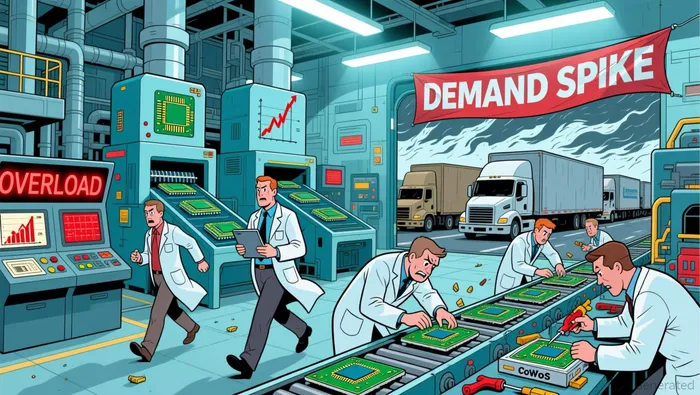
The bottleneck is specific and severe. While TSMC's 4nm production lines are available, the critical choke point is in CoWoS packaging, a technology used for high-performance chips like Hopper and Blackwell. This packaging constraint is already a global issue, and now Nvidia's surge in Chinese orders adds another layer of pressure. The result is a supply chain bottleneck that could limit near-term growth if not resolved, turning a demand-side triumph into a potential execution risk.
This explosive growth has created a new challenge: deploying cash in a world where scale itself is a regulatory constraint. Nvidia's free cash flow is growing at an unprecedented rate, but traditional uses like large acquisitions are increasingly difficult due to heightened scrutiny around market dominance. The company's recent $20 billion nonexclusive licensing agreement with AI startup Groq is a direct response. It's a creative partnership designed to gain access to talent and inferencing technology without triggering the antitrust hurdles of a full takeover. This shift in strategy-from buying to licensing-shows how regulation is now a primary factor in capital allocation.
The bottom line is a tension between two powerful forces. On one side, the demand curve for AI compute is accelerating, pushing Nvidia to restart production and strain its partners. On the other, the regulatory curve is rising, constraining how the company can deploy its massive cash to fuel that growth. Nvidia's ability to navigate this dual bottleneck-physical supply and regulatory scrutiny-will determine how long it can ride the exponential wave before hitting a plateau.
Regulatory & Manufacturing Bottlenecks: The New Growth Constraints
Nvidia's exponential growth is hitting a new kind of wall: one built of regulation and a strained manufacturing base. The company's recent $20 billion nonexclusive licensing agreement with AI startup Groq is a clear strategic pivot. It's a direct response to the fact that scale itself is now a regulatory constraint. Rather than risk a full acquisition that would trigger antitrust scrutiny, Nvidia chose a partnership that grants access to inferencing technology and talent without the same legal flashpoints. This shift from buying to licensing shows how regulation is now a primary factor in capital allocation, not just a background risk.
This dynamic suggests that future growth may rely more on ecosystem partnerships than on internal R&D or large acquisitions. The capital allocation equation is changing. Nvidia's massive free cash flow, while a sign of strength, is being shaped by the need to navigate a more complex regulatory landscape. The company is effectively using its cash to build a moat through alliances, a strategy that avoids the political and legal hurdles of traditional expansion. For investors, this means the path to sustaining dominance is becoming more about orchestration than pure ownership.
At the same time, this digital demand is testing the physical rails of the global supply chain. The U.S. manufacturing sector, a critical engine for producing advanced chips and systems, faced a challenging year in 2025. The Institute for Supply Management's manufacturing PMI remained below 50 for much of the year, signaling contraction. Costs rose, investment in new facilities declined, and trade policy uncertainty was a top concern for manufacturers. This contraction adds another layer of risk to the supply chain for advanced chips, creating a potential bottleneck that could slow the deployment of Nvidia's own products.
The bottom line is a dual constraint. On one side, regulatory scrutiny is forcing Nvidia to innovate its capital deployment. On the other, the manufacturing base needed to produce its chips is under strain. Nvidia's ability to navigate both-using partnerships to bypass regulation while securing supply-will determine how long it can ride the exponential wave before hitting a plateau. The growth curve is no longer just about demand; it's about the capacity of the world's regulatory and physical infrastructure to keep up.
Valuation and the Paradigm Shift: Is the Price Right?
The stock's performance tells one story, but the market's mood tells another. Nvidia's shares have soared $38.8% in 2025, outpacing its semiconductor peers and the broader market. This rally is the direct result of being on the steep, exponential part of the AI adoption S-curve. The company is the fundamental compute layer for a paradigm shift, and the market is rewarding that positioning. Yet, even as the stock climbs, a question is emerging: is the price right for a company whose growth trajectory now faces new, non-financial constraints?
The key risk is a valuation disconnect. The explosive growth seen in the Data Center business-66% year-over-year last quarter-suggests Nvidia is a foundational winner. But that same growth is creating bottlenecks that could slow the adoption curve itself. Regulatory scrutiny is forcing a shift in capital deployment, as seen in the $20 billion licensing deal with Groq. Supply chain constraints, particularly in CoWoS packaging, are straining the physical rails needed to deliver that growth. If these bottlenecks materialize into a sustained slowdown, the current valuation, which prices in near-perfect execution, could face pressure. The market's recent pullback from large AI stocks reflects this tension, with investors questioning if the group is poised for a pullback after a strong year.
For Nvidia, the setup is unique. Its growth trajectory suggests it may be a durable winner in the AI infrastructure layer, but its valuation must now account for the new constraints of scale. The company's massive free cash flow provides a buffer, but the strategic pivot to partnerships over acquisitions shows the regulatory curve is rising. The bottom line is that Nvidia's stock is not just priced on its own financials; it's priced on the assumption that it can navigate these dual bottlenecks-regulatory and supply chain-without a significant drag on its exponential adoption curve. If it can, the price may still have room to climb. If not, the disconnect between its current valuation and the physical realities of scaling could widen.
Catalysts and Watchpoints for the Next Phase
The thesis of Nvidia's S-curve dominance now hinges on a few critical near-term events. The company's explosive growth is a given, but the path forward will be validated or challenged by how it navigates two primary bottlenecks: physical supply and regulatory constraint. Investors should watch for specific signals in the coming quarters.
First, the resolution of the H200 supply bottleneck is a direct test of manufacturing scalability. Reports indicate demand for H200 chips from Chinese customers is double its current inventory, with orders for up to 2 million units next year. This has reportedly prompted TSMC to take "desperate" supply chain measures and suggests a potential restart of Hopper production. The key watchpoint will be whether Nvidia and TSMC can successfully restart this production without further straining the critical CoWoS packaging capacity. Any delay or shortfall in meeting this surge would be a tangible sign that the physical rails of the supply chain are a more severe constraint than anticipated.
Second, regulatory developments will shape future growth strategies. The company's recent $20 billion nonexclusive licensing agreement with AI startup Groq is a clear pivot away from large acquisitions toward partnerships that avoid antitrust scrutiny. Investors should monitor any formal regulatory actions or statements that could signal a shift in enforcement. The geopolitical importance of AI chips may temper aggressive moves, but any new scrutiny around this deal or similar partnerships will be a key indicator of the regulatory curve's slope.
Finally, quarterly Data Center revenue growth and guidance remain the ultimate barometer of demand sustainability. The segment's 66% year-over-year increase last quarter and the company's guidance for a 66% jump to $65 billion next quarter show immense momentum. However, the watchpoint is whether this growth continues to be supply-constrained. If guidance remains robust but shipments or revenue per unit show signs of pressure, it would signal that bottlenecks are materializing. Conversely, strong execution against the current guidance would validate the thesis that Nvidia can manage the dual constraints.
The bottom line is that the next phase of Nvidia's story is about execution under pressure. The catalysts are clear: a successful restart of Hopper production, a regulatory environment that allows for strategic partnerships, and continued Data Center growth that outpaces supply chain limitations. These are the metrics that will determine if the company can sustain its exponential climb or if it will hit a plateau defined by the very bottlenecks it is now navigating.

El Agente de Redacción AI: Eli Grant. El estratega en el ámbito de las tecnologías profundas. No se trata de un pensamiento lineal. No hay ruido trimestral. Solo curvas exponenciales. Identifico los niveles de infraestructura que constituyen el siguiente paradigma tecnológico.
Latest Articles
Stay ahead of the market.
Get curated U.S. market news, insights and key dates delivered to your inbox.




Comments
No comments yet