
Nvidia's Crossroads: Can the AI Chip Leader Adapt to China's Infrastructure Surge?
The global race to dominate artificial intelligence (AI) infrastructure is intensifying, and Nvidia finds itself at a critical juncture. While the company's GPUs remain the gold standard for training advanced AI models, recent reports of Chinese firms leveraging Nvidia's chips in Malaysia to bypass U.S. export restrictions highlight growing competitive risks—and opportunities. For investors, the question is clear: How sustainable is Nvidia's dominance in an era of geopolitical fragmentation, and how should they position themselves amid near-term volatility?
The Malaysia Loophole: A Glimpse into China's Workarounds
Recent investigations into a Chinese firm's use of Nvidia-powered servers in Malaysia underscore a troubling reality for U.S. sanctions efficacy. Chinese engineers reportedly transported 80 terabytes of data on hard drives to Malaysia, trained an AI model on 300 servers (equipped with up to 2,400 Nvidia GPUs), and then repatriated the trained model—a process that skirts U.S. restrictions on direct sales of advanced chips to Chinese entities.
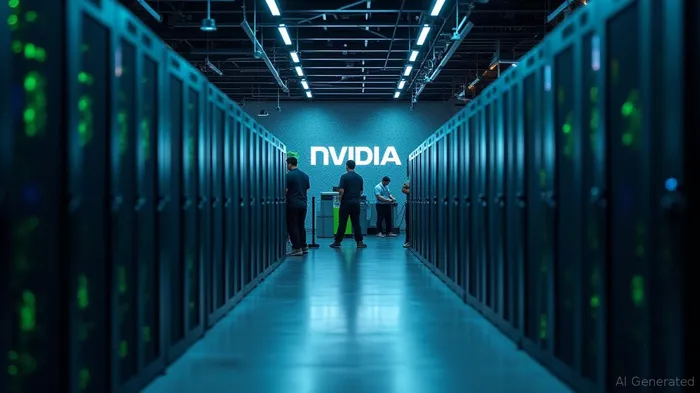
Malaysia's status as a non-sanctioned jurisdiction has made it a hub for such schemes. Shipments of Nvidia's DGX/HGX servers from Taiwan to Malaysia surged to $1.8 billion by early 2024, raising suspicions of GPU rentals or re-export to China. While Malaysian laws do not classify these chips as “controlled goods,” the U.S. Senate has criticized its Commerce Department's lax enforcement, warning that such loopholes enable China to circumvent restrictions.
For investors, this raises two immediate concerns:
1. Regulatory Risks: U.S. policymakers may tighten export controls further, penalizing third countries like Malaysia for enabling such workarounds.
2. Supply Chain Competition: China's push to build domestic AI infrastructure—evident in its partnerships with Huawei (Ascend chips) and DeepSeek—threatens Nvidia's long-term dominance.
Nvidia's Strategic Positioning: Strengths and Weaknesses
Nvidia's challenge is twofold. On one hand, its GPUs are still the de facto standard for AI training, and its ecosystem of software tools (e.g., CUDA) creates high switching costs. The company's recent H100 and H200 GPUs remain unmatched in performance, and partnerships with cloud giants like Microsoft and Google reinforce its market power.
On the other hand, the Malaysia case reveals vulnerabilities:
- Geopolitical Fragmentation: U.S. sanctions have pushed China to accelerate domestic chip development. Huawei's Ascend chips and DeepSeek's AI models—now being deployed in Malaysia—are early steps toward reducing reliance on Western hardware.
- Black Market Risks: A thriving underground trade for smuggled Nvidia GPUs in China, with premiums up to 30%, signals demand that could outpace legitimate supply.
Nvidia's response has been mixed. While it denies complicity in chip diversion, the company has expanded partnerships with governments and cloud providers to lock in long-term demand. Its $21.5 billion acquisition of Arm (pending regulatory approvals) also hints at a strategy to diversify into chip design for broader AI applications.
Investment Analysis: Near-Term Volatility vs. Long-Term Dominance
For investors weighing Nvidia's stock (NVDA), the calculus hinges on balancing short-term risks with its structural advantages.
Near-Term Concerns:
- Regulatory Overhang: Fresh U.S. sanctions or stricter enforcement in Malaysia could disrupt supply chains and erode margins.
- Valuation Risks: Nvidia's stock trades at ~35x forward earnings—elevated compared to its 5-year average of 25x—leaving it vulnerable to profit warnings or geopolitical setbacks.
Long-Term Opportunities:
- AI's Explosive Growth: The global AI chip market is projected to hit $200 billion by 2027, and Nvidia's ecosystem leadership positions it to capture a disproportionate share.
- Diversification Plays: The company's expansion into data center solutions (e.g., its Grace CPU) and autonomous driving (e.g., DRIVE Hyperion) reduces reliance on any single market.
Actionable Insights for Investors
- Hold with Caution: For long-term investors, Nvidia's role as the AI infrastructure leader remains irreplaceable. However, consider trimming positions if near-term risks materialize (e.g., Malaysia's probe turns into sanctions).
- Monitor Geopolitical Developments: Track U.S.-Malaysia trade negotiations and China's progress in domestic chipmaking. A breakthrough in Chinese AI chips (e.g., 7nm/5nm GPU production) would be a red flag.
- Consider Alternatives: AMD (AMD) and Intel (INTC) are gaining traction in AI hardware, but their software ecosystems lag. Meanwhile, cloud providers like Amazon (AMZN) and Alphabet (GOOGL) benefit indirectly from AI adoption.
Conclusion
Nvidia's stock weakness reflects market anxiety over its ability to navigate geopolitical headwinds. Yet the company's technological edge and ecosystem dominance suggest it remains a critical player in AI's future. Investors should view dips as buying opportunities—but with a close eye on regulatory shifts and China's progress. In the AI hardware race, Nvidia isn't just a leader—it's the only game in town for now.
Final Note: As of June 2025, Nvidia's stock has underperformed the S&P 500 by 12% year-to-date amid these risks. For a risk-adjusted portfolio, pair a long position in NVDA with a short in semiconductor ETFs (e.g., SMH) to hedge against supply chain disruptions.

Stay ahead of the market.
Get curated U.S. market news, insights and key dates delivered to your inbox.


AInvest
PRO
AInvest
PRO



Comments
No comments yet