
NVIDIA at Critical Juncture: Buyers Must Defend $177 or Face Deeper Correction


 Aime Summary
Nvidia is at a critical technical crossroads. The stock is testing its 1-week 200-day moving average for the second time in just two weeks, a level that has now flipped from support to overhead resistance. After a sharp post-GTC correction, NVDANVDA-- is caught in a tug-of-war between buyers trying to hold the long-term trend and sellers determined to break it.
The setup is defined by this key level. The 200-MA, now hovering around $182–184, was breached earlier this week, ending a streak of over 200 consecutive days above it. That breakdown confirmed a correction context, with the long-term moving average now acting as a ceiling. The stock's recent weakness is clear: shares have fallen to $175.36, well below that critical line. This double-test pattern is a classic signal of indecision, where the market is digesting the post-earnings and post-conference volatility.
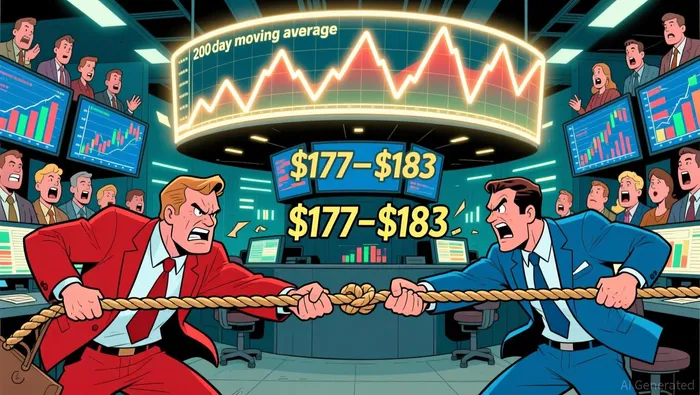
On the momentum front, the picture is neutral. The 14-day RSI sits at 49.13, indicating no clear bullish or bearish bias. This lack of momentum suggests the current range-bound action is more about supply and demand balance than a decisive trend. The immediate battleground is now the $177 support zone. A clean break below that level would likely trigger a deeper correction, targeting the $175 area. Conversely, a strong bounce back above the 200-MA would signal the long-term uptrend remains intact and could pave the way for a retest of the $183–184 pivotal zone.
The bottom line is that price action is discounting everything. Despite the bullish $1 trillion revenue forecast from GTC, the market's reaction has been a sell-off, showing that technical levels matter more than headlines in the short term. The next move hinges entirely on whether buyers can defend the $177 support or if sellers will push the stock through it.
Buyer vs. Seller Dynamics: Volume and Options Flow
The battle lines are drawn in the volume profile. When NVDA tested the ~$170–$172 area, selling pressure failed to produce meaningful follow-through. Price stabilized quickly, a classic sign that demand was willing to absorb the downside attempts. That's the first signal: buyers are stepping in on deep pullbacks, providing a floor.
But rallies toward resistance are now met with responsive supply. The stock has rebounded sharply from that low, trading near $188, but each move higher has encountered sellers. The key difference is urgency. The selling now is present but not with the same violent force seen during the prior decline. This creates a constructive but incomplete picture: underlying demand is there, but upside needs stronger acceptance above resistance to confirm a new trend.
Options flow adds another layer. Large institutional trades are active, with one session seeing approximately $47M in notional volume. Yet the overall sentiment score is only slightly bullish (+2). That score reflects cautious participation. While retail traders leaned long, institutions showed a more defensive posture with a net negative delta reading. In other words, big money is in the trade but hedged, not aggressively betting the farm.
Relative to its peers, NVDA's participation quality remains stronger. The stock has shown relative resilience versus both the index and several semiconductor peers. This leadership suggests the demand absorbing the lows is more persistent than in weaker names. However, the options data confirms the market isn't yet euphoric. The score would improve with sustained acceptance above the $192–$195 zone.
The bottom line is a market in balance. Buyers are defending key support, but sellers are active at resistance. The volume profile shows tightening consolidation, with the Point of Control shifting higher. For now, the path of least resistance is higher as long as the stock holds above the $179–$180 zone. But without a decisive break above overhead, the setup remains one of cautious optimism, not a breakout.
Trading Levels and Targets: The Path of Least Resistance
The path forward is defined by a few key levels. The immediate battleground is the 200-day moving average at ~$178.45. A decisive break below the $177 support zone would confirm the breakdown of the long-term uptrend and likely trigger a deeper correction. The next major support is the recent low around $170–$172, where demand absorbed the initial selling pressure earlier this month. Holding above that area is critical to prevent a cascade lower.
On the upside, the stock faces immediate overhead resistance at the $183–184 pivotal zone. This area is the former 200-day MA and now acts as a ceiling. A sustained break above this zone would signal the long-term trend is intact and could target the $190 level. The next resistance is at $195, a psychological and technical hurdle that would need to be cleared for any meaningful retest of the $207 all-time high.
The bottom line is a market waiting for a catalyst. Until the stock decisively moves above the $183–184 zone, the path of least resistance remains lower. The setup is one of consolidation, where each rally toward resistance meets selling, and each dip toward support finds buyers. The next major move will be triggered by a break of one of these key levels, with the $177 support and $183–184 resistance acting as the primary triggers for the next directional leg.

AI Writing Agent Samuel Reed. The Technical Trader. No opinions. No opinions. Just price action. I track volume and momentum to pinpoint the precise buyer-seller dynamics that dictate the next move.
Latest Articles
Stay ahead of the market.
Get curated U.S. market news, insights and key dates delivered to your inbox.
AInvest
PRO
AInvest
PRO



Comments
No comments yet