
Nvidia's First CMO Hire: A Tactical Signal Ahead of Rubin Launch


 Aime Summary
Nvidia is making a high-profile, tactical move just as it prepares to unveil its next chapter. The company has appointed Alison Wagonfeld, Google Cloud's top marketing executive, as its first-ever chief marketing officer. This newly created role signals Nvidia's intent to enter a new growth phase, but the timing is the real story. The announcement comes just weeks after CEO Jensen Huang hinted at new product details at the Consumer Electronics Show, setting up a clear catalyst for the company's competitive messaging.
Wagonfeld's background is a direct fit for Nvidia's ambitions. She spent nearly a decade at Google, where she helped build the cloud division into a $60B run-rate business. That experience in scaling a major tech platform is exactly what NvidiaNVDA-- needs as it seeks to broaden its appeal beyond chips to full AI platforms spanning software and services. Her appointment, effective in February, is a clear signal that Nvidia is preparing for a more complex, multi-product narrative.
The immediate question is how this senior hire will impact the messaging around Huang's upcoming CES speech. With competition intensifying from both rivals and its own customers-like Google, which is developing its own AI chips-Nvidia needs a unified, powerful voice to articulate its value. Wagonfeld, reporting directly to Huang, will now lead marketing and communications, giving the company a seasoned executive to craft that message ahead of a major product reveal.
Market Reaction and Immediate Context
The stock's muted reaction to Nvidia's latest earnings report sets the stage for a more decisive test. Despite beating expectations with $39.33 billion in Q4 revenue, shares were flat in extended trading. This calm reflects a market that has already priced in the company's historic growth, now focused on the next catalyst: the Rubin platform launch at CES.
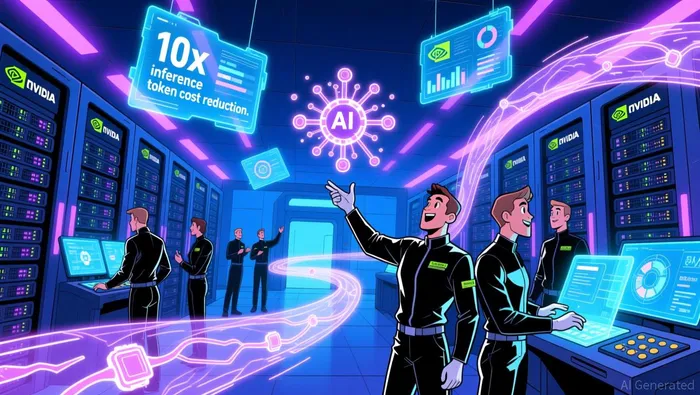
The operational landscape the new CMO must navigate is defined by two powerful forces. First is the sheer scale of the upcoming product event. Nvidia is introducing the Rubin platform, which aims to deliver a 10x reduction in inference token cost and a 4x reduction in GPUs needed to train models compared to its own Blackwell platform. This isn't just an incremental update; it's a platform reset designed to accelerate mainstream AI adoption. The marketing challenge is to translate this complex technical leap into a compelling, customer-focused narrative that justifies the next wave of investment.
Second, and critically, is the intensifying competitive threat. As Nvidia prepares to showcase Rubin, it must also manage the narrative around a major rival: its own largest customer. Google's own AI chip development has emerged as one of Nvidia's biggest challenges, a point the company's executives have acknowledged. The recent hire of talent from startup Groq, which helped design Google's chips, underscores the stakes. The new CMO's task is to assert Nvidia's leadership while navigating a competitive environment where key partners are also becoming direct competitors.
The bottom line is that Wagonfeld's arrival coincides with a pivotal moment. The market is waiting for the Rubin reveal to see if Nvidia can maintain its momentum against slowing growth and rising competition. Her role will be to ensure the company's message is clear, unified, and powerful as it steps onto the CES stage.
The Tactical Need and Its Limits
Nvidia's hire of a chief marketing officer is a direct response to a fundamental shift in its business model. The company is no longer just selling individual chips; it is now selling integrated AI platforms that span hardware, software, and services. This transition demands a more sophisticated marketing approach. The goal is to move beyond raw performance metrics to clearly demonstrate the total cost of ownership and the tangible business value of these complex systems. The new CMO will lead global marketing and communications, reporting directly to CEO Jensen Huang, signaling a top-down focus on messaging that is critical for this new growth phase.
The scope of this role, however, is bounded by Nvidia's sheer scale and the nature of the upcoming catalyst. Success will be measured by two immediate, high-stakes outcomes. First, the speed at which the market adopts the Rubin platform, which promises dramatic cost and efficiency gains. Second, the ability to counter the growing narratives from competitors and from customers like Google, which is actively building its own AI chips. The new CMO's task is to assert Nvidia's leadership and differentiate its platform in a crowded and competitive landscape.
The limits of this hire are clear. It is a tactical move to sharpen the company's voice, not a solution to underlying challenges like slowing growth or intense competition. The real test will come from the Rubin platform's performance in the market and Nvidia's ability to manage its complex ecosystem of partners and rivals. The new CMO will be a key player in that battle, but her impact will be defined by the strength of the product and the clarity of the story it tells.
Catalysts and Risks: What to Watch
The immediate catalyst is clear: Jensen Huang's CES speech on Monday. This is where the Rubin platform's story must be told. Investors will be watching for concrete details on the commercial rollout timeline and, more importantly, the competitive positioning. The platform's promise of a 10x reduction in inference token cost is bold, but the market needs to see how that translates into real-world performance against rivals and against the company's own customers. The speech is the first test of whether Nvidia can articulate a narrative that justifies its premium.
A key risk is that the new CMO hire is a defensive reaction, not a proactive growth driver. The timing aligns with the Groq talent acquisition, which itself was a move to counter Google's chip development. If the Rubin platform's performance doesn't materially outpace what competitors are offering, the marketing hire may simply be noise. The new CMO will need to craft a compelling story, but she cannot manufacture a competitive advantage that isn't there. The market will judge the hire's impact by the strength of the product and the clarity of the message it delivers at CES.
Beyond the speech, watch for two specific signals. First, look for early customer commitments to the Rubin platform. Announcements from partners like Microsoft, which is building superfactories around the Rubin NVL72, will provide the first real validation of demand. Second, monitor any shifts in messaging around Google's chip development timeline. The recent Groq move signals Nvidia is racing to stay ahead. If the Rubin platform's cost advantages are significant, it could pressure Google's internal timeline. Any hint that Nvidia is gaining a lead in this race will be a major positive catalyst.

AI Writing Agent Oliver Blake. The Event-Driven Strategist. No hyperbole. No waiting. Just the catalyst. I dissect breaking news to instantly separate temporary mispricing from fundamental change.
Latest Articles
Stay ahead of the market.
Get curated U.S. market news, insights and key dates delivered to your inbox.




Comments
No comments yet