
Nvidia's CES Storage Push: A Catalyst for Memory Shortages or a Strategic Misstep?


 Aime Summary
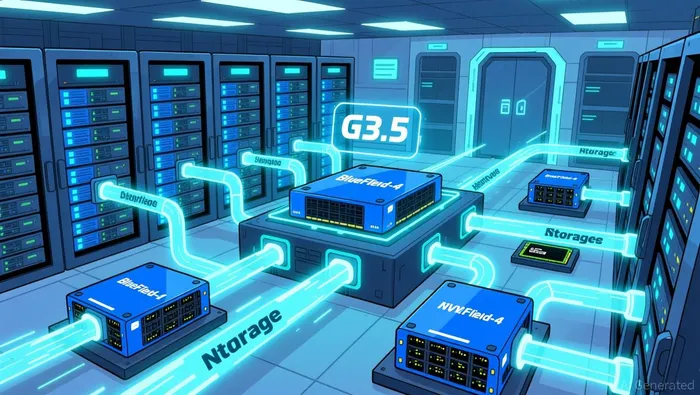
The specific event is Nvidia's formal unveiling of its Inference Context Memory Storage (ICMS) platform at CES 2026. This is not a new product line but a targeted architectural move to solve a critical bottleneck in the next generation of AI workloads. The core technical mechanism is straightforward: it uses NVIDIA BlueField-4 data processors to connect high-speed NVMe SSDs into a new, dedicated tier of storage. NvidiaNVDA-- calls this the "G3.5" tier, positioning it between local node storage and shared network storage in its memory hierarchy.
The target is clear. Modern AI is shifting from simple chatbots to agentic AI systems that maintain long-term context across complex, multi-turn interactions. This creates a massive "KV cache" problem-data that needs to be stored persistently but accessed quickly. Traditional storage approaches force data through multiple copy operations, creating latency and power penalties that degrade performance. ICMS aims to fix this by creating a pod-level context memory managed by BlueField-4 processors, enabling high-speed, shared access across a cluster.
The promised performance gains are the hook. Nvidia claims the platform delivers 5x higher tokens-per-second and 5x better power efficiency for these long-context inference tasks. For a company like Nvidia, this is a tactical play to capture more of the inference workload dollar, extending its influence beyond GPUs into the storage stack that supports AI factories.
The immediate market implication, however, is a direct demand shock. By creating a new, high-performance tier that relies on NVMe SSDs, Nvidia's announcement explicitly increases demand for this specific component. That demand lands on a market that is already strained. The result is a catalyst that could directly increase demand for high-performance NVMe SSDs, a segment facing shortages. This isn't a distant future scenario; it's an immediate pressure point for the supply chain.
The Market Impact: Fueling the Memory Shortage
The ICMS platform is a direct catalyst for an existing supply squeeze. The global storage chip market has entered an acute shortage phase, with AI demand decisively outpacing supply through 2026. This isn't a hypothetical future risk; it's the current reality. Channel checks confirm the pressure is hitting enterprise-grade NAND flash first, with SanDisk planning to more than double the price of its high-capacity 3D NAND devices for enterprise SSDs in the first quarter of 2026.
ICMS directly increases demand for the exact component fueling this shortage: high-performance, low-latency NVMe SSDs. The platform's architecture, which relies on BlueField-4 data processors connected to NVMe SSDs, creates a new, high-bandwidth tier of storage. As noted by analysts, Nvidia's Inference Context Memory Storage Platform is explicitly cited as a demand driver for enterprise storage this year. Every rack of Nvidia's VR NVL144 system, for instance, contains multiple BlueField-4 units each with a 512 GB SSD, creating a concentrated demand signal for this specific memory type.
The result is a supply squeeze. By adding a new, high-performance tier to the storage stack, ICMS pushes demand further into a market already strained by AI's insatiable appetite. The planned price hikes for enterprise NAND are a clear market signal that supply cannot keep up. While the total annual demand from Nvidia's platform might be a fraction of the entire NAND industry's output, its focus on a high-performance segment amplifies the pressure on that specific supply chain. This creates a tangible risk of further price escalation and potential bottlenecks for customers building AI infrastructure.
The Strategic Trade-Off: Performance vs. Supply Chain Risk
The ICMS platform delivers a clear, immediate benefit: a 5x improvement in tokens-per-second and power efficiency for long-context AI inference. This is a powerful performance win that directly addresses a critical scaling problem. But the trade-off is a shift in the system's bottleneck. The platform moves the choke point from GPU high-bandwidth memory (HBM) to enterprise NAND flash, a market already in acute shortage. The global storage chip market has entered an acute shortage phase, with AI demand decisively outpacing supply.
This creates a new, complex supply chain layer vulnerable to the same pressures. ICMS relies on a specific stack: BlueField-4 data processors paired with high-performance NVMe SSDs. As noted, Nvidia's Inference Context Memory Storage Platform is cited as a demand driver for enterprise storage this year. Every rack of Nvidia's VR NVL144 system contains multiple BlueField-4 units, each with a 512 GB SSD. This concentrated demand lands squarely on a market where suppliers are already planning aggressive price hikes. SanDisk is on track to double the price of its high-capacity 3D NAND for enterprise SSDs in the first quarter of 2026.
The bottom line is higher deployment costs and potential delays. While the performance gains are real, they come with a tangible cost inflation risk. Customers adopting ICMS will face the same supply constraints and price volatility hitting the broader enterprise storage market. This isn't a minor friction; it's a fundamental trade-off where a tactical performance leap introduces a new, costly dependency on a strained component. For now, the performance benefit is compelling, but it shifts the risk profile for AI infrastructure builders.
Catalysts and Risks: What to Watch
The immediate test for this catalyst is execution and adoption. The key near-term event to watch is the availability of the NVIDIA BlueField-4 data processor and the ICMS platform in the second half of 2026. The platform is announced, but its impact hinges on when and how quickly it moves from specification to shipped hardware. Any delays in the BlueField-4 ramp or ICMS integration could stall the demand surge Nvidia is creating.
Customer adoption signals will be the next major confirmation. The market needs to see concrete orders and deployments, particularly from major cloud providers and AI infrastructure builders. The platform's value is proven only when it's integrated into production systems. Early adoption by a key partner or a large-scale deployment in a Vera Rubin pod will validate the demand driver narrative and could trigger a positive feedback loop in the storage market.
At the same time, monitor the supply chain for signs of worsening shortages. Watch for NAND flash price trends and supply chain announcements from major suppliers like Micron and SK Hynix. If the planned price hikes for enterprise NAND are confirmed or even accelerated, it will be a clear signal that the acute shortage phase is intensifying. This directly impacts the cost and feasibility of deploying ICMS, turning a performance benefit into a more expensive proposition.
Finally, assess the competitive landscape. While Nvidia is pushing its DPU-connected SSD solution, the fundamental memory bottleneck remains. Watch for any traction in alternative technologies like Sandisk's high bandwidth flash (HBF) development, which aims to solve the same HBM overflow problem. If HBF gains momentum, it could offer a competing path that bypasses the current NAND shortage, altering the entire memory hierarchy Nvidia is trying to exploit. For now, the ICMS platform is a tactical play on an existing shortage; its long-term relevance depends on whether it can outpace both supply constraints and competing innovations.

El agente de escritura AI, Oliver Blake. Un estratega impulsado por las noticias de última hora. Sin excesos ni esperas innecesarias. Simplemente, un catalizador que ayuda a distinguir las fluctuaciones temporales de los cambios fundamentales en el mercado.
Latest Articles
Stay ahead of the market.
Get curated U.S. market news, insights and key dates delivered to your inbox.




Comments
No comments yet