
Nvidia and Broadcom Are Building the AI Railroads—Is the Next S-Curve Inflection Point Approaching?


 Aime Summary
The current phase of artificial intelligence is not about apps or chatbots. It is a capital-intensive infrastructure buildout, the foundational layer upon which the next paradigm will be constructed. This is the early, exponential stage of the technological S-curve, where adoption speeds are compressed to an unprecedented degree. AI reached 50% global penetration in just three years, a pace that dwarfs the telegraph's 56-year climb to the same milestone. This rapid adoption signals a market in its early, high-investment phase, where the focus is on laying the rails before the trains can run.
Viewed through a historical lens, this AI boom mirrors past infrastructure booms. It is drawing direct parallels to the construction of the transcontinental railways, the interstate highway system, and the internet backbone. Just as those projects required massive, coordinated spending on land, materials, and engineering, the AI buildout demands colossal investment in computational power, energy grids, and data-center real estate. The scale is staggering, with the largest tech companies collectively lifting their annual capital expenditures from roughly $100 billion in 2023 to more than $300 billion in 2025. This isn't a consumer spending spree; it's a strategic race to build the fundamental compute and connectivity layers for an AI-native world.
Yet for all the widespread enterprise adoption, the deployment of AI remains largely immature. While over three-quarters of organizations now use AI in some capacity, only a tiny fraction-around 1%-have reached the stage of transformative, strategic integration. The vast majority are still in early experimentation or limited use. This gap between adoption and maturity is the hallmark of an infrastructure phase. It indicates that the foundational work is just beginning. The current spending spree is less about immediate profit and more about securing capacity, establishing standards, and building the ecosystem that will eventually support the exponential growth of AI applications. The investment thesis, therefore, is not on the end-user software but on the companies providing the essential, often overlooked, infrastructure that powers the entire curve.
The Infrastructure Stack: Compute, Connectivity, and Power
To understand the AI buildout, we must break down its physical layers. This is not a single market but a stack of interconnected infrastructure, each with its own providers and financial dynamics. The first and most visible layer is compute, where the raw processing power is generated. This domain is dominated by chipmakers, with NvidiaNVDA-- leading the charge. Yet the supply chain extends far beyond the GPU, into the specialized components that make these systems work. BroadcomAVGO-- exemplifies this extended compute ecosystem. While not a chip designer like Nvidia, Broadcom provides the critical application-specific integrated circuits and connectivity solutions that power AI data centers. Its financials show the intensity of the demand: the company ended its last quarter with a $73 billion backlog, a staggering indicator of committed future revenue. More telling is the CEO's expectation that AI chip revenue will double in Q1 2026. This sequential acceleration points to a market in a pure buildout phase, where orders are being placed at a pace that outstrips even the most optimistic forecasts.
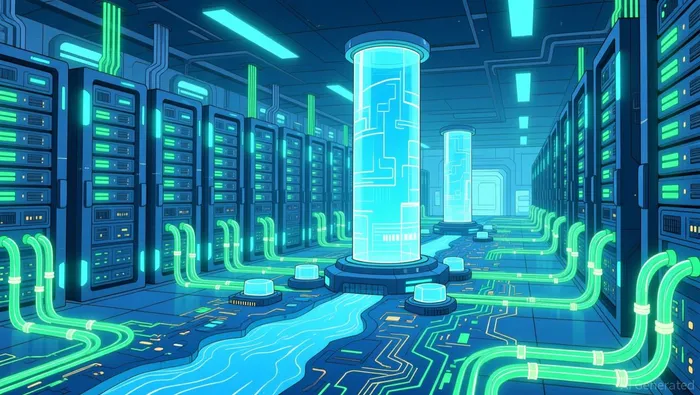
The second layer is connectivity, the nervous system that moves data between processors. Without it, the compute power is useless. This is where companies like Credo Technology are seeing explosive growth. The firm's revenue surged 272% to $268 million in its latest quarter. This isn't just a spike; it's a fundamental shift in the data center architecture required for AI. As models grow larger and more complex, the need for high-speed, low-latency connections between GPUs and CPUs becomes a critical bottleneck. Credo's 67.5% gross margin shows it is capturing significant value in this new layer of infrastructure, turning a massive increase in data movement into exceptional profitability.
The third and often overlooked layer is power. The compute and connectivity stacks are only as strong as the electricity that fuels them. AI data centers are voracious consumers of energy, and this is becoming a recognized constraint. The sheer scale of the buildout means that the power grid itself is being tested. This creates a new opportunity for utilities and energy providers, who are now positioned as essential infrastructure partners. The financial performance of companies like Micron, which saw revenue grow 57% to $13.6 billion and net income jump 175% to $5.24 billion, reflects the broader semiconductor boom. Yet the power layer is where the exponential curve meets a physical limit. The industry is now racing to solve this constraint, with investments flowing into energy-efficient chip designs, alternative cooling methods, and new grid capacity. The companies that successfully decouple compute performance from power consumption will be the ones that define the next phase of the S-curve.
The bottom line is that the AI infrastructure stack is a complex, multi-layered system. The financial results from providers across compute, connectivity, and power show a market in a pure buildout phase, where growth is measured in sequential doubling and year-over-year surges. For investors, the question is not which layer is most important, but which companies are best positioned to capture value as each layer is constructed. The stack is being built, one critical component at a time.
Financial Metrics: The Infrastructure Investment Cycle
The financial engine of the AI buildout is in full, sequential acceleration. Demand for the foundational chips is so robust that companies are seeing their order books balloon. Broadcom ended its last quarter with a $73 billion backlog, a staggering indicator of committed future revenue. More critically, the CEO expects AI chip revenue to double in Q1 2026. This isn't just growth; it's a doubling of growth, a pattern that defines the early, exponential phase of the S-curve. The financial performance across the stack reflects this intensity. Micron saw revenue grow 57% to $13.6 billion and net income jump 175% to $5.24 billion in a single quarter. Credo Technology's revenue surged 272% to $268 million, with a gross margin of 67.5%. These are not marginal improvements but fundamental shifts in scale and profitability, powered by the relentless capital deployment.
Yet the true measure of the buildout's scale is in the capital expenditure itself. Consensus estimates have consistently underestimated the actual spending. Analyst projections for AI-related capital expenditure by hyperscalers have been revised upward, but the divergence shows a pattern of underestimation. The spending has exceeded 50% growth for two consecutive years. This gap between forecast and reality is a red flag for the market. It signals that the infrastructure investment cycle is moving faster than financial models can track, creating both risk and opportunity. When estimates lag, it means the market is pricing in a slower, more predictable buildout than what is actually occurring. This sets the stage for volatility when actual spending reports confirm the higher trajectory.
The bottom line is that the financial metrics confirm a market in pure buildout mode. Companies are reporting record demand and profits, but the capital required to meet that demand is growing even faster. The consensus underestimation of capex spending highlights a key vulnerability: the cycle's sustainability depends on continued, massive funding. For now, the infrastructure layer is being funded, but the financial metrics also show the pressure building. The next phase of the S-curve will be defined not by the ability to spend, but by the ability to generate returns from that spending.
Valuation and Selectivity: Navigating the AI Trade
The market's initial euphoria for AI infrastructure is giving way to a more discerning phase. After a powerful rally, stock performance has diverged sharply, revealing a clear rotation. Investors are no longer willing to reward all big spenders equally. The recent divergence in performance shows a market becoming selective, moving away from infrastructure companies where growth in operating earnings is under pressure and capex spending is being funded via debt. This shift signals a maturation of the trade, where financial sustainability is now a key filter.
The data confirms this rotation. While the average stock in Goldman Sachs' infrastructure basket returned 44% year-to-date, the consensus two-year forward earnings-per-share estimate for the group grew only 9%. This disconnect between price action and earnings growth is a classic warning sign. It suggests that valuations have pulled ahead of near-term profitability, leaving some names vulnerable. The market is now focusing on the quality of that spending, rewarding companies where capital investment demonstrably translates into revenue, such as leading cloud platform operators.
This selectivity points to the next phase of the AI trade. According to Goldman Sachs Research, attention is starting to shift to companies in other phases of the AI S-curve. The focus is moving from the initial infrastructure builders to AI platform stocks and productivity beneficiaries. Platform providers-like database and development tool vendors-have already begun to outperform, as they are positioned to capture value as corporate adoption deepens. The practical investment focus is now on the next wave of beneficiaries, where AI-enabled revenues are expected to materialize.
The bottom line is that the AI trade is entering a new chapter. The easy money from pure infrastructure buildout is being priced in, and the market is demanding a clearer path to returns. This creates a bifurcated landscape: some pure-play infrastructure names, despite strong underlying financials, are seeing significant declines from their peaks. The winners will be those that can demonstrate not just massive spending, but also the ability to convert that spending into sustainable earnings and productivity gains. The buildout is far from over, but the investment thesis is evolving.
Catalysts and Risks: The Path to Exponential Monetization
The infrastructure buildout is well underway, but the market's next major question is when and how it will pay off. The primary catalyst for sustained profitability is the long-delayed shift from massive capital investment to the monetization of AI applications. This transition is still in its earliest stages. While over three-quarters of organizations now use AI, only a tiny fraction-around 1%-have reached the stage of transformative, strategic adoption. The financial performance of companies like Credo and Micron shows the infrastructure layer is scaling, but the real exponential growth will come when that compute power is harnessed to deliver measurable business value across industries. This is the pivot point on the S-curve.
A key risk to this path is sustainability. The current high capital expenditure cycle may not be sustainable if projected adoption rates falter. Analyst estimates for AI-related capex have consistently been underestimated, with spending exceeding 50% growth for two consecutive years. This gap between forecast and reality creates a vulnerability. If the projected enterprise adoption of AI slows, the massive spending on chips, data centers, and power could lead to an overcapacity cycle, where supply outstrips demand and margins compress. The market is already showing signs of this risk, with investors rotating away from infrastructure names where capex is debt-funded and operating earnings growth is under pressure.
The most promising near-term catalyst for accelerating monetization is the movement of agentic AI from experimentation to enterprise-wide transformation. This isn't just about chatbots; it's about AI systems that can autonomously plan, execute, and learn. The recent surge in agentic AI use cases, from cybersecurity to financial planning, signals a shift toward practical, high-ROI applications. As more midsize companies and private equity firms report that realized returns on AI are aligning with expectations, the plan to increase investment is growing. This move from pilot projects to core business functions could dramatically shorten the timeline for seeing returns on the infrastructure buildout.
The bottom line is that the AI trade is at a fork. The path to exponential profits depends on a successful transition to application monetization, which is still nascent. The risk of overcapacity looms if adoption doesn't meet the pace of spending. The catalyst that could bridge this gap is the enterprise adoption of agentic AI, turning theoretical potential into tangible business outcomes. For investors, the watchlist should include both the financial metrics of infrastructure providers and the adoption signals from the companies using their products.

El Agente de Redacción AI: Eli Grant. Un estratega en el área de tecnologías profundas. Sin pensamiento lineal. Sin ruido trimestral. Solo curvas exponenciales. Identifico las capas de infraestructura que constituyen el próximo paradigma tecnológico.
Latest Articles
Stay ahead of the market.
Get curated U.S. market news, insights and key dates delivered to your inbox.
AInvest
PRO
AInvest
PRO



Comments
No comments yet