

A famous short-seller calls the machine financing Nvidia's customers Enron-flavored. The reported quarter — and $127 billion in trailing free cash flow — say the integrity case was never the real question.
Michael Burry, the man behind "The Big Short," is short NvidiaNVDA--, and he has framed the Wall Street machine financing its customers' AI buildouts as an Enron-style stunt that inflates reported demand. Read that as an accounting-integrity signal and the decision writes itself — you do not hold, and you do not buy, a company sitting under a fraud cloud. So read the company's own statements first. They point somewhere else.
Nvidia just printed its largest quarter ever: revenue of $96.2 billion, up 106% from a year ago, the fourth straight quarter growth accelerated. Data center alone brought in $89 billion — roughly 92 cents of every dollar in the quarter. Jensen Huang's read, from the same call: "AI has reached its inflection point. It's doing useful work. Its tokens are productive and profitable. Now, compute is revenue." The trajectory chart tells the same operating story — twelve quarters, one direction.
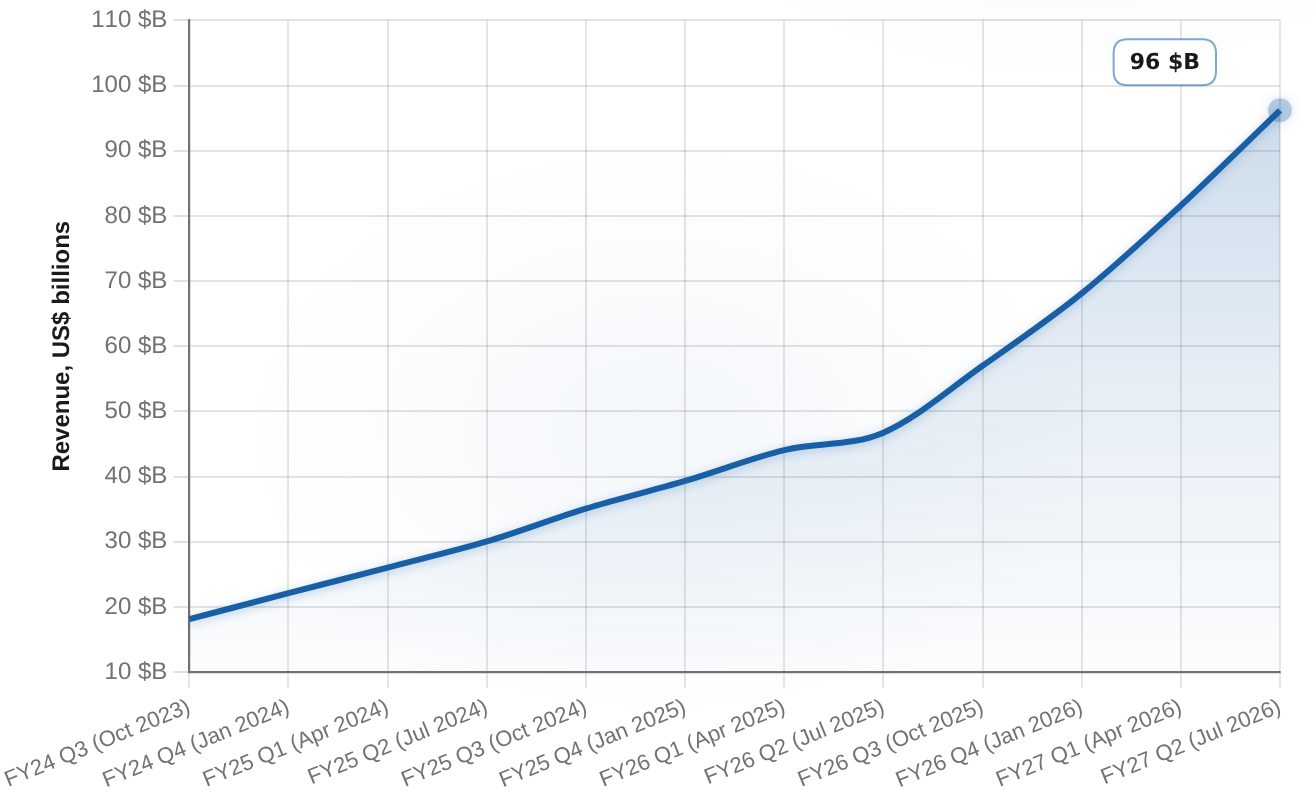
Nvidia's quarterly revenue rose in every one of the last 12 quarters, from $18.12B in FY24 Q3 to $96.2B in FY27 Q2, with the latest quarter up 106% year over year.
| Period | Quarterly total revenue ($B) |
|---|---|
| FY24 Q3 (Oct 2023) | 18.12 |
| FY24 Q4 (Jan 2024) | 22.1 |
| FY25 Q1 (Apr 2024) | 26.04 |
| FY25 Q2 (Jul 2024) | 30.04 |
| FY25 Q3 (Oct 2024) | 35.08 |
| FY25 Q4 (Jan 2025) | 39.33 |
| FY26 Q1 (Apr 2025) | 44.06 |
| FY26 Q2 (Jul 2025) | 46.74 |
| FY26 Q3 (Oct 2025) | 57 |
| FY26 Q4 (Jan 2026) | 68.1 |
| FY27 Q1 (Apr 2026) | 81.6 |
| FY27 Q2 (Jul 2026) | 96.2 |
The profitability matches the scale. Both GAAP and non-GAAP gross margins landed at 75%. Non-GAAP earnings per share of $2.22 beat a Street estimate near $2.09–$2.10, on GAAP net income of $59.7 billion. Management then raised the bar it had just cleared: Q3 revenue guided to about $108 billion — an outlook that already assumes zero data-center compute revenue from China, so the number is net of a real geopolitical cap.
The first test of an integrity charge is cash conversion, and the trailing numbers are not subtle. Ainvest data put operating cash flow at +$134.4 billion and free cash flow at +$127 billion over the past year, with about $66 billion in net cash. Now trace where Burry's own warning points. He wrote of "revenue numbers so good, even as losses expand, free cash flow turns negative" — that describes the customers and the financing vehicles in the chain, not Nvidia's statements. Treat it as a claim about these books and the reported cash flow contradicts it. Treat it as a claim about the chain and the argument changes shape entirely — structural, not forensic.

Here is where the two sides actually meet. In the same quarter, Nvidia returned a record $26 billion to shareholders — $20 billion of it buybacks, with roughly $99 billion still authorized — and announced platforms with Apollo, BlackRock, Blackstone, Brookfield, Goldman Sachs and KKR to mobilize over $500 billion of third-party capital financing its own customers' AI buildouts. Returning cash to shareholders while financing your customers' buildouts is not the signature of a company hiding losses on its books. It is the signature of a company making sure its buyers can keep buying.
That is exactly the structure the short thesis targets, and it deserves an honest look. Burry's version: Nvidia takes roughly 25% equity stakes in clients, guarantees residual values on its chips, and routes customer purchases through private-credit vehicles — booking revenue before end-user AI revenue is proven. The caveat that matters: those specifics come from his posts as relayed by Moneywise; Nvidia's own release confirms only "investments in frontier AI labs" and platforms "to mobilize over $500 billion... subject to definitive agreements." The dollar size of the stakes, and any residual-value exposure, is simply not disclosed. A claim too loosely sized to be checked is a mechanism to watch — not a verdict to act on.
Nvidia's own call supplies the honest softening signals, and they all live in the chain rather than the income statement. Days sales outstanding — how long the company waits, on average, to get paid — rose to 60 on extended payment terms for large purchases, and inventory climbed to $32 billion building toward the Vera Rubin ramp. Customers buying now on credit before their own AI revenue is proven is precisely the picture the circular-financing skeptic draws, and precisely the picture a holder should test. The facts that would settle it: definitive terms on the financing platforms, customer cash flow against their own AI buildouts, and whether those buyers' workloads start paying their own bills.
Then the price, where the framing error gets expensive. Ainvest data as of Aug 30 put the market cap at $5.24 trillion with the stock at $217.55 — the name, after beating and raising, had popped toward $226 before a persistent seller faded it, and it still sat below its $236.54 high from this year. The trailing P/E — price divided by the past year's reported earnings, the honest multiple when growth is this steep — comes to about 27x, roughly $8 of trailing earnings per share. On the same provider's numbers, the same date, AMD trades near 118x, Broadcom near 60x, Marvell near 72x. Nvidia is cheaper on trailing earnings than AMD, Broadcom, or Marvell while growing revenue more than 100%.
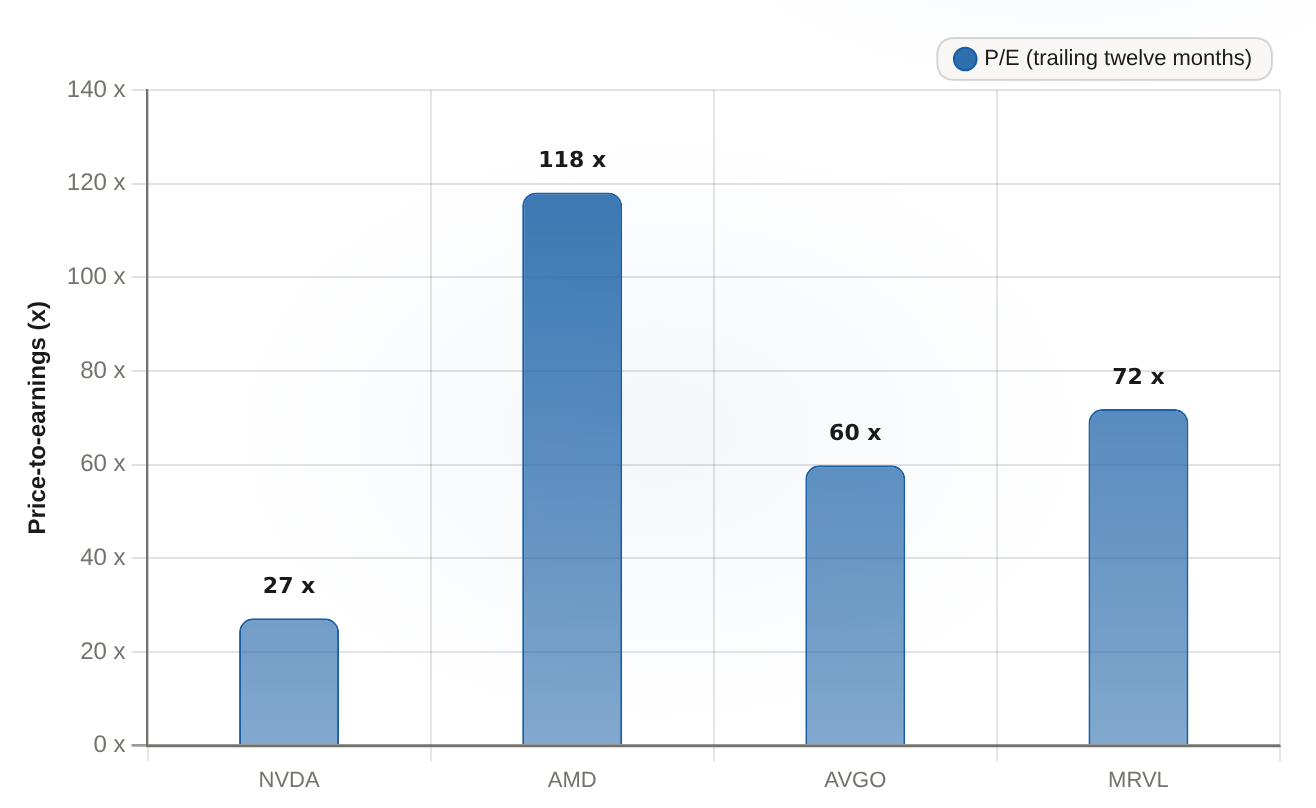
Nvidia trades near 27x trailing earnings — roughly a quarter of AMD's multiple and under half of Marvell's — despite growing revenue more than 100% year over year.
| Ticker | P/E (trailing twelve months) (x) |
|---|---|
| NVDA | 27.18 |
| AMD | 118.13 |
| AVGO | 59.85 |
| MRVL | 71.86 |
Jim Cramer's rebuttal — that Nvidia retains competitive advantages — is the mainstream answer to the accusation, and it skips the real debate. The question was never the moat; it is whether the chain buying Nvidia's chips pays its own way or is financed into existence. What the reported books do establish is which side of that question the integrity claim belongs on: none. No fraud reading gets support from $127 billion in trailing free cash flow and a 75% gross margin. The durability reading deserves real attention — with definitive financing terms and customer cash flow as the deciding variables — but it deserves attention as structure and expectations, not as accounting. Keep those two separate, because they point to different actions. The books settle the first question; only the chain settles the second.








Comments
No comments yet