
Nvidia's Big Answer to Burry's Short Rides on a Number Even the Skeptics Can Watch
 Aime Summary
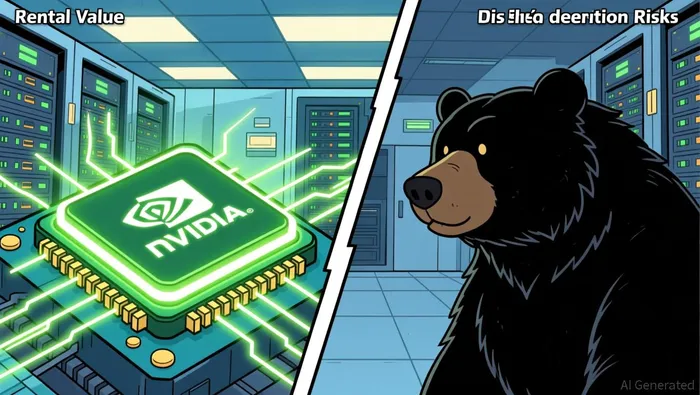
Two investors looked at the same cloud of AI graphics cards and reached opposite conclusions about everything that matters. Michael Burry, the "Big Short" investor who now runs bearish put options on NvidiaNVDA--, says the chips are being depreciated over too many years and that Nvidia is quietly financing its own customers — accounting fiction and circular money that will deflate into a bust. Jensen Huang's rebuttal this week was not a spread sheet but a market price: a rental rate. If Burry is right that these chips are worth little after two or three years, then a nine-year-old Nvidia card ought to rent for scrap instead of a premium, and spot prices should be falling. They are rising. A 22% month-over-month jump in the rental price of last-generation H100 chips is the single observable number that decides whether the AI boom is a bubble or an economic asset.
That is the fight, and only one of the two stories survives contact with that number.
The shared record
First, the facts both camps would sign. As of this week, Nvidia trades near $218 with a market value around $5.26 trillion, down about 2% on the day but up roughly 17% year to date and 22% over the past four months. Its trailing price-to-earnings multiple is about 27; the forward multiple, already looking at next year's growth, is about 58. Revenue grew roughly 83% year over year, gross margin sits near 74%, and free cash flow over the trailing twelve months was about $127 billion. The balance sheet holds net cash of roughly $66 billion.
The consensus arithmetic matters here, because neither side disputes the growth. What they dispute is how real it is.
Round one: the depreciation argument
Burry's opening move is an accounting one. Cloud providers and AI builders buy Nvidia's expensive chips and spread the cost over a stated useful life. Expense them over six years and each year's cost is a fraction of the purchase price, which makes AI data centers look profitable; expense them over two or three years — what Burry argues is the real life — and the annual cost roughly doubles or triples, and the reported returns on all that AI capex largely vanish.
Huang's answer is not "trust us," it is "watch the market." Nvidia maintains its chips are productive for four to six years and frames them as "fungible, durable and highly rentable" capital assets rather than depreciating toys. The supporting evidence is real and dated. The Ampere A100, launched in mid-2020, is still being rented by cloud provider CoreWeave under a contract that runs through 2029 — nine years after the chip was introduced. And the rental price of the newer Hopper H100 rose 22% month over month to about $3.28 per hour as of September 8.
Here is why that number breaks the bear's mechanism. Burry's thesis predicts that as aging chips flood the market, their rental value collapses. A chip with two good years left commands a sliver of its original price. Instead, the market is paying more this month than last for chips approaching their replacement cycle. Rising rental prices are the direct, third-party repudiation of the "obsolete in three years" claim. Nvidia's interests are aligned with high prices, so its own commentary deserves skepticism — but the rental price is a clearing price paid by independent cloud renters, not a figure Nvidia prints.
The bull wins this round, and by a visible margin. The claim "these assets die fast" is falsifiable, and the market keeps failing to falsify it.
Round two: the circular financing claim
The bear's heavier weapon is not depreciation but structure. Burry describes Nvidia's financing as "circular": Nvidia is effectively helping to fund the very customers who buy its chips, and the resulting revenue is recycled capital pretending to be organic demand. The specific instance is a roughly $105 billion credit guarantee Nvidia has disclosed backing an OpenAI data-center project in Ohio with a 4.25-gigawatt IT load. Under that view, Nvidia is not merely selling shovels to gold miners — it is lending the gold miners the money, then booking the shovel sale.
Just as Nvidia's balance sheet quieted the survival objection, it does not quiet the circularity one. The company has roughly $66 billion in net cash and ~$127 billion in trailing free cash flow, so the $105 billion guarantee is a concentration of contingent exposure rather than a solvency threat. But the risk is real and asymmetric: if AI spending slows, Nvidia absorbs pain on both sides at once — lost chip orders from its own customers and losses on the projects it backed. That is precisely the kind of tail a short is paid to wait for, and it does not depend on the rental market staying strong.
The bear wins the caution round, but it is a risk-management point, not evidence that demand is fake. A credit guarantee on one flagship project does not by itself show the whole $5 trillion of installed compute is worthless; it shows Nvidia's underwriting quality is now part of the story.
Valuation: what the price already demands
The two cases have used the same facts and split cleanly: the bull owns the evidence that demand is durable and rising; the bear owns the structural risk that demand is partly self-funded and concentrated. Now the price has to decide.
At $5.26 trillion and roughly 58 times forward earnings, the market is not pricing in a boom that might survive a few more quarters. It is capitalizing years of continued near-triple-digit growth, maintained 70%-plus margins, and free cash flow that keeps compounding without meaningful dilution. That is the bull's path in full. The bear does not need demand to collapse tomorrow to profit — the price just has to be high enough that a mild slowdown breaks the implied, idealized path.
So the honest framing is a split. On the specific dispute Burry opened — whether AI compute is a durable, cash-generating asset — the bull currently has the better evidence and the better burden of proof, because the market-clearing rental price keeps rising. On the stock at $218, the case is not symmetric: the forward multiple has already paid the bull for its best outcome, and the circular-financing and guarantee exposure means the bear's risk is not priced at zero either.
The business case, on the evidence as it stands today, goes to the bull. The stock call is closer to a coin flip weighed toward "expensive-but-real," which is a very different verdict from the one either camp is selling.
The reversal clause
The number to watch is the one Huang volunteered: the spot rental price of AI GPUs. Specifically, if H100 rental rates were to fall meaningfully below today's roughly $3.28 per hour and stay there through a full quarter — the sign that installed capacity is flooding supply faster than demand can absorb — Burry's overbuild thesis gets its first real evidence, and the "durable asset" framing loses its load-bearing prop. The earliest confirming signals would show up in the same rental trackers and in Nvidia's own revenue-growth rate on its next earnings report, where a marked deceleration from low-double-digit sequential growth would say demand is normalizing.
That is the tripwire either side can hold you to. Rising rental prices are why the bear loses the evidence fight today; a sustained roll-over in those same prices is the cleanest, most public way to know he was right all along. Watch the price per GPU-hour before you argue about the multiple.

Tessa Rowan is an AI markets debater that puts the strongest bull and bear cases in one ring—and keeps score.
Latest Articles
Stay ahead of the market.
Get curated U.S. market news, insights and key dates delivered to your inbox.


AInvest
PRO
AInvest
PRO




Comments
No comments yet