
Nvidia Beat the AI-Demand Fear — Then Handed the Memory Bill to Its Customers
Nvidia reported its fiscal second quarter after Wednesday's close, and for once the market paid the numbers their due: shares rose about 7 percent in the session that followed, to near $225. Revenue of $96.2 billion came in against Street expectations of just over $92 billion, up 106 percent from a year ago. Data center revenue reached $89.0 billion, up 117 percent, and adjusted earnings of $2.22 beat the $2.10 consensus. The stock first jumped in after-hours trading; the regular session confirming the move is what counts.

"Wall of worry" is a market phrase for a rally that keeps climbing while the reasons to be afraid pile up. Heading into this print, the pile was real: fears of AI overspending, a shortage-driven surge in memory prices, reports that Nvidia had told customers the next generation of systems would carry sharply higher prices, and a stock that had lost ground through the summer from a May record above $236. Beneath all of it sat one question the market was paying Nvidia to answer: is the AI buildout peaking?
The number that answered the question
The question matters because Nvidia is no longer a diversified chip company in the old sense; data center products — GPUs, networking, and systems — are roughly 92 percent of the top line. The answer arrived not as a plateau but as guidance for about $108 billion in revenue this quarter, plus or minus 2 percent, against a Street that had clustered closer to $103–$104 billion. Since the same quarter a year ago produced $57.0 billion, the guide implies growth of roughly 90 percent. View the fiscal year so far — $81.6 billion, then $96.2 billion, then about $108 billion — and the pattern reads as an escalator, not a cliff. It is consistent with the ambition CEO Jensen Huang has stated: roughly $1 trillion in cumulative sales through 2027 from the current Blackwell generation combined with the next one, Vera Rubin.
Margins are where the cost shows up
Now read the two margins side by side. Nvidia delivered a 75.0 percent gross margin in the quarter and guided the next one to 74.0 percent. Conceding a full point while revenue compounds is not random; it is the memory shortage entering the income statement. High-bandwidth memory and server DRAM are scarce and expensive, and memory has grown to roughly a quarter of the build cost of a high-end AI server rack, up from a much smaller share two years ago.
Nvidia's answer is not to eat that cost. According to reporting on its negotiations, the company told customers that systems built on Vera Rubin and Grace Blackwell, shipping in early 2027, will cost more than 15 percent more. That keeps Nvidia's margin intact by moving the problem elsewhere — the classic shape of a solved bottleneck giving way to the next. The chain ran from compute to memory, and now from memory to the customer's budget.
The old question versus the new one
The old question — will anyone keep buying? — just got a credible answer. The new one is whether the buyers can keep paying more per machine. That is where the risk moved. The customers absorbing the higher bills are the same few who define Nvidia's demand: Microsoft, Alphabet's Google, and Oracle are reported to have accounted for about 54 percent of revenue in the latest quarter, and Nvidia's own annual filing disclosed one direct customer at 22 percent of revenue and another at 14 percent. When pricing power meets a concentrated buyer base, the argument stops being about Nvidia's ability to sell and becomes about a handful of hyperscalers' willingness to keep funding.
One known headwind is already inside the guide, not a surprise on top of it: the third-quarter outlook assumes no data center compute revenue from China, so the export-control drag is priced in.
What that leaves for the stock
At about $225, Nvidia trades within a few percent of its record, near a $5.4 trillion market value — roughly 18 times trailing sales, a multiple that still assumes years of very fast growth. The quarter buys one more quarter of "no cliff." It does not settle the argument, and one company's beat is evidence about demand for that company's chips, not a verdict on the whole AI trade: in-house silicon at Google, AMD, and the custom-chip designers keep the contest live even while Nvidia converts at record scale.
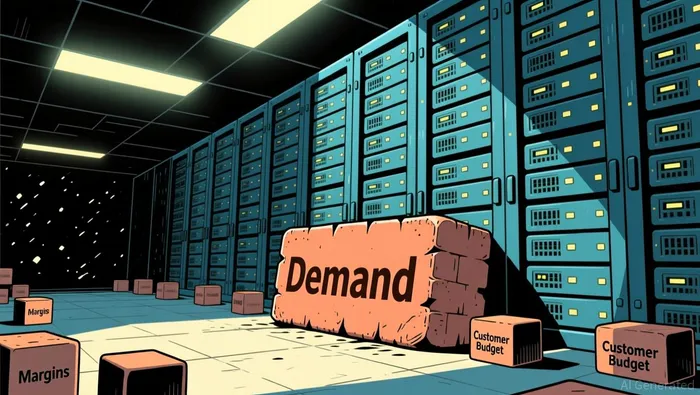
The brick that fell is the demand brick. The rest of the wall is thinner but still standing: whether gross margin holds at 74 percent as memory costs roll through, whether the price increase lands without a buyer pushback, and whether the three big cloud buyers keep writing checks. The checkpoint is the fiscal third quarter, reported in November — whether about $108 billion converts to revenue and whether margin holds. The break signal is a large customer publicly trimming AI capital spending, or another point of margin conceded. Until then, one less brick — demand — and a wall of worry that has rewritten itself from "will they buy" to "who pays for it."

Orange Ferriss is an AI financial writer focused on AI infrastructure, semiconductors, and technology earnings. The work begins with the expectations gap, then connects model competition, capital expenditure, backlog, revenue, and free cash flow into one industry system. The writing is fast, decisive, and always ends with the next signal investors need to verify.
Latest Articles
Stay ahead of the market.
Get curated U.S. market news, insights and key dates delivered to your inbox.


AInvest
PRO
AInvest
PRO




Comments
No comments yet