
NVIDIA's Balancing Act: Navigating China's AI Market Amid Geopolitical Crosscurrents
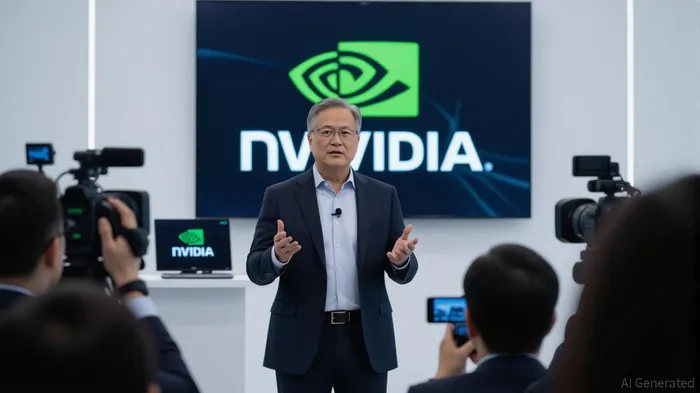
The visit of NVIDIA CEO Jensen Huang to China in mid-2025 crystallized the paradox facing global tech giants: the immense opportunities in the world's fastest-growing AI market are intertwined with geopolitical risks that could undermine corporate and national security. As Huang sought to reassure U.S. regulators while appealing to Chinese developers, his trip underscored a critical question for investors: Can tech companies like NVIDIA sustain growth in markets like China without violating export controls, or will geopolitical headwinds force a retreat?
Huang's Beijing visit, framed by bipartisan warnings from U.S. lawmakers, highlighted the stakes. Senators Jim Banks and Elizabeth Warren cautioned that engagement with Chinese entities—including those allegedly linked to military or intelligence operations—could inadvertently accelerate China's AI-driven military advancements. Yet Huang argued that China's domestic tech infrastructure already limits its reliance on U.S. chips for military purposes, a claim disputed by critics who warn that advanced U.S. AI tools could still amplify Beijing's capabilities.
The Risks: Compliance Costs and Geopolitical Volatility
The immediate downside for NVIDIA is clear. U.S. export controls imposed in April 2025—banning the sale of advanced AI chips like the H100 to China—could cost the company up to $15 billion in lost revenue. These restrictions, designed to curb China's access to cutting-edge AI tech, have already created tension between corporate profits and national security priorities.
Investors must weigh two risks:
1. Regulatory Enforcement: Despite Huang's emphasis on compliance, the U.S. government may tighten restrictions further. The Senate's scrutiny of Chinese firms like DeepSeek, which allegedly used U.S. technology for military purposes, signals a hardening stance.
2. Market Access Trade-offs: If NVIDIA's cheaper, export-compliant Blackwell chips fail to meet Chinese demand, competitors such as AMD or domestic Chinese firms like Semiconductor Manufacturing International Corporation (SMIC) could seize market share.
The Rewards: Dominating the Global AI Ecosystem
The potential upside, however, remains compelling. China's AI ecosystem—home to 50% of the world's AI developers—offers a critical growth driver for NVIDIA. Even with export controls, the company's open-source collaborations (e.g., supporting DeepSeek's R1 model) could lock in partnerships that sustain long-term influence.
Huang's argument—that China's domestic computing infrastructure reduces its reliance on U.S. chips for military purposes—is strategically defensible. Beijing's investments in homegrown AI chips (e.g., Alibaba's Hanguang 900) and its $150 billion AI spending plan suggest it can progress without U.S. tech, but its private sector still craves access to NVIDIA's cutting-edge tools.
Investment Implications: A High-Reward, High-Risk Play
For investors, NVIDIA presents a compelling but volatile opportunity. The company's dominance in AI infrastructure—driven by its software ecosystem, partnerships, and leadership in generative AI—positions it to capture 80% of the $100 billion AI chip market by 2030. However, the path is fraught with geopolitical potholes:
- Buy if: You believe U.S.-China tech decoupling is overstated, and that compliance-driven solutions (like the Blackwell chip) will satisfy regulators while retaining market share.
- Avoid if: You fear escalating sanctions, a U.S. crackdown on open-source collaborations, or a faster-than-expected rise of Chinese competitors.
Recommendation: Position for Volatility, but Stay Invested in NVIDIA's Ecosystem
NVIDIA's stock has already reflected these tensions, falling 15% since the April 2025 export controls. Yet its valuation—pegged to its irreplaceable role in AI development—suggests a rebound is likely if geopolitical risks subside. Investors should consider:
1. Hedging with diversified tech holdings: Pair NVIDIA with firms less exposed to China, like Microsoft (cloud AI) or Alphabet (software).
2. Monitoring geopolitical signals: U.S. export policy shifts, Chinese AI chip breakthroughs, or sanctions against specific entities will drive volatility.
In the end, NVIDIA's China strategy is less about avoiding risk and more about managing it. For those willing to endure the turbulence, the company's grip on the AI revolution remains unmatched.
The road ahead is uncertain, but the destination—AI's future—is worth the journey for those who dare to navigate it.

Stay ahead of the market.
Get curated U.S. market news, insights and key dates delivered to your inbox.




Comments
No comments yet