
Nvidia and AMD Fork Over 15% to Revive China Sales Under Trump's Chip Tax Gambit
In the high-stakes chess game of global semiconductor trade, the Trump administration has just played a bold gambit: extracting a 15% revenue slice from NvidiaNVDA-- Corp. and Advanced Micro DevicesAMD-- Inc.'s AI chip sales to China in exchange for easing export curbs. This unorthodox arrangement, unveiled amid a flurry of White House briefings, spotlights the collision of national security rhetoric with raw fiscal opportunism, potentially reshaping how America wields its tech dominance.
The Deal's Mechanics and Origins
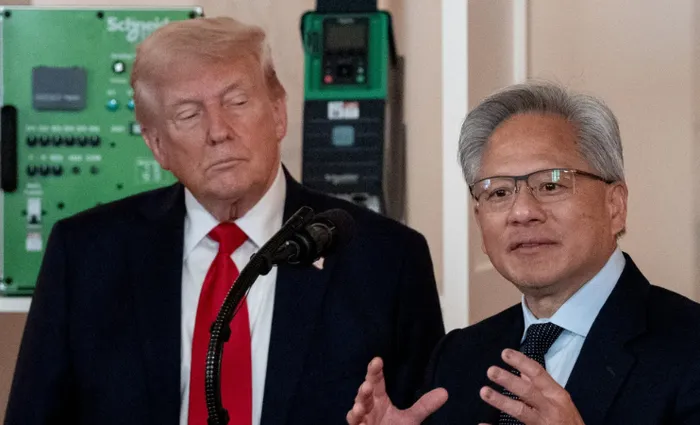
President Donald Trump, ever the dealmaker, didn't mince words during Monday's reporter huddle. He recounted haggling with Nvidia over its H20 AI accelerator, initially demanding a 20% cut before landing at 15%. "We negotiated a little deal," Trump quipped, framing it as a win-win that funnels cash back to Uncle Sam while cracking open the door to China's vast market. AMDAMD--, sources confirm, is on the hook for the same percentage from its MI308 chip revenues, though the company has stayed mum on the specifics.
At first blush, this looks like a pragmatic thaw in the U.S.-China chip wars. For years, Washington has clamped down on exporting cutting-edge AI silicon, fearing Beijing could repurpose it for military might—think hypersonic missiles or surveillance supercomputers. Only watered-down variants like the H20 have gotten the green light, and even those were frozen out until last month's license approvals. Now, with Treasury Secretary Scott Bessent calling these chips a "negotiating chip" in broader trade talks, the administration is dangling access in return for tribute.
Legal Vulnerabilities and National Security Concerns
But peel back the layers, and the deal reeks of improvisation. Trade experts are already sharpening their legal knives, arguing it veers perilously close to an unconstitutional export tax. The Constitution bars such levies without congressional approval, and this revenue-sharing pact—essentially a toll on foreign sales—could invite lawsuits from chipmakers or even free-trade advocates. "This seeming quid pro quo is unprecedented from an export-control perspective," warns Jacob Feldgoise, a researcher at the Center for Security and Emerging Technology in Washington. "It risks invalidating the national security rationale for U.S. export controls."
Indeed, the arrangement undercuts the very fortress America has built around its tech crown jewels. White House AI adviser David Sacks downplayed the H20 as not "the latest and greatest," while Trump dismissed it as "an old chip" compared to Nvidia's gleaming Blackwell powerhouse. Yet if security is paramount, why barter it for bucks? Critics see echoes of Trump's broader tariff playbook: threats of 100% duties on imported chips last week, unless firms plow investments stateside—though most majors like Taiwan Semiconductor Manufacturing Co. are already shielded by U.S. fab commitments or exemptions.
Revenue Projections and Production Hurdles
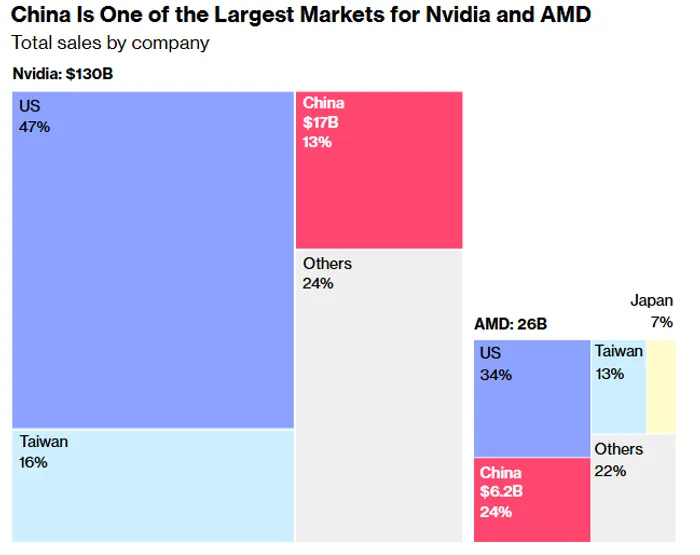
For Nvidia and AMD, the math is tantalizing yet treacherous. China's AI hunger is insatiable, powering everything from data centers to autonomous vehicles in the world's No. 2 economy. Before restrictions bit in April, Nvidia hauled in $4.6 billion from H20 sales in a single fiscal quarter, with another $2.5 billion stalled by bans. Extrapolate that, and a return to form could yield over $7 billion quarterly—handing the U.S. government a cool $1 billion windfall per period at 15%. AMD, per Morgan StanleyMS-- estimates, might unlock $3 billion to $5 billion in 2025 revenue if flows resume, chipping in hundreds of millions more.
Yet revival isn't a slam dunk. Both firms admit it'll take months to crank up production lines idled by uncertainty. And Chinese buyers? They're no pushovers. Domestic rivals like Huawei Technologies Co. have surged, snagging 20% to 30% of local demand with Ascend chips that sidestep U.S. sanctions. Beijing's state media mouthpiece, Yuyuantantian—linked to China Central Television—blasted the H20 over the weekend for alleged security holes and performance lags, signaling official disdain. "China has ample supply of domestic chips," Nvidia countered in a statement, insisting its product isn't military-grade and that Beijing never leaned on American tech for critical ops. Still, the subtext is clear: Why pay a premium for yesterday's silicon, especially if it comes laced with a de facto U.S. surcharge?
Market Reactions and Industry Ripples
Market reactions underscore the skepticism. Nvidia shares barely budged, while AMD eked out a sub-1% gain to $172.28 in New York trading Monday. "The market already priced in shipments resuming," notes Jay Goldberg, an analyst at SeaportSEG-- Global Securities. "The real wildcard is timing—and now these strings attached." Investors recall how past Trump-era volleys, like his recent call for IntelINTC-- Corp. CEO Lip-Bu Tan to step down over vague "conflicts" tied to China links, sent ripples without lasting tsunamis. Tan, facing heat from GOP Senator Tom Cotton, is slated to huddle with Trump, per sources, in a bid to steady the ship.
Nvidia CEO Jensen Huang, whom Trump lauded as a "very brilliant guy," has been a tireless lobbyist against blanket bans, warning they'd only accelerate China's homegrown tech sprint. His persistence seems to be paying off: Trump teased openness to a scaled-back Blackwell deal, hinting Huang might soon darken the Oval Office door again. But this flirtation with pay-to-play export easing could boomerang. Vey-Sern Ling, managing director at Union Bancaire Privee in Singapore, puts it bluntly: "The U.S. needs the money amid deficits and tariff zeal, but China's backdoor jabs at the H20 smell like a ploy to show they're not desperate."
Long-Term Implications for Global Tech Trade
Broader implications loom for the $500 billion-plus semiconductor arena. If this model sticks, expect copycats: Why not demand royalties from other sectors, like electric vehicles or biotech? It could erode alliances, too—U.S. partners in Europe and Asia, already chafing at America's unilateral controls, might balk at a system that prioritizes profit over principle. And for China, it's rocket fuel for self-reliance drives, pouring billions into firms like Semiconductor Manufacturing International Corp. to close the gap.
Trump's chip diplomacy, then, is a double-edged sword: a fiscal booster shot for a debt-laden America, but one that might hemorrhage credibility in the long run. As Huang and his peers navigate this minefield, the real test isn't just quarterly hauls—it's whether this "little deal" fortifies U.S. leadership or fractures it. In a world where silicon is the new oil, betting on short-term payouts risks igniting a bigger blaze.

Expert analysis on U.S. markets and macro trends, delivering clear perspectives behind major market moves.
Latest Articles
Stay ahead of the market.
Get curated U.S. market news, insights and key dates delivered to your inbox.
AInvest
PRO
AInvest
PRO



Comments
No comments yet