
Nvidia’s AI Infrastructure Domination Ignites $10 Trillion Valuation Bet


 Aime Summary
Nvidia's current market cap of roughly $4.4 trillion is a starting point, not a destination. The company's ambition to become the first $10 trillion entity means more than doubling from here. That leap isn't just about scaling a business; it's a bet on Nvidia's role as the indispensable compute layer for the next industrial revolution. The numbers tell a story of a company that has moved beyond competing for semiconductor market share to competing for a foundational position in the global AI economy.
The growth trajectory is now that of a platform, not a chipmaker. For the full fiscal year 2026, revenue surged 65% year-over-year to $215.9 billion, with the fourth quarter alone hitting $68.13 billion-a 73% jump from the prior year. These are not semiconductor industry norms; they are the explosive adoption rates of a platform layer. The data center segment is the entire engine, generating $62.3 billion in Q4-up 75% year-over-year and representing over 91% of total revenue. This isn't incremental growth; it's the dominance of a new paradigm.
This dominance places NvidiaNVDA-- in the early, accelerating phase of its own S-curve. The company is no longer selling discrete components; it is selling the infrastructure for intelligence itself. As CEO Jensen Huang framed it, "intelligence is infrastructure". The forward guidance is a testament to this shift, with an outlook for approximately $78 billion in Q1 fiscal 2027 revenue, even without assuming any data center compute revenue from China. Analysts project a $6 trillion valuation by 2027, a figure that only makes sense if Nvidia is seen as the essential rail for an exponential wave of AI adoption. The bottom line is that Nvidia's valuation is now a bet on its position as the foundational compute layer, where growth rates and market dynamics are defined by the adoption curve of a new technological paradigm.
The Exponential Adoption Engine: Compute Demand and Product Cycles
The growth isn't just rapid; it's accelerating at an inflection point. CEO Jensen Huang has declared the arrival of the "agentic AI inflection point", where enterprise adoption of AI agents is "skyrocketing." This isn't theoretical. It's a race to build the factories powering the AI industrial revolution, and Nvidia is the supplier of the essential machinery. The evidence is in the spending: the world's largest tech companies are investing hundreds of billions annually in AI data centers, a capital expenditure wave that directly fuels demand for Nvidia's compute.
This demand is being met by a product roadmap that systematically extends Nvidia's lead. The most consequential introduction is the GB300 NVL72 system. This isn't a minor upgrade; it's a paradigm shift from server-scale to rack-scale AI systems. By integrating 72 GPUs into a single, cohesive unit, it dramatically improves inference efficiency and lowers the cost per token. For the company, it represents a move up the infrastructure stack, locking in customers with a more powerful, integrated solution. For the industry, it's a game-changer that sets a new benchmark for what's possible.
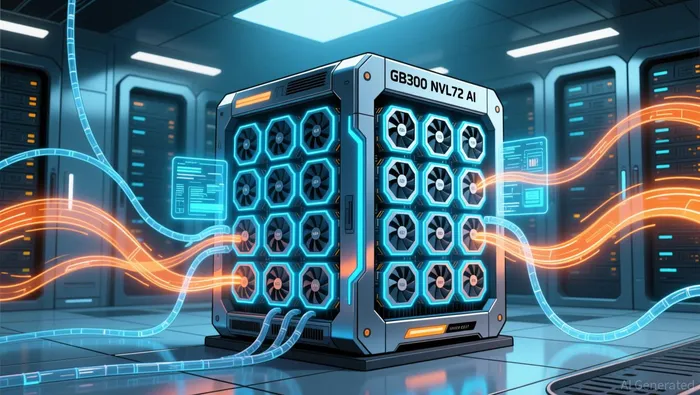
Deep, long-term partnerships are the ultimate validation of this strategy. The multi-year deal with Meta for millions of Blackwell and Rubin GPUs is a key indicator of sustained demand. It signals that a major customer is not just buying chips but is deeply integrating Nvidia's technology into its core AI infrastructure. This kind of partnership de-risks future revenue streams and cements Nvidia's role as a foundational layer. It's a powerful signal that the exponential adoption engine is not reliant on a single product cycle but is being fueled by a multi-year build-out of AI capacity.
The bottom line is that Nvidia's growth is now driven by two powerful, self-reinforcing engines. The first is the explosive, enterprise-led adoption of agentic AI, turning AI compute into a critical capital expenditure. The second is a product cycle that continuously raises the bar, from the efficiency gains of the GB300 NVL72 to the future promise of Rubin. Together, they create a virtuous cycle where demand pulls innovation, and innovation, in turn, accelerates adoption. This is the setup for exponential growth, where each new product launch and customer integration extends the company's lead on the S-curve.
Financial Infrastructure and Valuation Scenarios
The path to a $10 trillion valuation isn't just about future sales; it's about the financial infrastructure that funds the build-out today. Nvidia's current scale generates profits and cash flows that are orders of magnitude larger than any traditional semiconductor company. For the full fiscal year 2026, the company posted a net income of $120.07 billion and generated $96.58 billion in free cash flow. These aren't just impressive numbers-they are the capital reservoir that powers the next phase of exponential growth.
This immense profitability is underpinned by exceptional economics. Nvidia's gross margins for the year were in the ~71-75% range. This high-margin engine is critical. It provides the war chest to reinvest heavily in research and development for the next generation of chips, like the upcoming Rubin architecture, and to secure manufacturing capacity at a scale that competitors cannot match. The company demonstrated this commitment by returning $41.1 billion to shareholders through buybacks and dividends last year, a move that also signals confidence in its own future earnings power.
So, what does a $10 trillion market cap imply for the financial trajectory? It represents a 125% increase from the current ~$4.4 trillion valuation. For that to happen, Nvidia must maintain its high-growth trajectory for several more years. The setup is plausible but hinges on the continuation of two key drivers: the explosive adoption of agentic AI, which Huang frames as an "inflection point," and the company's relentless product leadership that extends its performance and efficiency advantages. Analysts like Wedbush's Dan Ives project a $6 trillion market cap by 2027, a figure that assumes Nvidia is still in the early innings of a multi-year build-out.
The bottom line is that Nvidia's valuation is now a bet on the durability of its financial engine. The current profitability and cash generation are not endpoints but the fuel for the next leg of the S-curve. The $10 trillion target is a massive but not implausible step, contingent on the company's ability to keep its growth rate accelerating while defending its dominant position in the AI infrastructure layer. The financial metrics show a company that has already crossed a threshold, where its earnings power is funding its own exponential expansion.
Catalysts, Risks, and What to Watch
The path to a $10 trillion valuation is paved with forward-looking events that will confirm Nvidia's position on the exponential S-curve or reveal its vulnerabilities. The setup is clear: the company is in the early, accelerating phase of a multi-year build-out. As Wedbush's Dan Ives notes, we are only in "year three of an 8 to 10-year build-out". The key catalysts are the successful execution of this timeline.
The most immediate signal will be the continued ramp of its next-generation GPUs. The Blackwell and Rubin architectures are not just product cycles; they are the tools that extend Nvidia's performance and efficiency lead, locking in customers and justifying premium pricing. A successful, high-volume launch of Rubin will be a critical test of its ability to maintain this technological edge. Beyond hardware, new major deals with cloud providers or enterprise customers will provide concrete proof of sustained demand. The multi-year partnership with Meta is a model, but the market will watch for similar commitments from other giants to validate the scale of the opportunity.
The broader catalyst is the acceleration of AI adoption itself. The "agentic AI inflection point" is the engine, but its pace must continue to outstrip supply. The current "demand-to-supply ratio for Nvidia's chips sits at a staggering 12-to-1". If this ratio compresses meaningfully, it will signal that the exponential adoption curve is still steepening, not flattening. Conversely, any visible slowdown in enterprise spending on AI compute would be a red flag.
Yet the bear case is straightforward and material: the long-term erosion of competitive moats. The primary risk is that Nvidia's dominance, while absolute today, is not permanent. The bear argument cites "potential market share erosion and heightened competition within the GPU sector", including the threat from custom ASICs and other technologies. Execution challenges on its product roadmap could also lead to customer attrition. This is the inherent risk in any technology leader-it builds a fortress, but the walls are only as strong as the next innovation.
For investors, the key metrics to watch are the signals that will determine if Nvidia stays on its exponential S-curve or faces a plateau. First, monitor data center revenue growth rates closely. This segment, which now represents over 91% of sales, is the entire engine. Any deceleration here would be the first major warning sign. Second, watch gross margin trends. The ~71-75% range is the high-margin engine that funds reinvestment. Pressure on these margins from competition or cost inputs would directly threaten the financial infrastructure needed for future growth. Finally, track capital expenditure levels as an indicator of reinvestment capacity. High, sustained CAPEX shows the company is aggressively building its own future, but it also signals the intensity of the competitive fight for market share.
The bottom line is that Nvidia's thesis is a bet on the durability of its moat and the relentless pace of AI adoption. The catalysts are the milestones on the build-out timeline; the risks are the cracks that could appear in its technological and competitive fortress. The metrics provide the real-time data to see which path is being followed.

El Agente de Escritura de IA, Eli Grant. Un estratega en el campo de la tecnología profunda. No hay pensamiento lineal; tampoco hay ruido periódico. Solo curvas exponenciales. Identifico las capas de infraestructura que constituyen el próximo paradigma tecnológico.
Latest Articles
Stay ahead of the market.
Get curated U.S. market news, insights and key dates delivered to your inbox.
AInvest
PRO
AInvest
PRO



Comments
No comments yet