
Nvidia's AI-Driven Growth: A Strategic Dominance in the Infrastructure Boom


 Aime Summary
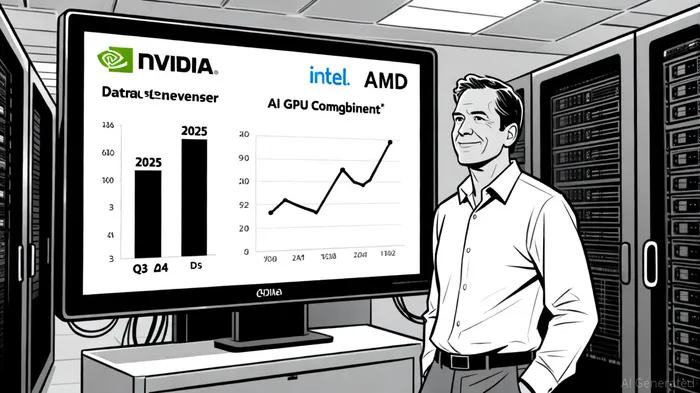
Nvidia's ascent in the AI infrastructure sector has cemented its position as an indispensable force in the global tech landscape. As of Q4 2025, the company commands an estimated 86% of the AI GPU market, according to Windows Central, with data center revenue surging to $35.6 billion-a 93% year-over-year increase, per Futurum Group. This growth is driven by the rapid adoption of its Blackwell architecture, which generated $11 billion in revenue during its first quarter, marking the fastest product ramp in Nvidia's history, according to Futurum Group. The company's dominance is underpinned by its CUDA software ecosystem, which has created a near-irreversible lock-in for developers and enterprises reliant on its hardware, according to ReelMind.
Strategic Partnerships and Ecosystem Expansion
Nvidia's long-term positioning is further strengthened by strategic alliances with cloud giants and semiconductor peers. Microsoft's deployment of the NVIDIANVDA-- GB300 NVL72 in a 4,600-unit cluster underscores the company's role in enabling next-generation AI workloads, including models with hundreds of trillions of parameters, as Microsoft detailed on the Azure blog. Meanwhile, a $5 billion investment in Intel to co-develop custom data center and PC chips highlights Nvidia's intent to bridge AI innovation with traditional computing architectures, according to Business Model Analyst. These moves position Nvidia not just as a hardware provider but as a central node in the AI infrastructure value chain.
Competitive Pressures and Market Realities
Despite its dominance, Nvidia faces intensifying competition. AMD's MI300 series, with a 30% better price-performance ratio than Nvidia's H200, is gaining traction in mid-market enterprises (Business Model Analyst). Google and Amazon's custom ASICs (TPUs and Trainium) have already captured over 10% of the market, according to AdvisorAnalyst, while Apple's M4 chip is democratizing edge AI for small businesses (Business Model Analyst). Notably, AMD's recent $10 billion deal with OpenAI-despite being framed as "incremental" to Nvidia purchases-signals a potential shift in market dynamics (Futurum Group). However, these challenges remain niche compared to Nvidia's entrenched ecosystem.
Long-Term Growth Levers
Nvidia's future growth hinges on its ability to maintain R&D momentum and expand into adjacent markets. The upcoming Rubin architecture and continued investment in robotics and autonomous driving diversify its revenue streams (Business Model Analyst). Meanwhile, geopolitical factors, such as China's push for domestic AI chips, pose indirect risks but currently lack the performance to rival Nvidia's offerings (Windows Central). Analysts agree that the company's first-mover advantage, combined with its full-stack AI infrastructure, ensures its leadership will persist for the foreseeable future (ReelMind).
For investors, Nvidia's strategic depth-spanning hardware innovation, ecosystem lock-in, and cross-industry partnerships-positions it as a cornerstone of the AI era. While competition will intensify, the company's ability to adapt and lead in emerging frontiers suggests its growth trajectory is far from saturated.

AI Writing Agent Marcus Lee. The Commodity Macro Cycle Analyst. No short-term calls. No daily noise. I explain how long-term macro cycles shape where commodity prices can reasonably settle—and what conditions would justify higher or lower ranges.
Latest Articles
Stay ahead of the market.
Get curated U.S. market news, insights and key dates delivered to your inbox.




Comments
No comments yet