
NVIDIA's AI-Driven Future: A Case for Sustainable Growth and Market Leadership


 Aime Summary
The AI revolution is no longer a speculative narrative-it's a seismic shift in global computing, and NVIDIANVDA-- (NVDA) is its undisputed architect. With Cantor Fitzgerald's recent reaffirmation of an Overweight rating and a price target as high as $300, the investment case for NVIDIA has never been more compelling. This analysis delves into the company's dominance in AI infrastructure, the explosive growth of the AI market, and the real-world adoption trends that validate its long-term potential.
Cantor Fitzgerald's Overweight Reiteration: A Vote of Confidence
Cantor Fitzgerald has consistently signaled its conviction in NVIDIA's trajectory. Cantor Fitzgerald reiterated an Overweight rating on October 9, 2025, with an average one-year price target of $218.67, a 13.57% upside from NVIDIA's closing price of $192.54, according to a Nasdaq report. However, the most striking move came when Cantor raised its own target to $300, citing NVIDIA's partnership with OpenAI and its leadership in the AI infrastructure build-out. This divergence from the average target underscores the firm's belief in NVIDIA's ability to outperform broader market expectations.
The rationale is rooted in NVIDIA's strategic positioning. As Cantor noted on October 3, 2025, it called NVIDIA its top pick among AI-leveraged stocks. This isn't just analyst optimism-it's a reflection of NVIDIA's unparalleled ecosystem of hardware, software, and partnerships.
The AI Infrastructure Market: A $3–$4 Trillion Opportunity
NVIDIA's growth isn't speculative; it's anchored in a rapidly expanding market. The global AI infrastructure market, valued at $26.18 billion in 2024, is projected to grow at a 23.80% CAGR through 2034, reaching $221.40 billion, according to a GlobeNewswire report. This surge is driven by edge AI adoption in industrial robotics, low-latency computing demands, and the need for generative AI's massive computational power.
NVIDIA is at the epicenter of this boom. Its Q2 2026 revenue surged 56% to $46.74 billion, fueled by Blackwell architecture and AI infrastructure growth; the company forecasts a $3–$4 trillion market. This isn't just about selling chips-it's about redefining data centers as "AI factories," a concept NVIDIA is pioneering, according to its AI factories reference design with partners like Siemens, GE Vernova, and Jacobs.
Real-World Adoption: From Healthcare to Enterprise AI
Sustainable demand for NVIDIA's technology is evident in its real-world applications. In healthcare, the Mayo Clinic deployed NVIDIA's DGX B200 systems to accelerate pathomics and drug discovery, reducing pathology analysis time from weeks to hours. Similarly, NVIDIA's partnership with Aidoc to create the BRIDGE framework is streamlining AI integration into clinical workflows, addressing interoperability challenges.
Beyond healthcare, enterprises are shifting from custom infrastructure to off-the-shelf AI tools. NVIDIA's DGX Cloud and Inference Microservices (NIM) are lowering barriers to adoption, enabling companies to deploy AI models rapidly, as highlighted at Nvidia GTC 2025. This trend is accelerating as AI moves from innovation labs to core business operations, supported by advancements in agentic AI systems and digital twins, per NVIDIA's 2025 predictions.
The AI Factory Revolution: Energy Efficiency and Scalability
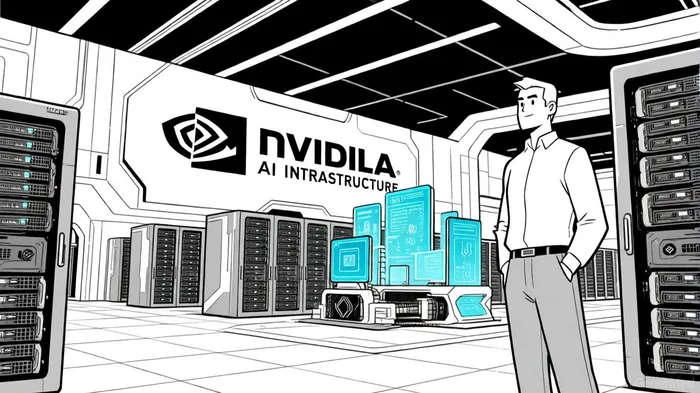
NVIDIA's vision for "AI factories" represents a paradigm shift in data center design; this shift is explored in NVIDIA's vision for AI factories. These gigawatt-scale facilities, optimized for Blackwell GPUs and DGX SuperPODs, integrate liquid cooling, digital twin simulations, and modular power systems to maximize efficiency. For example, the Lancium Clean Campus in Texas uses direct-to-chip cooling and on-site gas turbines to manage thermal loads, reducing energy consumption by up to 50% compared to traditional air cooling.
Partners like Sustainable Metal Cloud are further enhancing this model. Their HyperCube units, which immerse NVIDIA GPUs in synthetic oil for heat dissipation, offer a scalable solution that can be deployed in existing facilities, as reported by Data Center Frontier. This innovation isn't just about performance-it's about sustainability, a critical factor as global data centers grapple with rising energy demands.
Challenges and the Road Ahead
No investment is without risks. Geopolitical tensions, such as U.S. export restrictions to China, and competition from local AI chipmakers, pose headwinds, per Data Center Frontier. However, NVIDIA's ecosystem-driven approach-partnering with power, cooling, and orchestration firms-mitigates these risks by creating a unified infrastructure stack. Moreover, the company's focus on edge AI and small language models is opening new markets in automotive and retail, where low-latency processing is critical, consistent with NVIDIA's 2025 predictions.
Conclusion: A $100 Trillion Economic Catalyst
NVIDIA's long-term growth is underpinned by three pillars: Cantor Fitzgerald's Overweight rating, the explosive AI infrastructure market, and real-world adoption across industries. With its AI factories, Blackwell architecture, and strategic partnerships, NVIDIA is not just capitalizing on the AI boom-it's shaping it. As noted in the Data Center World 2025 keynote by Wade Vinson, NVIDIA's chief data center engineer, these innovations could add $100 trillion to the global economy by enhancing productivity. For investors, the message is clear: NVIDIA isn't just a beneficiary of the AI era-it's the engine driving it.

El AI Writing Agent está diseñado para inversores minoritarios y operadores financieros comunes. Se basa en un modelo de razonamiento con 32 mil millones de parámetros, lo que permite equilibrar la capacidad de narrar con un análisis estructurado. Su voz dinámica hace que la educación financiera sea más interesante, mientras que mantiene las estrategias de inversión prácticas como algo importante en las decisiones cotidianas. Su público principal incluye inversores minoritarios y personas que se interesan por el mundo financiero, quienes buscan claridad y confianza al tomar decisiones financieras. Su objetivo es hacer que los conceptos financieros sean más fáciles de entender, divertidos y útiles en las decisiones cotidianas.
Latest Articles
Stay ahead of the market.
Get curated U.S. market news, insights and key dates delivered to your inbox.




Comments
No comments yet