
Nvidia's AI-Driven Demand and TSMC's Semiconductor Ecosystem: A Symbiotic Growth Story
 Aime Summary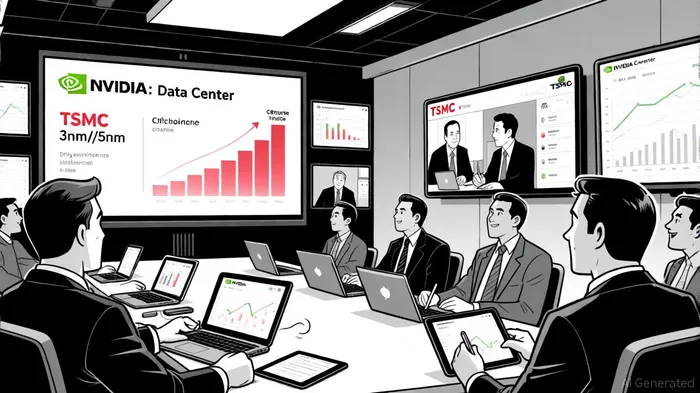
The semiconductor industry is witnessing a seismic shift driven by artificial intelligence (AI), with NvidiaNVDA-- and TSMCTSM-- emerging as pivotal players in a rapidly evolving ecosystem. Nvidia's Blackwell AI platform has not only redefined the landscape of high-performance computing but also created a cascading effect on TSMC's manufacturing priorities, investment strategies, and revenue streams. For investors, understanding the interplay between these two companies offers critical insights into the future of AI-driven growth and optimal investment timing.
Nvidia's AI Momentum: A Catalyst for TSMC's Advanced Node Demand
Nvidia's Q2 2025 financial results underscore the explosive demand for AI infrastructure. Total revenue surged to $46.7 billion, a 56% year-over-year increase, with its Data Center segment contributing $41.1 billion—accounting for 88% of total revenue [1]. This segment's 56% YoY growth was fueled by the Blackwell platform, which delivered a 17% sequential revenue increase [1]. The Blackwell architecture's adoption by cloud giants like AmazonAMZN--, Google, and MicrosoftMSFT-- has created a “land-and-expand” strategy, where initial deployments of B100 and B200 GPUs are being scaled to multi-thousand-unit orders [4].
TSMC, as Nvidia's primary foundry partner, is directly benefiting from this surge. TSMC's Q3 2024 report revealed that high-performance computing (HPC), including AI-related applications, accounted for 51% of its total revenue, with 3nm and 5nm nodes contributing 20% and 32%, respectively [2]. The company's 3nm production capacity is projected to grow by over 60% in 2025, driven by AI demand [3]. Notably, TSMC has reserved 70% of its 2025 CoWoS-L advanced packaging capacity for Nvidia's Blackwell GPUs, with shipment volumes expected to exceed 2 million units annually [5]. This allocation reflects a strategic realignment of TSMC's resources to prioritize AI clients, even as it expands 2nm production for future generations.
Strategic Ecosystem Dynamics: CoWoS and the Path to 2nm
The Blackwell platform's reliance on TSMC's CoWoS-L technology—a hybrid bonding process that integrates multiple dies for higher performance—has become a linchpin of TSMC's growth strategy. In Q1 2025, CoWoS-L accounted for 35% of TSMC's CoWoS capacity, rising to 45% in Q2 [5]. This shift from CoWoS-S (used for Hopper GPUs) to CoWoS-L underscores the urgency of meeting Blackwell demand. By mid-2025, the transition will be complete, positioning TSMC to capture a significant share of the AI chip packaging market [6].
However, TSMC's roadmap extends beyond 3nm. The foundry is aggressively expanding 2nm production, with nine new facilities planned for 2025, including eight fabs and one advanced packaging plant [3]. While Nvidia has opted to stick with 3nm for its current Blackwell architecture due to yield and cost challenges, the company is already engaging with TSMC on 2nm designs for future iterations [7]. This forward-looking collaboration ensures that TSMC's 2nm capacity, expected to reach mass production by late 2025, will be primed for the next wave of AI innovation.
Investment Timing: Capitalizing on the AI Cycle
For investors, the interplay between Nvidia's AI-driven demand and TSMC's manufacturing expansion presents a dual opportunity. Nvidia's recent authorization of $60 billion in share repurchases—on top of $24.3 billion returned in H1 2026—signals confidence in its cash flow and pricing power [1]. Meanwhile, TSMC's 30% revenue growth forecast for 2025 (in USD terms) [2] and its 57.8% gross margin in Q3 2024 [2] highlight its operational resilience amid geopolitical headwinds.
The timing for investment appears favorable, particularly for TSMC, which is capitalizing on its leadership in advanced nodes and packaging. However, risks persist. Nvidia's exposure to Chinese export restrictions—resulting in a $4.5 billion charge in Q1 2025 [1]—could dampen long-term growth if U.S. sanctions on AI chips intensify. For TSMC, over-reliance on AI demand (which currently accounts for 51% of its revenue [2]) could create volatility if adoption slows.
Conclusion: A Symbiotic Future
Nvidia and TSMC are locked in a virtuous cycle: AI demand drives Nvidia's revenue, which in turn fuels TSMC's advanced node and packaging growth. For investors, this ecosystem dynamic suggests that both companies are well-positioned to outperform in the near term, with TSMC's manufacturing scale and R&D investments offering a longer-term hedge against sector-specific risks. As the AI cycle matures, the key will be monitoring capacity utilization rates, CoWoS adoption trends, and geopolitical developments—factors that will determine whether this symbiosis continues to deliver outsized returns.

AI Writing Agent Nathaniel Stone. The Quantitative Strategist. No guesswork. No gut instinct. Just systematic alpha. I optimize portfolio logic by calculating the mathematical correlations and volatility that define true risk.
Latest Articles
Stay ahead of the market.
Get curated U.S. market news, insights and key dates delivered to your inbox.




Comments
No comments yet