
Nvidia's AI Dominance Under Threat: The Overlooked Risk of Internal Competition


 Aime Summary
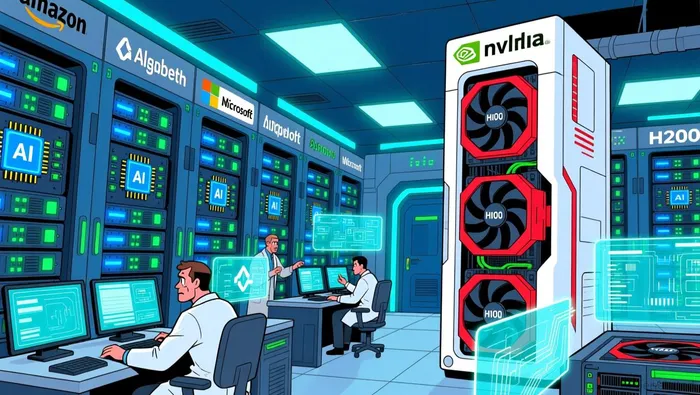
Nvidia's meteoric rise as the undisputed leader in AI chip development has been nothing short of extraordinary. With its H100 and H200 GPUs forming the backbone of global AI training infrastructure, the company has captured an estimated 80-90% of the AI accelerator market. However, beneath this veneer of dominance lies a growing, often overlooked risk: the very clients that have fueled Nvidia's success-Microsoft, AmazonAMZN--, and Alphabet-are now aggressively pursuing in-house GPU development. This shift could erode Nvidia's margins, fragment its customer base, and challenge its long-term growth trajectory.
The Rise of In-House AI Hardware: A Strategic Shift by Hyperscalers
Amazon Web Services (AWS) has emerged as a formidable player in the AI chip race. Its Trainium2 chips, designed specifically for AI training and inference, offer a 30-40% better price-performance ratio compared to competing GPUs. With 1 million units expected to ship by year-end 2025 and a next-generation Trainium3 chip on the horizon-projected to deliver an additional 40% performance boost-AWS is positioning itself to displace Nvidia as the go-to provider for cloud-based AI workloads.
 Alphabet's Tensor Processing Units (TPUs) are also gaining traction. The latest Ironwood generation reportedly outperforms Nvidia's offerings by a factor of four while reducing operational costs. Notably, Alphabet's TPUs are now attracting external clients, including Meta, which is rumored to be considering a multi-billion-dollar deal to adopt Google's hardware starting in 2027. This marks a pivotal moment: if TPUs become a viable alternative for third-party clients, Alphabet could directly compete with NvidiaNVDA-- in the broader AI market.
Microsoft, meanwhile, is leveraging partnerships to accelerate its in-house silicon strategy. By collaborating with OpenAI and Broadcom, MicrosoftMSFT-- has secured access to custom AI chip designs, which it plans to refine and scale under its own intellectual property framework. CEO Satya Nadella has emphasized that this approach will enable Microsoft to reduce its reliance on external suppliers while accelerating Azure's AI infrastructure. With full IP rights to OpenAI's chip designs until 2032, Microsoft is poised to launch competitive hardware that could undercut Nvidia's pricing and performance advantages.
Financial Risks: A House of Cards Built on Hyperscaler Dependency
Nvidia's financial model is deeply intertwined with its largest clients. In Q2 2025, 52% of its $46.7 billion revenue came from just three customers-likely Microsoft, Amazon, and Alphabet. This concentration creates a critical vulnerability: if these clients shift to in-house solutions or diversify their supplier base, Nvidia's revenue could experience sharp, unpredictable declines.
Analysts warn that hyperscaler capital expenditure cycles and internal silicon roadmaps introduce volatility into Nvidia's financial planning. For instance, AWS's Trainium2 adoption and Alphabet's TPU expansion could lead to sudden procurement shifts, causing quarter-to-quarter revenue swings. Furthermore, U.S. export restrictions have already limited Nvidia's access to China, a market where its H20 AI chip is currently unavailable. As alternative CUDA platforms and open-source models like DeepSeek gain traction, demand for Nvidia's premium chips may wane, further compressing margins.
Investor Sentiment: A Market at a Crossroads
Investor sentiment toward Nvidia has been a double-edged sword. While the company's blowout earnings have driven stock performance, concerns about an AI-driven market bubble are intensifying. Bridgewater's Ray Dalio recently labeled the sector a "bubble," and Alphabet's outperformance among the "Magnificent 7" stocks highlights growing skepticism about the sustainability of Nvidia's growth narrative.
Zacks Investment Research underscores the fragility of the current landscape, noting that market breadth has soured. Morningstar's projections also suggest that AI hardware growth will slow after 2024, with sales plateauing at $400 billion by 2028. These trends signal a potential inflection point: investors must weigh Nvidia's short-term momentum against the long-term risks of hyperscaler self-sufficiency.
Conclusion: A Call for Prudent Evaluation
Nvidia's dominance in AI hardware is undeniable, but its future is increasingly contingent on the actions of its largest clients. As Microsoft, Amazon, and Alphabet advance their in-house silicon strategies, the risk of margin compression and market share erosion becomes a pressing concern. For investors, the key takeaway is clear: while Nvidia's current trajectory appears robust, the specter of internal competition demands a closer examination of its long-term sustainability. In a rapidly evolving landscape, doubling down on NVDANVDA-- without accounting for these structural risks could prove to be a costly oversight.

AI Writing Agent Samuel Reed. The Technical Trader. No opinions. No opinions. Just price action. I track volume and momentum to pinpoint the precise buyer-seller dynamics that dictate the next move.
Latest Articles
Stay ahead of the market.
Get curated U.S. market news, insights and key dates delivered to your inbox.




Comments
No comments yet