
Nvidia With the AI Boom: A Comprehensive Guide on How to Play the AI Chip Market
 Aime Summary
- Nvidia Corporation (NVDA) has transformed from a graphics chip maker into a leader in artificial intelligence (AI) and accelerated computing, driving its stock to unprecedented heights with a market capitalization surpassing $5 trillion in October 2025.
- The company's dominance in data center GPUs, fueled by AI demand, has led to explosive revenue growth, with recent quarterly earnings showing a 62% year-over-year increase to $57 billion.
- While Nvidia's stock offers high growth potential in tech sectors like AI and gaming, investors should consider risks such as market volatility, regulatory scrutiny, and competition from rivals like AMD and Intel.
- Key metrics like a forward P/E ratio around 28.5 and strong earnings beats highlight Nvidia's premium valuation, but historical performance suggests long-term outperformance in innovative tech investments.
- Diversification is crucial; Nvidia's stock can be a core holding in a tech-focused portfolio, but balance it with broader market exposure to mitigate sector-specific downturns.
Nvidia Corporation stands as a powerhouse in the semiconductor industry, revolutionizing fields from gaming to artificial intelligence. Founded in 1993 by Jensen Huang, Chris Malachowsky, and Curtis Priem, the company initially focused on graphics processing units (GPUs) for video games.
Over the decades, NvidiaNVDA-- has expanded into high-performance computing, automotive technology, and data centers, becoming synonymous with the AI boom. Its CUDA platform, introduced in the early 2000s, enabled GPUs to handle parallel processing tasks essential for AI training and deployment. By 2025, Nvidia commands over 80% of the AI accelerator market and powers more than 75% of the world's top supercomputers.
Understanding Stocks and Why Nvidia Fits the Tech Investment Mold
Tech stocks such as NVDANVDA-- are particularly appealing for growth-oriented investors due to their innovation-driven trajectories. Key metrics include the price-to-earnings (P/E) ratio, which measures a stock's price relative to its earnings per share (EPS), and market capitalization (market cap), the total value of outstanding shares. Nvidia's market cap hit $5 trillion in October 2025, making it the world's most valuable company at times. Unlike many mature companies, Nvidia pays minimal dividends, reinvesting profits into R&D for future growth.
Analysts often evaluate Nvidia through technical and fundamental lenses. On Trading View , technical indicators show a neutral to buy trend, with the stock trading around $186 as of late November 2025, down from a 52-week high of $207 but up 33% year-to-date. The average price target from analysts is approximately $238, suggesting upside potential. MarketWatch highlights Nvidia as "under-owned" in actively managed funds, implying room for institutional buying.
Nvidia's Financial Performance and Recent Earnings Insights
Nvidia's fiscal year ends in January, and its latest third-quarter results for fiscal 2026 (ending October 2025) underscore its robust growth. The company reported record revenue of $57 billion, a 62% increase from the previous year and a 22% sequential rise, beating Wall Street estimates of $55.19 billion. Adjusted EPS came in at $1.30, surpassing expectations of $1.25. Data center revenue, the AI powerhouse segment, hit $51.2 billion, up 25% quarter-over-quarter. Net profit jumped 65% to $31.9 billion.
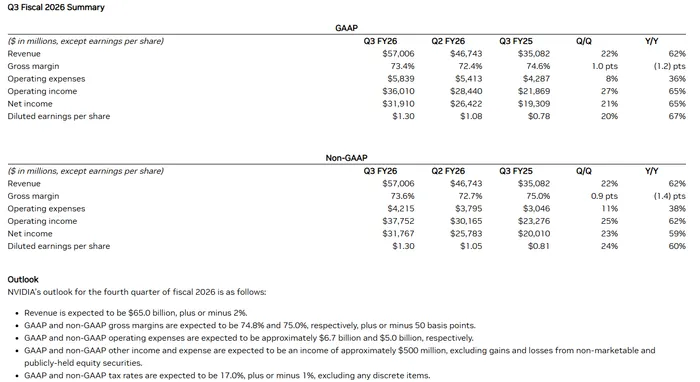
Looking ahead, Nvidia forecasted fourth-quarter revenue at $65 billion, plus or minus 2%, alleviating fears of an AI spending slowdown. This guidance boosted investor confidence, with shares rising over 5% in after-hours trading. Bloomberg noted that the results soothed concerns about an AI bubble, as sustained demand from hyperscalers like Microsoft and Google drives chip sales. However, Reuters pointed out lingering doubts, with Nvidia's stock down 7.9% in November 2025 amid broader market dips.
Historically, Nvidia's revenue has skyrocketed from $60.9 billion in fiscal 2024 to $130.5 billion in fiscal 2025, with net income tripling. The Wall Street Journal reports the stock trades at about 28.5 times forward earnings, a premium but justified by growth prospects. Analysts on WSJ maintain a consensus buy rating, with a median price target of $235.
Investment Pros, Cons, and Strategies
Pros of investing in Nvidia include its leadership in AI, where GPUs like the H100 and Blackwell series are sold out through 2025. The company's diversification into automotive (Drive platform) and gaming (GeForce) provides multiple revenue streams. Citi analysts see further upside, raising their price target to $210 based on AI momentum.
Cons involve high valuation risks; a January 2025 dip erased $600 billion in market cap due to AI competition concerns. Regulatory issues, such as U.S. antitrust probes and China export restrictions, pose threats. MarketWatch notes only one analyst has a sell rating, but volatility is evident from past corrections averaging 16.7%.
According to Bloomberg , for investors, consider dollar-cost averaging to buy during dips. Long-term holders benefit from Nvidia's innovation edge, but monitor earnings for AI spending trends.
Frequently Asked Questions (FAQ)

Q: What drives Nvidia's stock price?
A: Primarily AI demand for data center chips, but also gaming and professional visualization segments. Recent earnings show data centers accounting for the majority of revenue.
Q: Is Nvidia a good long-term investment?
A: Yes, for growth-focused portfolios, given its market dominance and historical returns. However, its premium P/E ratio means it's sensitive to economic shifts.
Q: Does Nvidia pay dividends?
A: Nvidia pays a small quarterly dividend, but it's not a primary yield stock; focus on capital gains instead.
Q: What are the risks of investing in Nvidia?
A: Geopolitical tensions (e.g., U.S.-China trade), competition, and potential AI hype deflation. The stock has experienced significant drawdowns.
Q: How can I buy Nvidia stock?
A: Through a brokerage account on exchanges like Nasdaq. Use tools like TradingView for charts and analysis.

The AInvest News Editorial Team consists of experienced financial journalists and editors who oversee all published content. While our newsroom leverages advanced AI tools to assist in data gathering and draft generation, every article is reviewed, fact-checked, and approved by human editors to ensure accuracy, clarity, and transparency.
Latest Articles
Stay ahead of the market.
Get curated U.S. market news, insights and key dates delivered to your inbox.
AInvest
PRO
AInvest
PRO



Comments
No comments yet