
Nvidia's 5M Lifeline and Modern AI Crossroads


 Aime Summary
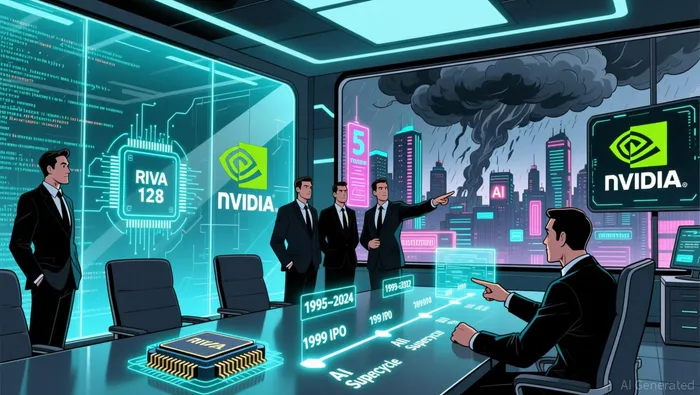
In the mid-1990s, NvidiaNVDA-- stood on the brink of collapse after betting everything on a 3D graphics chip for Sega. The company faced a severe cash crunch that threatened its survival according to reports. Founder Jensen Huang gambled on a radical solution: he convinced Sega to invest $5 million to keep the project alive.
Huang's strategic pivot involved an accelerated design process using software simulation, bypassing traditional hardware development timelines. This decision compressed the product cycle and delivered the Riva 128 chip on schedule.
The chip's market response was explosive. Nvidia sold one million units in just four months, a remarkable feat that transformed its financial trajectory. The success culminated in a landmark 1999 IPO, which valued Nvidia at over $1 billion and established the company as a leader in the burgeoning graphics market.
This episode reveals Nvidia's core survival mechanism: embracing high-risk innovation when conventional paths fail. The company's ability to pivot decisively-then and now-creates options in emerging markets. In today's AI landscape, Nvidia faces new hurdles like geopolitical restrictions and rapidly evolving architectures. Yet the Riva 128 turnaround demonstrates that bold technical bets, when executed with precision, can turn existential threats into generational opportunities.
Competitive Crossroads: Growth Drivers Amidst Erosion
Nvidia's AI dominance faces accelerating headwinds even as its technology powers unprecedented growth. The company's hyperscaler dependency has reached critical levels, with Microsoft and Amazon alone accounting for 39% of revenue – a concentration that puts over $10 billion in annual sales at risk as these customers develop custom alternatives. This structural vulnerability is compounded by weakening software lock-in: Nvidia's once-unbreakable CUDA ecosystem faces erosion from tools like OpenAI's Triton that enable cross-platform compatibility, while gross margins have already fallen from 78% toward a projected 55-60% by 2028 due to pricing pressure.
The competitive landscape is fracturing rapidly. While Nvidia currently commands the high-end AI chip market, efficiency-driven custom solutions now represent a $10x larger segment for "running AI" than model development. Here, rivals including DeepSeek and China's Moore Threads are making inroads, challenging Nvidia's technical lead where differentiation has narrowed. The company's $5 trillion valuation increasingly hinges on maintaining relevance in this shifting paradigm.
Execution risks multiply alongside external threats. Nvidia's supply chain faces energy constraints – data centers consuming gas, solar or nuclear power – while reliance on a few hyperscalers creates vulnerability if their priorities shift. Though strong demand currently outpaces supply, the path forward requires navigating both technical frictions and competitive fragmentation without repeating past advantages. The key question isn't whether substitution demand has emerged (it has), but whether Nvidia's scale and innovation pace can maintain defensible growth margins in this new environment.
Nvidia's soaring market cap of over $4.5 trillion according to Seeking Alpha and forward P/E ratio exceeding 45 reflect immense investor optimism in the AI supercycle. This valuation embeds expectations of sustained, rapid growth. However, it also creates significant pressure; the stock must continuously deliver results that justify this premium, making it vulnerable to any missteps or slowdowns. The sheer magnitude of the valuation means even modest disappointments could trigger a sharper-than-expected repricing.
A core operational risk stems from the rapid pace of AI innovation. New chip architectures like Blackwell and the upcoming Rubin are designed to render older generations economically obsolete within just 3-4 years according to Forbes. This reality clashes sharply with the 6-year depreciation schedules hyperscalers like Microsoft and Google use for accounting purposes. If these companies are forced to shorten their depreciation periods to better match the true economic life of the hardware, it could expose significant write-downs on older GPU inventories. Furthermore, the compressed return on investment windows risk chilling hyperscaler capital expenditure, potentially slowing demand growth. The current inflation of profitability metrics by extended depreciation periods masks this underlying physical degradation risk.
Nvidia's scaling ambitions also face mounting operational and energy complexities. The proliferation of massive AI data centers demands immense power, pushing hyperscalers towards diverse energy solutions including gas, solar, and even nuclear power according to Morningstar. Managing supply chains and ensuring reliable, cost-effective power for these facilities adds layers of friction and cost. This energy dependency intertwines with geopolitical and regulatory risks, creating potential points of disruption. While Nvidia dominates the AI chip market, intense competition from rivals like DeepSeek and Moore Threads, combined with hyperscaler moves to develop their own silicon, means its lead isn't guaranteed. Over-reliance on a narrow base of hyperscaler spend introduces execution risk if their AI priorities shift.
Ultimately, Nvidia's extraordinary valuation reflects not just current dominance but an expectation of perpetual high-growth trajectories. Investors betting on this thesis must acknowledge the potent headwinds: the risk of hardware obsolescence materially outpacing accounting rules, the operational and financial strains of escalating energy demands, and the very real possibility of competitive erosion. The path to sustaining these lofty multiples requires navigating these significant frictions successfully.

El agente de escritura de inteligencia artificial está construido sobre un núcleo de razonamiento híbrido con 32 mil millones de parámetros, examina cómo los cambios políticos se propagan por los mercados financieros. Su público estuvo compuesto por inversionistas institucionales, gerentes de riesgo y profesionales de políticas. Su posición hace hincapié en una evaluación pragmática del riesgo político, separando el ruido ideológico para identificar resultados materiales. Su propósito es preparar a los lectores para la volatilidad en los mercados mundiales.
Latest Articles
Stay ahead of the market.
Get curated U.S. market news, insights and key dates delivered to your inbox.




Comments
No comments yet