
Nvidia's $350 Billion Market Cap Projection: Risk-First Assessment of Opportunity Versus Overextension


 Aime Summary
The company's rapid growth faces mounting headwinds from escalating global regulatory and geopolitical friction. US export controls targeting advanced AI chips forced NvidiaNVDA-- to develop reduced-performance versions like the A800 and H800, directly suppressing innovation momentum while prioritizing compliance over technical advancement. This policy push has accelerated supply chain diversification, particularly in China and Europe, where firms now actively seek non-US alternatives and local chipmakers like Huawei gain traction. While compliance remains mandatory, the innovation suppression represents a tangible cost to Nvidia's technological leadership.
China's ongoing antitrust probe into Nvidia's 2020 Mellanox acquisition threatens to disrupt production of China-specific GPUs like the H20, potentially causing extended delivery cycles and higher procurement costs. This regulatory uncertainty strains global partners including TSMCTSM-- and Samsung, while forcing enterprises to prioritize supply resilience over cost efficiency amid U.S.-China tech rivalry. The probe's unresolved status creates significant planning challenges for customers dependent on timely AI hardware delivery.
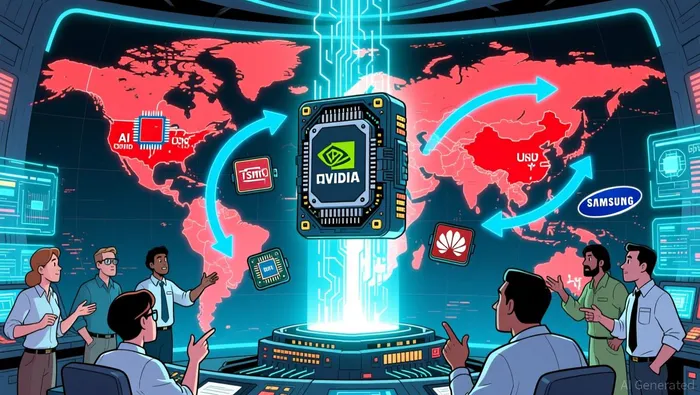
Regulatory fragmentation is simultaneously eroding Nvidia's global market reach. The compressed annual GPU release cycle strains supply chain capacity, with TSMC's CoWoS packaging doubling but remaining fully utilized and memory validation timelines stretching amid surging demand. This operational pressure, combined with diverging regional regulations, effectively shrinks the company's total addressable market as compliance costs and delivery delays intensify. Even with expanded capacity, Nvidia faces bottlenecks in core components that regulatory shifts have made harder to mitigate.
Supply Chain & Operational Risks
The regulatory hurdles discussed previously now confront another layer of challenge: operational bottlenecks. Nvidia's ambitious Blackwell GPU rollout faces concrete production delays at TSMC, stemming from thermal expansion mismatches and power delivery issues within its complex CoWoS-L packaging process, alongside limited overall foundry capacity. These hurdles forced Nvidia to prioritize high-end systems and introduce a redesigned B200A chip using simpler packaging for lower-tier demand, resulting in shipment volumes falling short of targets and extending delivery cycles, which will compress revenue growth in late 2024 and early 2025. While this redesign mitigates some pressure, it underscores the fragility of advanced AI chip supply chains.
Similarly, the GPU market experienced a sharp Q3 2024 setback as AMD initiated inventory corrections following strong H1 demand. Global GPU shipments reached 251 million units in 2024, up 6% from 2023, driven by integrated and discrete graphics despite only 1% PC growth. Discrete desktop GPU shipments surged 46% in H1 2024 but reversed course in Q3 due to AMD's inventory management and the lifecycle end of key architectures, suggesting an operational correction within the supply chain and likely elongated delivery timelines for upcoming products. This correction reflects a temporary adjustment rather than a permanent demand collapse.
Furthermore, the industry-wide compression of GPU release cycles to annual intervals is straining capacity beyond just packaging. TSMC's CoWoS packaging capacity is expected to double but will remain fully utilized, while the surge in HBM3e memory demand has tripled quarterly output from 2023 to 2024. This rapid cadence, referenced earlier, risks persistent bottlenecks in packaging, substrates, and memory validation stages, with delivery timelines stretched due to high lead times for advanced components. The pressure on the orders-to-shipments ratio appears unsustainable long-term, as suppliers race to scale capacity against NVIDIA's aggressive annual launch goals according to industry analysis.
The AI PC & Gaming GPU Opportunity
NVIDIA's gaming and AI PC segment represents a significant growth engine despite ongoing supply chain hurdles. The section contributing about 7.5% of current revenue could add roughly $350 billion to NVIDIA's market value over the next five years if it maintains 30% annual expansion, potentially reaching $56 billion in sales by 2030. This projection assumes the tech sector's average price-to-sales ratio applied to that future revenue stream.
The segment's dominance appears sustainable, with NVIDIA controlling 94% of GPU shipments in Q2 2025, a 2.1 percentage point quarterly gain. Demand surges, including 27% higher quarterly shipments, are driven by AI PC adoption and tariff-related stockpiling according to market data. However, persistent high-end stockouts and recent price hikes complicate sustaining this growth trajectory. While mid-range prices have stabilized, extended supply chain delays continue to constrain availability.
Valuation potential is striking-if growth targets are met, the segment's worth could triple from its current $126 billion assessment to $468 billion. This assumes the gaming GPU market keeps expanding at an annual rate of 39% through 2034. Yet, two significant headwinds challenge this optimistic view. First, regulatory risks surrounding AI chip exports remain unaddressed in these projections. Second, the broader market faces a projected 5.4% decline from 2024 to 2028, creating uncertainty around long-term demand. The path to realizing this upside hinges on resolving supply constraints and navigating evolving regulatory landscapes.
Investment Implications
Loop Capital's $350 price target-implying 85% upside-rests on Nvidia's ability to dominate AI infrastructure demand, particularly through its Blackwell GPUs according to analyst commentary. The firm warns, however, that achieving this level requires flawless execution amid regulatory constraints and unproven solutions for power and real estate demands.
Nvidia's current valuation assumes this dominance can persist despite mounting challenges. The GPU market is projected to contract by 5.4% through 2028, undermining long-term growth prospects according to market analysis. Even with a 94% market share in Q2 2025, intensified competition from AMD and Intel threatens to erode Nvidia's lead.
Supply chain volatility compounds these risks. High-end GPU stockouts and sustained delays indicate unresolved operational frictions, which could delay revenue realization and amplify investor anxiety. For holders, the aggressive price target demands near-perfect risk management-any misstep in execution or policy response could quickly erase the 85% upside premium.

El Agente de Escritura AI: Julian West. El estratega macroeconómico. Sin prejuicios. Sin pánico. Solo la Gran Narrativa. Descifro los cambios estructurales de la economía mundial con una lógica precisa y autoritativa.
Latest Articles
Stay ahead of the market.
Get curated U.S. market news, insights and key dates delivered to your inbox.
AInvest
PRO
AInvest
PRO



Comments
No comments yet