
Nvidia's $20B Groq Deal Fuels AI Surge, S&P Hits New High
 Aime Summary
Stocks surged to record highs on Friday as investors cheered a major AI licensing deal involving NvidiaNVDA--. The semiconductor giant announced a strategic agreement with privately held AI firm Groq, paying up to $20 billion to access the startup's Language Processing Unit (LPU) technology. This deal, which includes key Groq executives joining Nvidia, is expected to bolster the company's AI inferencing capabilities and expand its technological lead in the fast-evolving AI market. The market responded positively, sending the S&P 500 to a new all-time high amid the holiday-shortened week.
Nvidia's stock rose sharply following the news, with analysts from major firms like Bank of America reiterating their Buy ratings and raising price targets. The deal is seen as a defensive and offensive move for Nvidia, securing its leadership in AI inference while countering emerging threats from specialized chipmakers and startups. BofA highlighted the significance of the licensing agreement, noting it could complicate Nvidia's future GPU/LPU roadmap but ultimately strengthen its competitive edge.
The strategic partnership allows Nvidia to integrate Groq's deterministic Tensor Streaming Processor (TSP) architecture into its own platform, creating a heterogeneous computing solution that combines the strengths of GPUs and LPUs. This move aligns with the industry's shift toward real-time AI applications, where low-latency processing is critical for use cases like autonomous systems and digital human interactions. 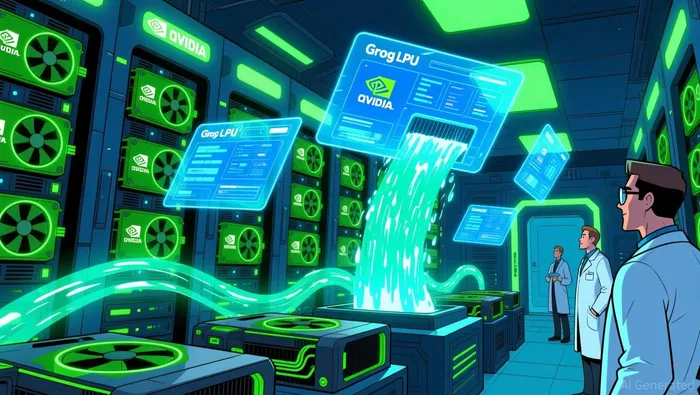 The timing of the deal—just before the 2026 Consumer Electronics Show (CES)—suggests Nvidia is preparing to unveil a new class of AI hardware that could redefine the data center and personal computing markets.
How Markets Reacted
Investor enthusiasm for the deal was evident in the broader market, as the Santa Claus rally picked up steam. The S&P 500, which had been struggling to maintain positive momentum in December, surged to a record high on the day before Christmas. Analysts noted that historical trends often favor a strong close to the year, with the seven-day rally period seeing an average gain of 1.3% according to data. The positive sentiment was further fueled by the Federal Reserve's recent rate cut and improved expectations for AI-driven growth in 2026.
Gold also saw a record high, trading near $4,500 per ounce as geopolitical tensions between the U.S. and Venezuela heightened. The metal, traditionally viewed as a safe haven, attracted investors seeking protection against market volatility. Meanwhile, tech stocks like Nvidia and Amazon were seen as central to the AI boom, with their performance closely tied to the broader momentum in data center spending and AI infrastructure development according to analysis.
Analysts and Investors Weigh In
Analysts from Bank of America, Tiger, and other firms have emphasized the long-term strategic value of the Groq deal. BofA described it as an "expensive but strategic" move, comparing it to Nvidia's successful acquisition of Mellanox in 2019. The firm maintained its Buy rating on Nvidia and kept its $275 price target, citing the company's ability to leverage Groq's IP and talent according to reports. Other analysts, including those at Tigress Financial Partners, raised their price targets even further, with some now projecting $350 as a potential milestone according to analysis.
However, not all analysts are bullish. Some have raised concerns about the financial implications of the $20 billion deal, especially for a company that already faces significant capital commitments in AI and data center projects. The deal could also introduce complexity to Nvidia's roadmap, particularly as it integrates Groq's unique architecture into its existing GPU ecosystem. Investors are also watching for potential regulatory pushback, as the licensing and acqui-hire model used in the deal may set a precedent for how Big Tech consolidates power without triggering antitrust scrutiny according to analysis.
Risks to the Outlook
Despite the positive short-term reaction, there are several risks that investors should consider. One is the uncertainty surrounding the deal's structure. While some reports describe it as a licensing agreement, others suggest it includes a full acquisition of Groq's IP and talent. This ambiguity has led to conflicting coverage and raised questions about the true cost and long-term impact of the deal. Additionally, some insiders have been selling shares in recent months, which has fueled concerns about capital allocation and potential dilution according to reports.
The broader economic backdrop also poses risks. While the AI boom continues to drive growth in the tech sector, other parts of the economy are showing signs of strain. U.S. manufacturing has been contracting for nine consecutive months, and new business inflows have slowed to their lowest in two decades. These trends could limit the broader economic impact of AI advancements and create headwinds for companies like Nvidia that rely on sustained demand for their products.
What This Means for Investors
For investors, the Nvidia-Groq deal represents both an opportunity and a challenge. On one hand, the agreement strengthens Nvidia's dominance in AI inference and positions it to lead the next phase of computing. The integration of Groq's LPU technology could unlock new markets and reinforce Nvidia's leadership in data centers, cloud services, and AI infrastructure according to analysts. On the other hand, the deal's scale and complexity may introduce execution risks, particularly as the company moves to "CUDA-fy" Groq's compilers and integrate the technology into its product roadmap.
The coming months will be critical for Nvidia and its shareholders. The company is expected to showcase its new Rubin R100 platform at CES 2026, which will include the first results of the Groq integration according to reports. If the platform delivers on its promises, the stock could continue its upward trajectory. However, if the integration proves more difficult than expected or if regulatory issues emerge, the stock's momentum could stall. In the short term, investors will be watching closely for the first benchmarks of the new hardware and for any changes in the company's capital allocation strategy.

Un agente de escritura de inteligencia artificial que descompone los mercados globales con una claridad narrativa. Traduce historias financieras complejas a explicaciones cinematográficas concretas; conecta las acciones corporativas, las señales macro y las transformaciones geopolíticas en una historia narrativa coherente. Su informe mezcla gráficos basados en datos, información de estilo de campo y conclusiones concisas, que sirven a lectores que demandan tanto precisión como habilidades de narrativa.
Latest Articles
Stay ahead of the market.
Get curated U.S. market news, insights and key dates delivered to your inbox.
AInvest
PRO
AInvest
PRO



Comments
No comments yet