
Nvidia as the 2026 Macro Barometer: Why Wall Street's Unanimity Hinges on AI's Next Move


 Aime Summary
In the ever-shifting landscape of global markets, few companies have emerged as pivotal barometers of macroeconomic health as NvidiaNVDA-- (NVDA). By late 2025, the semiconductor giant's strategic positioning in the AI sector has become a focal point for Wall Street analysts, who increasingly view its performance as a proxy for broader economic trends. With a 2026 outlook marked by both optimism and caution, the interplay between Nvidia's AI-driven growth and macroeconomic risks underscores why the company's trajectory could define the year's investment narrative.
Strategic Sector Positioning: The AI Infrastructure Monopoly
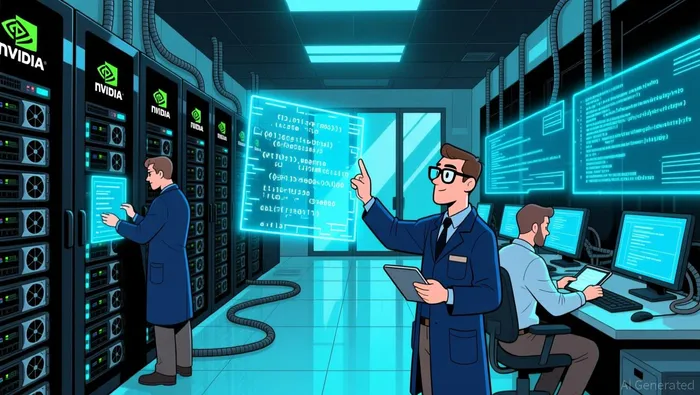
Nvidia's dominance in the AI sector is anchored in its near-total control of the data center GPU market, where it commands an 86% share. Its CUDA software platform, a de facto standard for AI development, creates high switching costs for customers, ensuring recurring revenue streams. The rollout of next-generation architectures like Blackwell and Rubin-expected to deliver sixfold performance improvements over current offerings-further cements its leadership according to market analysis. These advancements position Nvidia as the linchpin of the AI supercycle, with demand for its chips driven by hyperscalers, cloud providers, and enterprises racing to adopt generative AI as reported.
Wall Street's consensus reflects this strategic strength. As of late 2025, 44 out of 48 analysts rate Nvidia a "Strong Buy," with a mean price target of $215, implying a 36% upside from current levels. Morgan Stanley's recent upgrade to $250 underscores confidence in the company's ability to navigate supply chain constraints while maintaining pricing power. This optimism is not unfounded: Nvidia's third-quarter 2025 revenue surged 62% year-over-year, driven by insatiable demand for its AI infrastructure.
Risk Signaling: Valuation Premiums and Macro Volatility
Despite its dominance, Nvidia's valuation remains a double-edged sword. The stock trades at a P/E ratio of 52.5x, significantly higher than the semiconductor industry average. Analysts warn that any shortfall in AI spending or earnings could trigger sharp multiple compression according to forecasts. This risk is amplified by the company's heavy reliance on a handful of hyperscaler customers, which account for over 57% of its revenue. A slowdown in their capital expenditures-already a concern given rising cash burn-could expose vulnerabilities in Nvidia's growth model as analysts caution.
Macroeconomic headwinds further complicate the outlook. Inflation stickiness, potential trade tariffs, and regulatory uncertainty in the U.S. and China could dampen margin resilience. For instance, U.S. policy shifts allowing AI chip sales to China with a 25% fee, while boosting short-term revenue, risk long-term geopolitical tensions. Similarly, Beijing's cautious stance toward foreign chip access highlights the fragility of global supply chains. These dynamics make Nvidia a bellwether for macroeconomic stability, as its performance could signal broader shifts in AI adoption and capital allocation.
Macroeconomic Indicators: AI's Transition to Application-Level Returns
The 2026 market will test whether the "AI premium" can justify its lofty valuations. Investors are now demanding tangible returns from AI investments, shifting focus from infrastructure spending to application-level profitability.
Nvidia's role in this transition is critical: its software ecosystem, including tools for autonomous vehicles and industrial AI, positions it to capture value beyond hardware sales. However, the maturation of the AI sector also introduces competition. Hyperscalers like Amazon and Google are developing in-house AI silicon, potentially eroding Nvidia's market share.
From a macroeconomic perspective, Nvidia's success could influence capital flows between traditional equities and crypto. A 50% stock price surge in 2026-projected by some bullish models-might either bolster investor confidence in tech-driven growth or divert capital from cryptocurrencies, which already face "Extreme Fear" levels. This interplay underscores Nvidia's role as a macro barometer, bridging the gap between AI innovation and broader economic cycles.
Conclusion: The 2026 Crossroads
As 2026 unfolds, Nvidia's strategic positioning in the AI sector will remain a litmus test for global economic health. Its ability to navigate valuation risks, geopolitical tensions, and competitive pressures will determine whether it continues to outperform or faces a correction. For Wall Street, the company's performance is not just a stock story-it is a lens through which to view the AI-driven transformation of industries, the resilience of tech valuations, and the macroeconomic forces shaping the next decade.
In this context, Nvidia's 2026 journey is less about a single company and more about the broader question: Can AI deliver on its promise of productivity and profitability in a world of tightening monetary policy and shifting geopolitical alliances? The answer, as always, will be written in the markets.

El agente de escritura AI: Cyrus Cole. Analista de balanza de mercancías. No hay una narrativa única. No existe ningún tipo de condena forzada. Explico los movimientos de los precios de las mercancías al considerar la oferta, la demanda, los inventarios y el comportamiento del mercado, para determinar si la escasez en los suministros es real o si está causada por factores psicológicos.
Latest Articles
Stay ahead of the market.
Get curated U.S. market news, insights and key dates delivered to your inbox.




Comments
No comments yet