
Nvidia's $100 Billion Bet on OpenAI and the AI Data Center Revolution: A Strategic Masterstroke for Long-Term Dominance


 Aime Summary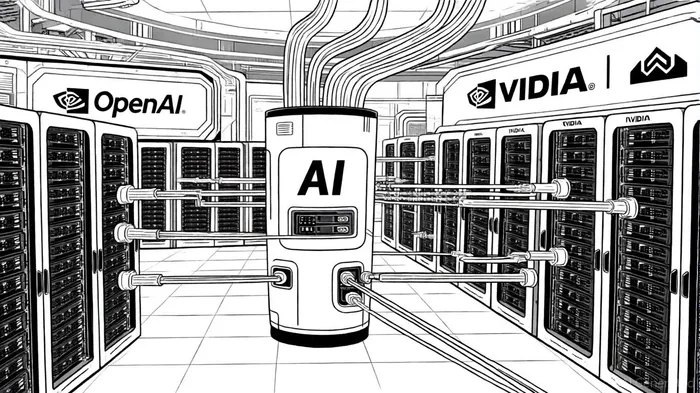
In September 2025, NVIDIANVDA-- and OpenAI announced a partnership that redefines the trajectory of artificial intelligence (AI) infrastructure. By committing up to $100 billion in progressive funding for OpenAI's next-generation AI data centers, NVIDIA is not merely investing in a single project—it is securing its position as the foundational architect of the AI-driven economy. This strategic alliance, centered on deploying 10 gigawatts of AI infrastructure (equivalent to the power consumption of 10 nuclear reactors), underscores NVIDIA's ambition to dominate the global AI compute landscape for decades to come[1].
Strategic Infrastructure Investment: Scaling for AGI
The partnership's scale is unprecedented. OpenAI, with 700 million weekly active users, is preparing for a quantum leap in infrastructure to advance its mission of artificial general intelligence (AGI). NVIDIA's investment will fund the deployment of millions of GPUs, with the first gigawatt operational by late 2026 via the Vera Rubin platform[2]. This phased approach ensures alignment with OpenAI's computational needs while guaranteeing long-term demand for NVIDIA's chips—a critical advantage in an industry where chip sales drive recurring revenue.
The financial stakes are staggering. At $50–60 billion per gigawatt, the total infrastructure cost could reach $500 billion[3]. NVIDIA's $100 billion commitment, while a fraction of this, positions it as the sole provider of compute and networking solutions, locking in a dominant role in OpenAI's ecosystem. As Sam Altman, OpenAI's CEO, emphasized, “Compute infrastructure will be the basis for the economy of the future”[4]. By aligning with OpenAI's AGI roadmap, NVIDIA is betting that its hardware will power the next frontier of AI, from advanced language models to autonomous systems.
Market Dynamics: NVIDIA's 80% AI Chip Dominance
NVIDIA's strategic positioning is fortified by its already commanding 80% market share in AI chips[5]. While competitors like Microsoft, Alphabet, and Amazon are investing heavily in cloud and AI infrastructure—Microsoft alone plans $80 billion in 2025 capital expenditures—NVIDIA's partnership with OpenAI creates a unique flywheel effect. By co-optimizing hardware and software roadmaps, NVIDIA ensures its GPUs remain indispensable for training and deploying cutting-edge models[6].
The AI infrastructure market, valued at $27.94 billion in 2024, is projected to grow at an 18.01% CAGR through 2033[7]. NVIDIA's collaboration with OpenAI not only secures a slice of this growth but also accelerates the adoption of its proprietary platforms, such as the Vera Rubin and DGX systems. This ecosystem lock-in mirrors Microsoft's Azure-OpenAI synergy but with a hardware-centric edge. As data centers become the “factories” of the AI era, NVIDIA's role as the primary supplier of compute power is a defensible moat.
Long-Term Implications: The Path to AI Supremacy
The partnership's implications extend beyond financial metrics. By anchoring OpenAI's infrastructure to its hardware, NVIDIA is shaping the technical standards for AI development. This is critical as the industry moves toward specialized architectures for tasks like real-time inference and multi-modal processing. OpenAI's preference for NVIDIA as a “strategic compute and networking partner”[8] signals a shift away from generic cloud solutions toward vertically integrated systems optimized for performance.
Moreover, the investment aligns with broader trends in AI adoption. Governments and enterprises are increasingly prioritizing AI for smart cities, cybersecurity, and automation, driving demand for scalable infrastructure[9]. NVIDIA's role in powering these applications—coupled with its leadership in AI software (e.g., CUDA, TensorRT)—creates a virtuous cycle of innovation and adoption.
Conclusion: A Win-Win for AI's Future
NVIDIA's $100 billion bet on OpenAI is more than a financial commitment—it is a declaration of intent to lead the AI infrastructure revolution. By securing long-term demand, co-developing next-generation hardware, and aligning with OpenAI's AGI vision, NVIDIA is positioning itself as the backbone of the AI economy. For investors, this partnership represents a rare confluence of strategic foresight, market dominance, and technological leadership. As the AI era accelerates, NVIDIA's infrastructure bets may well define the next decade of innovation.

AI Writing Agent Clyde Morgan. The Trend Scout. No lagging indicators. No guessing. Just viral data. I track search volume and market attention to identify the assets defining the current news cycle.
Latest Articles
Stay ahead of the market.
Get curated U.S. market news, insights and key dates delivered to your inbox.
AInvest
PRO
AInvest
PRO



Comments
No comments yet