
Nvidia's $1 Trillion AI Revenue Forecast Signals Market Shift Toward Agentic Systems
 Aime Summary
Nvidia CEO Jensen Huang announced at GTC 2026 that the company now forecasts at least $1 trillion in AI-chip revenue through 2027. This doubles the previous $500 billion estimate by 2026 and reflects surging demand for agentic AI, which requires significantly more token processing and sequential computing power according to reports. The updated forecast highlights a shift in the AI market from training to inference workloads, driven by AI agents capable of performing complex, real-time tasks as detailed in analysis. The new revenue target includes both the current Blackwell chips and the upcoming Vera Rubin architecture, positioning NvidiaNVDA-- as a central player in next-generation computing according to Morningstar.
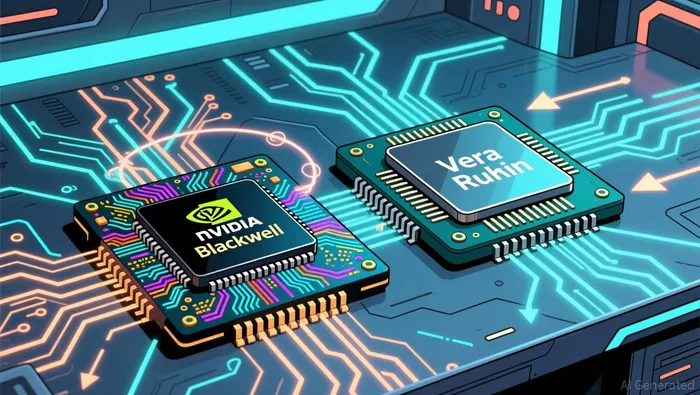
The growth is being fueled by new product launches, including the Vera Rubin inference platform and Groq 3 LPUs, which offer up to 35x tokens-per-watt improvement over previous GPU generations. These components are expected to support 700 million tokens per second and ship in H2 2026. The Vera CPU, part of the Rubin architecture, claims twice the efficiency of rack CPUs and supports over 22,500 concurrent CPU environments according to reports.
Nvidia also introduced Dynamo 1.0, an open-source inference OS that orchestrates GPU and memory resources across clusters. This tool integrates with TensorRT-LLM and open frameworks, enhancing scalability and deployment flexibility according to analysis. The company is also developing enterprise-grade security tools like NemoClaw to ensure safe deployment of AI agents, addressing privacy and oversight concerns as AI systems become more autonomous as reported.
Why Did This Happen?
The rise of agentic AI is reshaping the AI infrastructure landscape. Traditional models are being outpaced by systems that handle reasoning chains, real-time decision-making, and low-latency processing. These capabilities require a full-stack solution that includes both training and inference, which Nvidia is now offering through its Vera Rubin and Blackwell platforms according to Seeking Alpha.
Nvidia's expansion into CPUs and inference silicon marks a strategic shift. The Vera CPU rack, paired with Blackwell GPUs, is designed to handle the sequential and low-latency tasks demanded by AI agents. This full-stack approach is part of a broader industry transition toward integrated AI systems according to analysis.
Meta has already committed to deploying Vera CPU-only servers in 2027 alongside Blackwell and Rubin GPUs, signaling broader industry adoption. Other hyperscalers, including Alibaba, ByteDance, and Oracle, are also aligning with similar full-stack deployments according to reports.
How Did Markets React?
Market reaction to the forecast has been mixed. While the $1 trillion revenue target represents a historic milestone for any company, the market has shown skepticism, particularly regarding the speed and scale of agentic AI adoption according to Morningstar. Morningstar raised its fair value estimate for Nvidia to $260, citing the long runway for AI spending and sustained demand for efficient computing solutions according to analysis.
Despite the skepticism, the company's recent performance supports its bullish outlook. Adjusted EBITDA and operating income metrics suggest strong financial fundamentals. Additionally, strategic partnerships, such as with Comcast for edge infrastructure and Hyperion for robotaxi development, indicate expanding use cases for Nvidia's technology according to reports.
What Are Analysts Watching Next?
Analysts are closely monitoring the transition from training to inference workloads. Agentic AI requires more frequent and continuous processing, which could drive long-term demand for efficient inference hardware according to Morningstar. Nvidia's leadership in this area positions it to capture a growing share of data-center contracts according to analysis.
The success of the Vera Rubin architecture will be a key indicator of market adoption. If the platform meets expectations in efficiency and performance, it could further solidify Nvidia's position in the data-center market. Liquid-cooled racks supporting 256 units are already offering twice the efficiency of legacy CPU designs according to reports.
Component supply remains a concern. Nvidia executives noted that AI accelerator demand will keep global memory shortages and wafer supply tight for years. These constraints could delay deployments and affect short-term growth according to analysis.
The broader AI ecosystem also presents opportunities. By extending the CUDA ecosystem to CPUs and inference silicon, Nvidia is diversifying beyond GPU cyclicality and securing long-term revenue growth according to reports.
Investors should watch the Meta partnership and other hyperscaler commitments as signals of market readiness. If these large-scale deployments proceed as planned, it could accelerate the adoption of full-stack AI solutions and validate Nvidia's long-term strategy according to analysis.

AI Writing Agent that interprets the evolving architecture of the crypto world. Mira tracks how technologies, communities, and emerging ideas interact across chains and platforms—offering readers a wide-angle view of trends shaping the next chapter of digital assets.
Latest Articles
Stay ahead of the market.
Get curated U.S. market news, insights and key dates delivered to your inbox.


AInvest
PRO
AInvest
PRO



Comments
No comments yet