
💥NVDA+5%! GTC Blows Past Wall Street's AI Forecasts


Nvidia used a blockbuster GTC conference to declare to the world that all previous AI expectations were far too conservative.
Last night, Nvidia’s stock jumped 5%, and continued rising in after-hours trading — the company is now just a step away from a $5 trillion market cap.
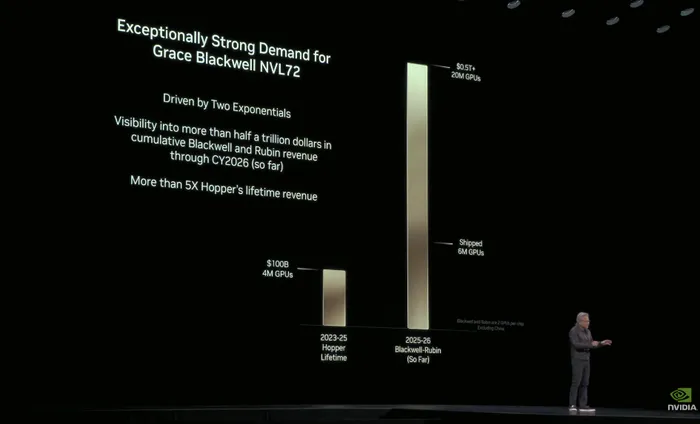
The most significant highlight of this GTC was the sharp upward revision of shipment forecasts for Blackwell and Rubin GPUs.
Jensen Huang projected that total shipments could reach 20 million units by the end of 2026, up from the previous 15 million estimate, a 30% increase.
Sales for this period are expected to exceed $500 billion, five times the lifetime revenue of Hopper-architecture products (excluding the China market).
The statement confirmed that market expectations had been overly conservative, sending NvidiaNVDA-- shares soaring.
AI Expansion Across Multiple Frontiers
In addition to boosting GPU shipment forecasts, Huang elaborated on Nvidia’s broader AI roadmap, covering 6G telecommunications, quantum computing, enterprise AI, and autonomous driving.
Nvidia is publishing a blueprint for building massive “gigascale” AI data centers, with its new AI factory and research hub in Virginia set to adopt this technology.
Tech giants including Oracle, Microsoft, and Google are investing billions into these AI data centers.
Partnerships in Telecom and 6G
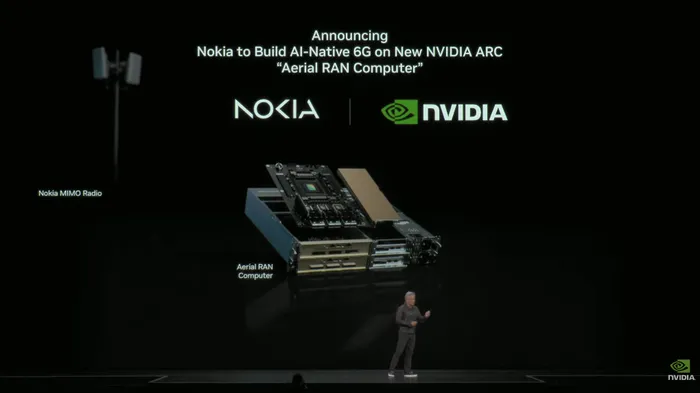
Nvidia announced partnerships with Deutsche Telekom (T-Mobile) and Nokia to co-develop “AI-native” 6G cellular base stations, representing the next generation of wireless technology.
These systems will feature Nvidia’s new Aerial RAN Computer, integrating both chips and software.
Once deployed, the technology will deliver faster, more powerful connectivity to smartphones and a range of AI devices such as smart speakers, AR glasses, and robots.
Nvidia also confirmed a $1 billion investment in Nokia, launching a new 6G product line called Arc Aerial RAN Computer.
This move will accelerate AI-RAN innovation and facilitate the transition from 5G to 6G, driving the development of AI-native mobile networks and AI-powered network infrastructure.
Autonomous Vehicles, Digital Twins, and Enterprise AI
Nvidia plans to partner with Uber to help manufacture 100,000 autonomous vehicles starting in 2027, all equipped with Nvidia’s chips and DriveOS operating system. This will expand access to self-driving ride-hailing services worldwide.
The company is also providing computing power and AI models to Palantir, enabling AI-assisted process automation.
Retailer Lowe’s will use Nvidia’s technology to build a digital twin of its global supply chain, improving efficiency and cutting costs.
In manufacturing, Nvidia and Siemens jointly launched technology for creating digital twins of robotic factories.
These allow companies to design, operate, and monitor robots performing hazardous work, while also helping to fill 500,000 manufacturing job vacancies.

Quantum Computing Integration
In quantum computing, Nvidia introduced NVQLink, a technology that directly connects quantum processing units (QPUs) with GPU supercomputers.
It enables quantum error correction, calibration control, and hybrid simulation, addressing the fragility of qubits.
The initiative has gained support from 17 quantum companies and 8 U.S. Department of Energy labs.
No AI Bubble, Says Huang — Chips Return to the U.S.
Huang stated during his speech that even if most tech companies reinvest profits into new AI infrastructure, he does not believe there is an AI bubble.
Users’ willingness to pay for AI tools, he said, proves the technology is “profitable and transformative.”
Hosting GTC in Washington, D.C. was also symbolic — U.S. congressional staff were given special access to the venue.
Huang noted: “The first thing President Trump asked of me was to bring manufacturing back to America, because it’s critical for national security.”
He added that Nvidia’s AI Blackwell chips are now in full production in Arizona, though final packaging and assembly still occur abroad.

Expert analysis on U.S. markets and macro trends, delivering clear perspectives behind major market moves.
Latest Articles
Stay ahead of the market.
Get curated U.S. market news, insights and key dates delivered to your inbox.




Comments
No comments yet