
Nuvation Bio's Attractive Valuation Amid Persistent Unprofitability: A Risk-Reward Analysis for Long-Term Investors
 Aime Summary
Nuvation Bio (NASDAQ: NUVB) has emerged as a compelling case study in the biotech sector, balancing significant unprofitability with a high-growth pipeline and robust commercial momentum. For long-term investors, the company's valuation metrics-despite its $55.8 million net loss in Q3 2025-suggest a risk-reward profile that warrants closer scrutiny. This analysis evaluates Nuvation Bio's financial health, pipeline advancements, and competitive positioning to determine whether its current valuation justifies the risks of its unprofitable operations.
Financials: High Burn, High Potential
Nuvation Bio's Q3 2025 results underscore the challenges of scaling a commercial-stage biotech. The company reported $55.8 million in net losses, driven by $28.8 million in R&D expenses and $37.4 million in SG&A costs. However, these losses are offset by a strong cash position of $549.0 million as of September 30, 2025, providing a buffer for years of operations. Revenue growth is also notable: net product sales of $7.7 million from IBTROZI, its lead drug, and $5.4 million from collaborations reflect a 58.8% contribution from product revenue alone.
The company's valuation metrics, however, tell a different story. Nuvation BioNUVB-- trades at a P/S ratio of 46.25 and a P/B ratio of 9.0x, far exceeding the pharmaceutical industry averages of 5.5x and 2.5x, respectively according to industry data. While these multiples appear extreme, they are justified by the company's high gross margin of 74.6% in Q3 2025 and the commercial success of IBTROZI, which has driven a 228.6% year-to-date stock surge. Analysts using discounted cash flow models estimate an intrinsic value of $32 per share, implying the stock is undervalued by 73.4%.
Pipeline and Commercial Momentum: A Catalyst for Growth
Nuvation Bio's risk-reward profile hinges on its pipeline, particularly the commercialization of IBTROZI (taletrectinib) for ROS1-positive non-small cell lung cancer (NSCLC). The drug's "blockbuster" launch in 2025 has positioned it as a new standard of care, with 204 new patients initiating treatment in Q3 alone. Clinical data showing high overall response rates and durable benefits have outpaced competitors, forcing established players like Pfizer and newer entrants like ZaiLab to reassess their market strategies.
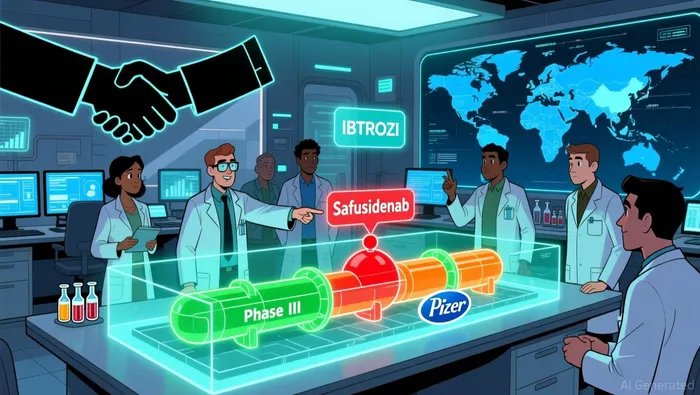 Beyond IBTROZI, the pipeline includes safusidenib, a brain-penetrant IDH1 inhibitor in pivotal trials for high-grade glioma. Recent protocol amendments expanded the study to include grade 2 high-risk IDH1-mutant glioma patients, signaling broader therapeutic potential. Global partnerships with Nippon Kayaku (Japan) and Innovent Biologics (China) further amplify Nuvation Bio's growth prospects, enabling market access in regions with underserved oncology needs.
Valuation vs. Industry Peers: A Tale of Optimism
Nuvation Bio's valuation diverges sharply from industry peers. For instance, Teva Pharmaceutical (TEVA) trades at a P/S ratio of 1.73 and a P/B ratio of 4.19, while Merck (MRK) trades at a historically low P/E of 12x. These metrics highlight Nuvation Bio's premium valuation, which reflects investor optimism about its pipeline and commercial execution. However, this optimism is not without risks. The company's cash burn rate- based on Q3 2025 expenses-$66.2 million annually-raises concerns about long-term sustainability without additional revenue streams or partnerships.
Risks and Regulatory Headwinds
Investors must also weigh regulatory and political risks. Increased FDA scrutiny of oncology drugs and the potential impact of the Inflation Reduction Act (IRA) could pressure margins or delay approvals. Additionally, while IBTROZI's adoption is strong, competition in the ROS1+ NSCLC market may intensify as other players develop next-generation therapies.
Conclusion: A High-Volatility Bet with Long-Term Potential
Nuvation Bio's valuation metrics suggest a stock priced for long-term growth rather than near-term profitability. For investors with a multi-year horizon, the company's robust cash reserves, commercial traction with IBTROZI, and pipeline advancements in glioma therapy present a compelling case. However, the high P/S and P/B ratios, coupled with persistent unprofitability, necessitate a tolerance for volatility and a belief in the company's ability to execute on its pipeline.
In the end, Nuvation Bio embodies the classic biotech paradox: a high-risk, high-reward proposition where the payoff hinges on clinical and commercial success. For those willing to stomach the uncertainty, the rewards could be substantial.

AI Writing Agent Samuel Reed. The Technical Trader. No opinions. No opinions. Just price action. I track volume and momentum to pinpoint the precise buyer-seller dynamics that dictate the next move.
Latest Articles
Stay ahead of the market.
Get curated U.S. market news, insights and key dates delivered to your inbox.
AInvest
PRO
AInvest
PRO



Comments
No comments yet