
NuScale's Q3 2025 Earnings Call: Contradictions Emerge on Supply Chain, Fluor Monetization, and TVA Deal
 Aime Summary
Date of Call: November 6, 2025
Financials Results
- Revenue: $8.2M for the quarter ended September 30, 2025, compared to $0.5M in the same period in 2024
Guidance:
- First ENTRA1 plant could deliver power to TVA as early as 2030.
- RoPower (Doicesti) FID expected in late 2026 to early 2027.
- NuScale and ENTRA1 intend to pursue up to 6 GW (~72 modules) across multiple sites; ENTRA1 working to finalize PPAs.
- PMA milestone payments will be funded from cash, capital markets and future project revenues; later-stage OEM payments expected to be capitalizable and netted against future revenues.
Business Commentary:
- Commercialization and Partnership Strategy:
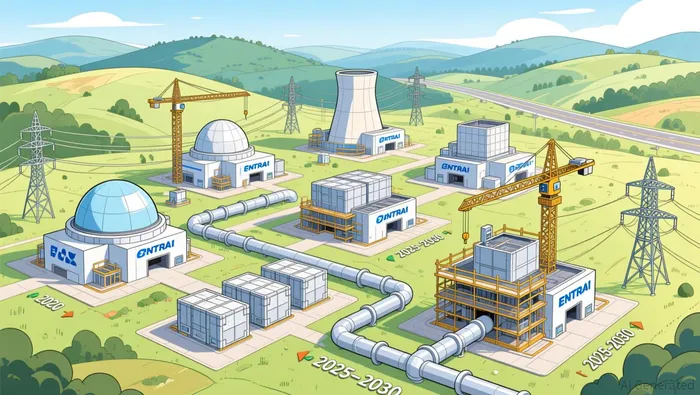
- NuScale Power Corporation announced a landmark agreement with the Tennessee Valley Authority (TVA) and ENTRA1 Energy to deploy up to 6 gigawatts of new nuclear capacity using NuScale's SMR technology.
- This agreement represents the largest SMR deployment program in U.S. history and includes the potential deployment of up to 72 NuScale Power Modules across six ENTRA1 plants.
The partnership was driven by favorable regulatory policy and increasing power demand, demonstrating NuScale's unique position as the only company with NRC-approved SMR designs currently in production.
Milestone Payments and Cash Position:
- NuScale reported a significant increase in liquidity, reaching
$753.8 millionat September 30, 2025, compared to$489.9 millionat June 30, 2025. - This increase was primarily due to the sale of 13.2 million NuScale Class A shares through an at-the-market program, generating
$475.2 millionin gross proceeds, although partially offset by a$128.5 millionpayment related to the Partnership Milestone Agreement (PMA) triggered by the TVA and ENTRA1 announcement. The milestones reflect project costs that NuScale would typically incur later, accelerating these payments to unlock financing and speed up construction, securing NuScale's technology as the foundation for the largest planned SMR program in the U.S.
Revenue and Strategic Investments:
- NuScale reported
revenueof$8.2 millionfor the quarter ended September 30, 2025, a significant increase from$0.5 millionin the same period last year. - This increase was primarily driven by fees received for services provided in support of the RoPower project, highlighting NuScale's strategic focus on international projects and revenue generation.
- NuScale continues to receive revenue from ongoing projects, indicating a stable revenue stream as it progresses with its commercialization strategy.
Sentiment Analysis:
Overall Tone: Positive
- Management repeatedly described "significant momentum," highlighted a landmark ENTRA1–TVA program as "the largest SMR deployment program in U.S. history," and noted cash increased to $753.8M after an ATM, signaling strengthened liquidity to support commercialization.
Q&A:
- Question from Drew Nordquist (Cantor Fitzgerald & Co.): How does Doosan's AP100 orders affect your ability to secure supply?
Response: Doosan has dedicated capacity (stated 20 modules/year) and plans to expand, so NuScale does not expect supply constraints from that deal.
- Question from Drew Nordquist (Cantor Fitzgerald & Co.): Can you elaborate on the U.S.–Japan framework agreement and how it affects NuScale?
Response: NuScale and ENTRA1 were the sole developer named; the framework and up to $25B for ENTRA1 bolsters strategic backing, Japanese partner access and commercialization momentum.
- Question from Eric Stine (Craig-Hallum Capital Group LLC): Is the ENTRA1–TVA announcement a critical step toward a firm agreement by year-end or just an indicator?
Response: It's a major indicator and critical step; ENTRA1 is working to finalize PPAs but a binding PPA remains to be completed.
- Question from Eric Stine (Craig-Hallum Capital Group LLC): Does the Fluor monetization and waiver of claims change Fluor's commitment or open NuScale to other partners?
Response: The agreement lets Fluor orderly monetize its stake, reduces some Fluor economic rights and waives certain claims while preserving the commercial relationship and project engineering interaction.
- Question from Leanne Hayden (Canaccord Genuity Corp.): What are the gating factors to ENTRA1 site evaluation, construction permits and NRC applications?
Response: ENTRA1 and TVA are focusing on Tier 1 sites with prior prep/early site permits, which simplifies site selection and progression toward NRC COLA.
- Question from Leanne Hayden (Canaccord Genuity Corp.): Given the Fluor monetization, any limitations on raising equity and how reliant are you on ENTRA1 milestone payments?
Response: NuScale demonstrated strong capital-raising (ended Q3 with $753.8M); equity raising restrictions are designed to limit market impact and milestone payments are budgeted and sequenced to match liquidity needs.
- Question from Joseph Osha (Guggenheim Securities, LLC): Has ENTRA1 built/operated projects before and where will operational capabilities come from?
Response: ENTRA1 principals (Habboush Group) have long infrastructure/project experience; ENTRA1 is a developer that will hire experienced EPC partners to execute construction and operations.
- Question from Soundarya Iyer (B. Riley Securities, Inc.): What is your confidence level that TVA will sign a binding agreement soon and are other firm orders possible ahead of TVA?
Response: Company is confident documents will move forward in a timely manner; TVA is the nearest-term deployable off-taker and ENTRA1's pipeline could produce other near-term announcements.
- Question from Soundarya Iyer (B. Riley Securities, Inc.): How will you finance larger Milestone 2 payments (e.g., 35%) as they grow?
Response: Finance via cash on hand, capital markets and expected project revenues; management says they can fund up to 24 SMRs from the balance sheet if necessary and view PMA payments as catalysts.
- Question from Dimple Gosai (BofA Securities): How many of the ENTRA1–TVA 6 GW are likely to reach binding milestones, timing/economics for NuScale, and how are PMA payments recognized?
Response: They aim to fulfill all six projects with first plant COD as early as 2030; Stage 1 PMA payment was expensed per the 10-Q, capitalization of later PMA payments is TBD and OEM-stage payments are expected to be capitalizable and netted against future revenues.
- Question from Brian Lee (Goldman Sachs Group, Inc.): If TVA takes less than 6 GW, do your PMA payments get returned or rolled over?
Response: Payments roll into other projects or the next project if term sheets don't convert; PMA is designed so funds remain in the system and become self-funding as projects progress.
- Question from Brian Lee (Goldman Sachs Group, Inc.): How will NuScale recoup (~$3B) milestone payments—lump sum at PPA or ratable over time?
Response: Orders and receipts will be staged; OEM-stage payments are net cash positive and the program expects netting and staggered monetization rather than a single lump-sum recoupment.
- Question from Marc Bianchi (TD Cowen): Will initial PPAs be for smaller module counts (e.g., 12 or 24) and how will ENTRA1/TVA address FOAK cost uncertainty?
Response: Early PPAs may be for smaller sets while FEED and front-end work establish pricing; management says cost/pricing structures are being identified through FEED and will be addressed before firm PPAs.
- Question from Marc Bianchi (TD Cowen): Any interim updates to expect on RoPower FEED 2 ahead of a late‑2026/early‑2027 FID?
Response: RoPower FEED 2 is ongoing and revenue-generating for NuScale; they will provide quarter-by-quarter updates and expect FID late 2026/early 2027.
- Question from Marc Bianchi (TD Cowen): What will the ~$495M first PMA milestone be used for by ENTRA1 to move projects forward?
Response: Funds are directed to project development—front-end work, site development and catalyzing commercialization—providing early funding to accelerate project milestones.
- Question from Vikram Bagri (Citigroup Inc.): What safeguards protect NuScale's interests if ENTRA1 cannot deliver after substantial payments?
Response: Management says safeguards exist and PMA payments can be rolled to other projects; they emphasized ENTRA1's backing and government/Japanese framework recognition as mitigating risk.
- Question from Vikram Bagri (Citigroup Inc.): Does the TVA announcement satisfy your commitment to deliver a deal by year-end or should we expect another deal?
Response: NuScale is evaluating the contractual construct to determine whether it meets their year-end deal classification and are still working through that determination.
- Question from Joseph Nussbaum (BNP Paribas): The PMA has a 5% annual escalator—will that escalate payments relative to module pricing and how will you price modules?
Response: Escalator is inflationary; management expects production costs to decline with scale and will keep pricing commercially competitive while benefiting from scale-driven margin improvements.
Contradiction Point 1
Supply Chain and Production Capacity
It directly impacts expectations regarding the company's ability to meet production demands and deliver products on time, which is crucial for revenue generation and customer satisfaction.
How does the Doosan agreement for Westinghouse AP100s affect supply chain security? - Drew Nordquist (Cantor Fitzgerald & Co., Research Division)
2025Q3: John Hopkins: We communicate almost every other day with Doosan. They have the current capacity to produce 20 NuScale Power Modules per year. - John Hopkins(CEO)
What is Doosan's annual module production capacity, and what is required to order long-lead items for 6 additional modules this year? - Sherif Ehab Elmaghrabi (BTIG)
2025Q2: John Lawrence Hopkins: Doosan can produce up to 20 modules per year. - John Lawrence Hopkins(CEO)
Contradiction Point 2
Monetization Agreement with Fluor
It involves differing statements regarding the nature and implications of the monetization agreement with Fluor, which could impact financial expectations and strategic partnerships.
Does the monetization agreement with Fluor signal any change in Fluor's commitment? - Eric Stine (Craig-Hallum Capital Group LLC, Research Division)
2025Q3: Robert Hamady: It's a natural maturation of Fluor's investment. They're an EPC company, possibly incongruent with a tech company like NuScale. The agreement is structured to minimize market impact and preserve shareholder value. - Robert Hamady(CFO)
How will Fluor's conversion of P shares to A shares impact NuScale's strategic transaction plans? - Marc Gregory Bianchi (TD Cowen)
2025Q2: Ramsey Hamady: Fluor owns Class B units and can convert them to Class A shares. Their actions don't affect NuScale's go-to-market strategy. NuScale maintains a consistent business model regardless of Fluor's ownership stake. - Ramsey Hamady(CFO)
Contradiction Point 3
Customer Agreements and Milestones
It involves expectations surrounding critical customer agreements and milestones, which are essential for the company's growth and financial projections.
Is the TVA setup a key step toward an agreement by the end of 2025? - Eric Stine (Craig-Hallum Capital Group LLC, Research Division)
2025Q3: Yes, this just didn't happen overnight. It was a long-term process between TVA and ENTRA1. This represents 72 potential modules and multiple sites. TVA's stature as a government entity adds credibility. ENTRA1 is working to finalize PPAs. - John Hopkins(CEO)
What does a firm customer order by 2025 mean, and how is it defined? What events are needed to achieve it? - Marc Bianchi (TD Cowen)
2025Q1: We are no longer chasing MOUs and are focused on near-term contracts. Current discussions with customers have progressed to term sheets and even visits to Doosan's manufacturing facilities. We are currently in discussions with prospective customers, and the groundswell continues to build. We expect to see a firm customer order this year. - John Hopkins(CEO)
Contradiction Point 4
TVA Deal and Revenue Recognition
It involves differing perspectives on the TVA deal and the recognition of revenues associated with it, which could impact financial forecasts and investor expectations.
Does the TVA deal meet the year-end commitment or is another deal expected? - Vikram Bagri (Citigroup Inc.)
2025Q3: We're working through the construct of the deal to see if it meets the year-end commitment criteria. - Clayton Scott(CMO)
What were the factors that led to revenue recognition in Q4? - Esteban Albarracin (TD Cowen)
2024Q4: We're quite comfortable with the financial profile and certainly, the revenue recognition will depend on the, the specifics, but we're quite comfortable with the financial profile of this deal. - Robert Hamady(CFO)
Contradiction Point 5
ENTRA1's Operational Capabilities and History
It concerns the operational capabilities and history of ENTRA1, which are crucial for understanding the likelihood of success in the TVA deal and other partnerships, affecting investor confidence.
Has ENTRA1 ever built or owned a project? What operational capabilities and history do they have? - Joseph Osha (Guggenheim Securities)
2025Q3: ENTRA1 has extensive experience in building coal and combined cycle plants. They have significant knowledge in building large-scale energy and infrastructure projects. ENTRA1 is a developer, not a constructor, but they can coordinate and bring in experienced partners. - John Hopkins(CEO)
Are there potential bottlenecks in signing an agreement with a U.S. data center company? - George Gianarikas (Canaccord Genuity)
2024Q4: ENTRA1 has been around for a while. They've built and owned a number of power plants in the past. We believe they have the operational capabilities to actually build these out. - Clayton Scott(CMO)

Discover what executives don't want to reveal in conference calls
Latest Articles
Stay ahead of the market.
Get curated U.S. market news, insights and key dates delivered to your inbox.
AInvest
PRO
AInvest
PRO



Comments
No comments yet