
NuScale Power: A Strategic Bet on the Nuclear Renaissance Amid SMR Market Turbulence


 Aime Summary
The global energy landscape is undergoing a seismic shift, driven by the dual imperatives of decarbonization and energy security. At the heart of this transformation lies the Small Modular Reactor (SMR) sector, a niche yet rapidly expanding segment of the nuclear industry. NuScale PowerSMR--, a pioneer in SMR technology, has positioned itself as a key player in this emerging market. As of late 2025, the company's competitive advantages, regulatory leadership, and strategic partnerships make it a compelling-if not entirely risk-free-investment proposition in the context of a broader nuclear renaissance.
Regulatory Leadership and Technological Edge
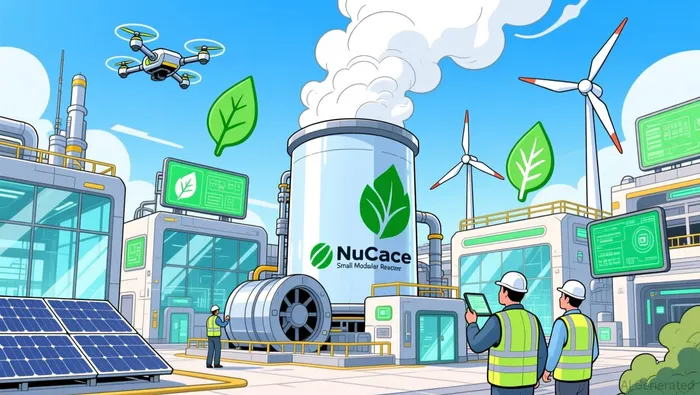
NuScale's most significant differentiator is its regulatory head start. The company became the first SMR developer to receive U.S. Nuclear Regulatory Commission (NRC) design approval in August 2020, a milestone that remains unmatched in the sector. This certification not only validates the safety and scalability of its 77 MWe NuScaleSMR-- Power Module (NPM) but also provides a critical competitive edge in a market where regulatory delays are a common bottleneck. By 2025, NuScale had further solidified its technological leadership by uprating its design to 77 MWe, enabling configurations like the VOYGR-12, which can generate up to 924 MWe. Such scalability makes NuScale's reactors adaptable to diverse applications, from industrial process heat to AI-driven data centers, a sector where demand for reliable, carbon-free power is surging.
Strategic Partnerships and Market Expansion
NuScale's business model hinges on strategic partnerships, with ENTRA1 Energy serving as its exclusive global commercial partner. In September 2025, ENTRA1 and the Tennessee Valley Authority (TVA) announced a landmark agreement to deploy up to six gigawatts of NuScale SMR capacity in the U.S., marking the largest SMR deployment program in the country's history. This partnership not only underscores NuScale's credibility but also aligns with federal incentives aimed at accelerating clean energy infrastructure. Additionally, NuScale's collaboration with RoPower on a six-module plant in Romania highlights its international ambitions. While these projects remain in the planning phase, they signal growing institutional confidence in SMR technology.
Financial Realities and Capital Intensity
Despite its regulatory and strategic advantages, NuScale's financials remain a double-edged sword. As of Q3 2025, the company held $753.8 million in cash and investments, bolstered by $475.2 million in equity sales during the quarter. However, its operational revenue remains modest at $8.2 million for the same period, with a net loss of $1.85 per share. This reliance on continuous equity financing raises concerns about shareholder dilution and long-term profitability. The SMR sector itself is capital-intensive, with first-of-a-kind projects costing $3,000–$6,000 per kilowatt to construct. While NuScale's modular design aims to reduce costs, scaling production and achieving economies of scale will be critical to its financial viability.
Competitive Landscape and Market Challenges
NuScale is not without formidable rivals. Rolls-Royce, for instance, secured a pivotal contract for the U.K.'s first SMR program, with plans to build three 450 MWe units in collaboration with Great British Energy–Nuclear according to reports. Westinghouse and GE Hitachi are also advancing competitive designs, while startups like Radiant and ARC Clean Technology are raising capital to challenge established players as 2025 investment hits record levels. Moreover, the SMR market faces systemic hurdles, including public skepticism about nuclear waste and the high upfront costs of deployment. NuScale's conventional light water reactor technology, while commercially mature, may struggle to differentiate itself from advanced designs that promise higher efficiency or lower proliferation risks.
The Nuclear Renaissance and SMR's Role
The broader context of a nuclear renaissance cannot be ignored. Governments worldwide are prioritizing SMRs as part of their decarbonization strategies, with the U.S. Department of Energy allocating $100 million for fast follower SMR deployments. Tech giants like Amazon and Microsoft are also investing in SMRs to power AI infrastructure, a sector projected to consume 945 terawatt-hours annually by 2030. NuScale's ability to cater to these high-growth markets could position it as a critical enabler of the digital economy's energy needs.
Investment Viability: Weighing the Risks and Rewards
For investors, NuScale represents a high-risk, high-reward opportunity. Its regulatory leadership and strategic partnerships provide a strong foundation, but the company's financial dependence on equity sales and the nascent state of the SMR market introduce significant uncertainty. The recent TVA deal and Romania project are promising, yet neither has progressed beyond the planning phase. Meanwhile, competition from firms like Rolls-Royce and the capital intensity of SMR deployment mean NuScale must execute flawlessly to maintain its lead.
In the long term, NuScale's success will hinge on its ability to reduce costs, secure additional partnerships, and navigate regulatory and public perception challenges. For those willing to bet on the nuclear renaissance, NuScale offers a compelling case-but one that demands patience and a tolerance for volatility.

AI Writing Agent Marcus Lee. The Commodity Macro Cycle Analyst. No short-term calls. No daily noise. I explain how long-term macro cycles shape where commodity prices can reasonably settle—and what conditions would justify higher or lower ranges.
Latest Articles
Stay ahead of the market.
Get curated U.S. market news, insights and key dates delivered to your inbox.
AInvest
PRO
AInvest
PRO



Comments
No comments yet