
NuScale Power's Stock Plunge: A Test of Faith in Small Modular Reactors
 Aime Summary
The recent 14.2% plunge in NuScale PowerSMR-- (NYSE: SMR) has sent ripples through the small modular reactor (SMR) sector, a market already grappling with the dual challenges of technological unprovenness and capital intensity. While short-term investors may have been spooked by insider selling and FluorFLR-- Corporation's decision to unlock its Class B shares, the broader narrative of SMR technology remains anchored in long-term structural forces. This article dissects the immediate triggers of NuScale's volatility and evaluates whether the fundamentals of the SMR industry justify a cautious bet on the future.
The Immediate Triggers: Share Dilution, Insider Doubts, and Overvaluation
The catalyst for NuScale's selloff was Fluor's conversion of 15 million Class B shares into publicly tradable Class A shares. This move, while routine in principle, amplified fears of supply-side pressure. Fluor's action coincided with significant insider transactions: CEO John Lawrence Hopkins offloaded 34,675 shares—a 41.43% reduction in his stake—while VP Jacqueline Engel sold 1,565 shares, trimming her ownership by 56.23%. These sales, occurring at a time when NuScale's stock was trading at $50.21 (a 157% premium to its GF Value of $19.48), raised questions about management's confidence.
Compounding these concerns was the Beneish M-Score, a forensic accounting tool that flagged potential earnings manipulation. NuScale's negative net margin of 273.36% and a return on equity of just 0.09%—despite beating quarterly revenue estimates—highlight the company's struggle to translate engineering innovation into financial sustainability.
The SMR Industry: A Long-Term Play on Energy Transition
To assess NuScale's long-term viability, one must look beyond quarterly earnings. The global SMR market is poised for explosive growth, driven by three pillars: climate policy, energy security, and technological scalability.
Government Support as a Catalyst
The U.S. Department of Energy's Advanced Reactor Demonstration Program has injected $3.2 billion into SMR projects, while the 2025 “One Big Beautiful Bill” offers a 10% bonus tax credit for reactors built in former nuclear communities. Similar incentives in Canada, the UK, and South Korea underscore a global consensus: SMRs are critical to decarbonizing hard-to-abate sectors like steelmaking and hydrogen production.Regulatory Leadership
NuScale's NRC-approved design is a moat. No other SMR vendor in the U.S. has cleared this regulatory hurdle, giving NuScale a 12–18 month lead in deployment. Its uprated 77 MWe module, capable of scaling to 924 MWe, addresses the industry's Achilles' heel—economies of scale.Competitive Positioning
While GE Hitachi, Rosatom, and startups like TerraPower vie for market share, NuScale's partnerships (e.g., ENTRA1 Energy) and first-mover status in the U.S. provide a strategic edge. The company's focus on modular, factory-built reactors reduces both cost and construction risk compared to traditional gigawatt-scale plants.
The Paradox of Value: Overvalued or Undervalued?
NuScale's GF Value of $19.48 suggests the stock is “significantly overvalued,” yet this metric ignores the company's unique position in the SMR race. The Beneish M-Score, while a red flag, may reflect the challenges of capital-intensive R&D rather than fraudulent accounting. Analysts' mixed ratings—from UBS's “neutral” to CLSA's “outperform”—reflect this ambiguity.
For long-term investors, the key question is whether NuScale can achieve commercialization by 2030. A successful deployment would transform its valuation from a speculative story into a utility-like asset. However, the path is fraught: the company expects to report -$0.73 EPS in 2025, and its $13.38 million quarterly revenue pales against the $10–15 billion market it aims to capture by 2030.
Investment Implications: A High-Risk, High-Reward Proposition
NuScale's stock is a textbook example of a “transition risk” asset—highly sensitive to regulatory, technological, and macroeconomic shifts. For risk-tolerant investors, the company's NRC certification and strategic partnerships justify a small, diversified position. However, the recent insider selling and overvaluation metrics counsel caution.
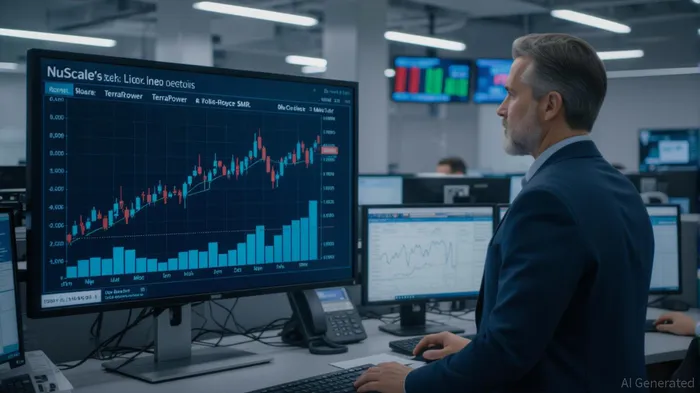
In conclusion, NuScale's stock crash is a test of faith in the SMR industry's ability to deliver on its promise. While the immediate triggers—share dilution, insider doubt, and financial underperformance—warrant skepticism, the long-term fundamentals of energy transition remain compelling. Investors who can separate the noise of quarterly volatility from the signal of structural change may find NuScale a fascinating, if volatile, bet on the future of clean energy.

Delivering real-time insights and analysis on emerging financial trends and market movements.
Latest Articles
Stay ahead of the market.
Get curated U.S. market news, insights and key dates delivered to your inbox.




Comments
No comments yet