
Nuclear Renaissance in the Arctic: Oklo's Strategic Play for Defense and Energy Dominance
The U.S. Air Force's partnership with OkloOKLO--, Inc., to deploy a microreactor at Eielson Air Force Base in Alaska marks a turning point in America's push to modernize defense infrastructure through advanced nuclear energy. This $100M+ 30-year deal is not merely a contract—it's a catalyst for a broader renaissance in nuclear technology, driven by geopolitical tensions, energy resilience demands, and the urgent need to decarbonize critical infrastructure. For investors, Oklo's success could unlock a multibillion-dollar market in military bases, remote communities, and even data centers.
The Geopolitical Imperative: Why the Military Needs Nuclear
The Arctic is a frontline of 21st-century geopolitics. Permafrost degradation, extreme weather, and logistical challenges make energy supply to remote military bases a national security priority. Oklo's 5 MW microreactor, capable of running for a decade without refueling and operating off-grid, directly addresses these risks. The Air Force's pilot project at Eielson—paired with plans for a 75 MW reactor by late 2025—aligns with a broader strategy to reduce reliance on fossil fuels and vulnerable energy grids.
But this is just the start. The U.S. Department of Defense (DoD) has identified microreactors as critical to its goal of achieving net-zero emissions by 2030 while maintaining readiness. With Russia and China expanding Arctic military presence, U.S. bases must be energy-independent in one of the harshest environments on Earth.
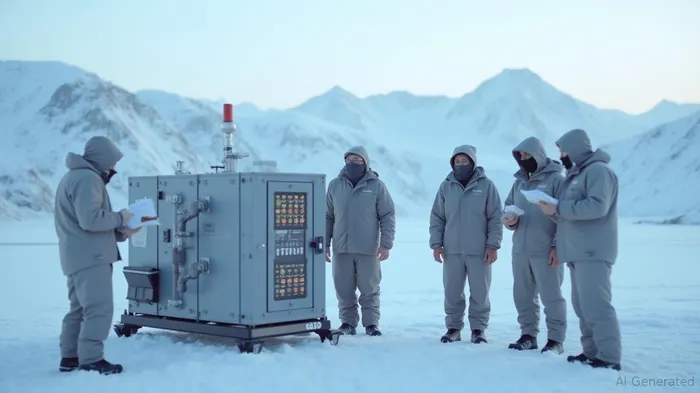
Oklo's Technical Edge and Financial Momentum
Oklo's reactor design is a masterclass in practical innovation. Its fuel cycle—lasting 10 years—eliminates the need for frequent refueling, a lifesaver in regions where winter roads close for months. The reactor's ability to operate independently of the grid also insulates bases from cyberattacks or grid failures.
Financially, Oklo is primed for growth. Its $400M public stock offering (ticker: OKLO) has provided the capital to pursue military and civilian projects. The Air Force deal alone could generate recurring revenue for three decades, while non-binding agreements with data center giants like Equinix (EQIX) to supply up to 12 GW of power by 2044 hint at a scalable business model.
The Regulatory and Political Tailwind
Oklo's path to deployment benefits from bipartisan support. The project is backed by Section 327 of the 2019 National Defense Authorization Act and Executive Order 13972, which prioritize advanced nuclear as a national security asset. The Nuclear Regulatory Commission (NRC) is under pressure to fast-track approvals, given the DoD's urgency.
Political momentum is also key. Oklo's CEO, Jacob DeWitte, has secured White House backing, including a meeting with former President Trump, underscoring nuclear energy's role in U.S. strategic autonomy. With the Air Force and Department of Energy (DOE) collaborating on environmental impact studies, regulatory hurdles are being minimized.
Broader Opportunities: Beyond Bases to Data Centers
The military's microreactor push isn't an isolated effort. The Army's Project Pele and the DOE's SMR programs are part of a coordinated federal strategy to revive nuclear as a clean, reliable power source. For investors, Oklo's success could unlock adjacent markets:
- Defense Infrastructure: Over 50 U.S. bases face energy vulnerability; Oklo's modular designs could be deployed globally.
- Remote Communities: Arctic towns, mining sites, and islands need off-grid power.
- Data Centers: The AI boom demands vast, reliable energy. Oklo's 75 MW reactors could power hyperscale data hubs at half the cost of renewables.
Risks and Considerations
- Regulatory Delays: The NRC's approval process could stretch timelines, though the Air Force's influence may expedite it.
- Cost Competitiveness: Oklo must prove its microreactors are cheaper than alternatives like liquefied natural gas (LNG) in remote areas.
- Public Perception: Nuclear's historical safety concerns, though largely outdated, could slow civilian adoption.
Investment Thesis: Oklo as a Nuclear “Tesla”
Oklo is positioning itself as the Tesla of nuclear—combining cutting-edge tech, scalability, and a vision for decarbonization. Its stock (OKLO) offers exposure to a sector with bipartisan support and multi-decade tailwinds:
- Near-Term Catalysts: NRC licensing (targeted for late 2025), Air Force site construction milestones, and data center partnerships.
- Long-Term Upside: A $500B global market for SMRs by 2040 (per the World Nuclear Association).
Investors should consider Oklo's valuation relative to its growth trajectory. While current valuations may seem high, the company's first-mover advantage and DoD backing could justify premium multiples. Notably, a recent analysis of short-term strategies—such as a 30-day hold following MACD Golden Cross signals—showed a 14.28% decline in OKLO's stock during the period (Jan–June 2025), underscoring the importance of adhering to a multi-year investment horizon.
Conclusion: A Nuclear Future, Anchored in the Arctic
Oklo's deal with the Air Force is more than a contract—it's a blueprint for how nations will power their future. In a world of climate volatility and geopolitical rivalry, Oklo's reactors could become the energy backbone for defense, tech, and remote economies. For investors, this is a rare opportunity to bet on a company at the intersection of national security, innovation, and climate resilience.
Actionable Takeaway:
- Buy OKLO for long-term exposure to the SMR boom, with a 3–5 year horizon.
- Monitor NRC approvals and Air Force construction timelines as key catalysts.
- Consider a small position in DOE contractors like BWX Technologies (BWXT) for diversified exposure to nuclear infrastructure.
The Arctic's icy tundra may soon host a symbol of America's energy future—one reactor at a time.

Delivering real-time insights and analysis on emerging financial trends and market movements.
Latest Articles
Stay ahead of the market.
Get curated U.S. market news, insights and key dates delivered to your inbox.
AInvest
PRO
AInvest
PRO



Comments
No comments yet