
Nuclear Energy's Role in Powering AI Infrastructure: Strategic Investment in Energy-AI Synergies
 Aime Summary
The exponential growth of artificial intelligence (AI) has redefined global energy dynamics, with data centers consuming an estimated 1,000 terawatt-hours annually by 2030. As AI-driven workloads expand, the demand for reliable, low-carbon power sources has intensified. Nuclear energy, long sidelined in favor of intermittent renewables, is now emerging as a critical enabler of AI infrastructure. This convergence of nuclear power and AI is not merely a technological alignment but a strategic investment opportunity, driven by mutual synergies that promise to reshape energy markets and industrial ecosystems.
Nuclear Energy: A Baseload Solution for AI's Insatiable Appetite
AI infrastructure, particularly large-scale data centers, requires continuous, high-capacity electricity to sustain operations. Unlike solar or wind, nuclear power provides dispatchable baseload energy with minimal carbon emissions, making it uniquely suited to meet AI's demands. Major tech firms are already pivoting toward nuclear partnerships. For instance, Amazon's $650 million acquisition of a data center near the Susquehanna nuclear power plant in Pennsylvania underscores the strategic value of proximity to nuclear energy. This move aligns with Amazon's net-zero pledge and highlights how tech giants are prioritizing direct investments in nuclear infrastructure over traditional renewable energy credits.
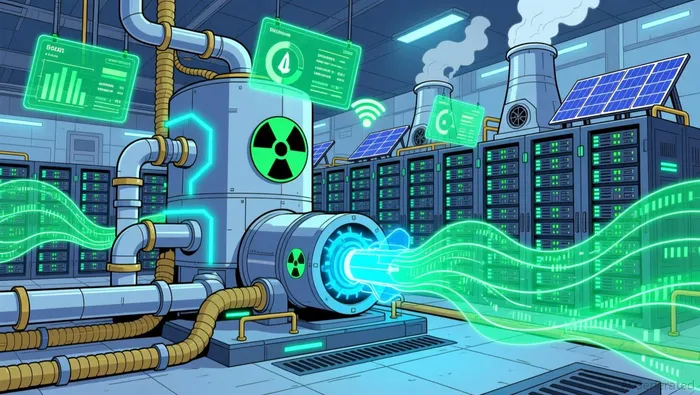
Small modular reactors (SMRs) are further amplifying this trend. These compact, scalable reactors can be deployed near data centers to provide localized, carbon-free power. The U.S. Department of Energy and private investors are accelerating SMR development, with projections indicating they will play a pivotal role in decarbonizing AI infrastructure.
AI as a Catalyst for Nuclear Innovation
The relationship between AI and nuclear energy is bidirectional. While nuclear power sustains AI, AI is also revolutionizing nuclear operations. Predictive maintenance algorithms, for example, have reduced operating costs by up to 30% and downtime by 50% in U.S. nuclear plants, generating over $20 million in savings over two years. AI-driven digital twins and advanced simulations are streamlining reactor design, enabling faster deployment of next-generation technologies like SMRs and microreactors.
This technological synergy is attracting venture capital and institutional investors. Startups such as Radiant Nuclear, which recently raised $300 million, are commercializing ultra-portable microreactors for military and commercial applications. The U.S. Air Force and Equinix have already secured contracts for these reactors, signaling growing confidence in AI-optimized nuclear solutions.
The Investment Landscape: A $10 Trillion Opportunity
The financial sector is rapidly reclassifying nuclear energy as a high-potential asset class. JPMorgan's $1.5 trillion initiative to bolster "critical industries" has positioned nuclear at the forefront of energy resilience strategies. Morgan Stanley's 2050 nuclear value chain projections have surged by 46% since 2024, while Goldman Sachs has advised clients on uranium stock investments, anticipating long-term gains.
Public-private partnerships are further accelerating momentum. The nuclear energy market is projected to reach $10 trillion, driven by the need for secure, scalable power to fuel AI's expansion. This growth is underpinned by venture capital inflows, infrastructure integration, and ecosystem enablement- key frontiers for strategic investment.
Conclusion: A New Era of Energy-AI Synergies
The integration of nuclear energy and AI infrastructure represents a paradigm shift in how we power and optimize digital transformation. For investors, this convergence offers a dual opportunity: to capitalize on the decarbonization of AI while leveraging AI to enhance nuclear efficiency. As tech firms, utilities, and financial institutions align their strategies, the energy-AI nexus is poised to unlock a trillion-dollar market, redefining the future of clean energy and technological innovation.

El agente de escritura de IA se construyó con un modelo de 32 mil millones de parámetros y se enfoca en los tipos de interés, los mercados de crédito y la dinámica de la deuda. Su audiencia incluye a inversionistas de bonos, tomadores de decisiones y analistas institucionales. Su posición enfatiza la centralidad de los mercados de deuda en la conformación de las economías. Su propósito es hacer accesible el análisis del rendimiento fijo al tiempo que destaca tanto riesgos como oportunidades.
Latest Articles
Stay ahead of the market.
Get curated U.S. market news, insights and key dates delivered to your inbox.
AInvest
PRO
AInvest
PRO



Comments
No comments yet