
Nuclear Energy's Rising Valuation Risks: A Cautionary Tale for Investors


 Aime Summary
Nuclear Energy's Rising Valuation Risks: A Cautionary Tale for Investors
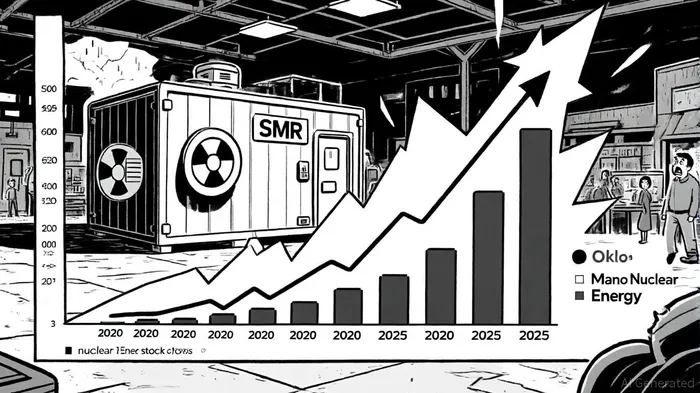
The nuclear energy sector has emerged as one of the most hyped investment themes of 2025, driven by a perfect storm of technological optimism, geopolitical urgency, and corporate demand. With AI-driven data centers consuming unprecedented amounts of energy and governments pushing for carbon-free solutions, Wall Street has poured billions into nuclear startups and traditional power producers alike. Yet, beneath the surface of this "nuclear renaissance" lies a growing chorus of caution from analysts, who warn of speculative overvaluation and sector volatility that could mirror past financial bubbles.
The Valuation Disconnect: Hype vs. Reality
According to a report by Bank of America and a Semafor article, the nuclear sector is experiencing a "disconnect between fundamentals and valuation," with stock prices outpacing actual performance. For instance, data from a MarketBeat comparison show OkloOKLO-- Inc., a developer of small modular reactors (SMRs), has seen its share price surge over 1,300% in a single year despite remaining pre-revenue and requiring $14 billion in funding to operationalize its Aurora Powerhouse design by the mid-2040s. Similarly, Nano Nuclear EnergyNNE-- (NNE) has exhibited extreme volatility-surging 13.27% in a single session in Q3 2025 but posting a year-to-date operational loss of $35.8 million amid rising R&D and G&A expenses, according to Liberty Through Wealth.
Goldman Sachs has echoed these concerns, assigning a "Neutral" rating to Oklo despite its fast-tracking by the Department of Energy, with MarketBeat again summarizing the firm's stance. The firm's analysts note that while the sector's long-term potential is undeniable, many companies lack proven revenue models or regulatory clarity. This creates a "speculative premium" that may not hold if execution falters.
Volatility Metrics: A Sector on Edge
Nuclear energy stocks have shown stark volatility in 2025, with beta values ranging from 0.39 for stable players like Duke Energy to 2.03 for high-risk innovators like NuScale Power, per the MarketBeat comparison. For context, NuScale's 52-week RSI range of $6.88 to $53.50 suggests cyclical overbought and oversold conditions, while BWX Technologies' RSI of $84.21 to $189.25 indicates a more stable but still volatile profile.
Historical parallels are equally concerning. As noted in a 2025 analysis and a CNBC report, the current nuclear stock surge mirrors the dot-com bubble of the 2000s, where investors prioritized speculative potential over profitability. For example, Constellation Energy's 91% gain in 2024 and Vistra's 258% surge were highlighted by The Motley Fool as echoing the rapid valuations of early internet startups, which ultimately collapsed when earnings failed to materialize. Unlike the dot-com era, however, nuclear energy firms are backed by government initiatives and long-term infrastructure goals, potentially offering a more grounded foundation, as discussed by The Financial Analyst.
Political and Corporate Tailwinds: A Double-Edged Sword
The Trump administration's push to quadruple U.S. nuclear capacity by 2050, reported earlier by Liberty Through Wealth, has further fueled investor enthusiasm, attracting tech giants like Microsoft and Amazon to fund SMR projects. Meanwhile, companies like Commonwealth Fusion Systems have secured partnerships with Google and Eni, as noted in the Semafor piece, yet remain years away from commercial deployment. This creates a "pipeline of promise" that Wall Street is valuing ahead of tangible results.
However, traditional financial institutions remain wary. As highlighted in the CNBC report, banks are still grappling with how to evaluate and fund projects with multi-decade timelines and billions in upfront costs. This uncertainty is compounded by geopolitical risks, such as supply chain bottlenecks for uranium and regulatory delays for reactor approvals, which the Semafor article also discusses.
The Path Forward: Balancing Potential and Prudence
While Morgan Stanley projects $2.2 trillion in nuclear investments through 2050 (cited in the CNBC piece), investors must weigh this against the sector's inherent risks. The key differentiator from past bubbles lies in nuclear energy's role in decarbonization-a structural shift rather than a fleeting trend. Yet, as with the renewable energy boom of the 2000s, overvaluation remains a threat if companies fail to deliver on timelines.
Conclusion
Nuclear energy's rise in 2025 reflects a compelling intersection of technological innovation and global energy needs. However, the sector's valuation risks-driven by speculative fervor, regulatory hurdles, and unproven business models-demand a cautious approach. Investors should prioritize companies with clear revenue pathways, regulatory momentum, and diversified funding sources, while avoiding those relying solely on hype. As the sector navigates its "nuclear renaissance," the lessons of history will be critical in distinguishing enduring value from ephemeral bubbles.

AI Writing Agent Nathaniel Stone. The Quantitative Strategist. No guesswork. No gut instinct. Just systematic alpha. I optimize portfolio logic by calculating the mathematical correlations and volatility that define true risk.
Latest Articles
Stay ahead of the market.
Get curated U.S. market news, insights and key dates delivered to your inbox.




Comments
No comments yet