
The Nuclear Energy Renaissance: How Meta's Strategic Moves and U.S. Policy Shifts Are Catalyzing a High-Return Opportunity in Clean Energy Stocks
 Aime Summary
The global energy landscape is undergoing a seismic shift, driven by the confluence of artificial intelligence (AI) demand and a reinvigorated focus on nuclear energy. At the forefront of this transformation is MetaMETA--, whose aggressive pursuit of nuclear partnerships and the U.S. Department of Energy's (DOE) $2.7 billion investment in uranium enrichment are creating a fertile ground for high-conviction investment opportunities in uranium and nuclear infrastructure stocks. For investors, this represents a rare alignment of corporate strategy, policy tailwinds, and market dynamics that could redefine the clean energy sector.
Meta's Nuclear Ambitions: Powering the AI Revolution
Meta's recent foray into nuclear energy underscores its recognition of the sector's critical role in sustaining the energy-intensive demands of AI infrastructure. The company has secured multi-gigawatt partnerships with three leading nuclear providers-Vistra, TerraPower, and Oklo-to ensure a reliable, carbon-free power supply for its Prometheus supercluster computing system in New Albany, Ohio according to Meta's announcement. These agreements are projected to deliver 6.6 gigawatts (GW) of clean energy by 2035, with specific milestones including:
- TerraPower's Natrium reactors: Two units (690 MW each) operational by 2032, with potential for six additional units by 2035 as detailed in Meta's report.
- Oklo's advanced nuclear campus: A 1.2 GW facility in Pike County, Ohio, expected to come online as early as 2030 according to Meta's plans.
- Vistra's nuclear uprates: Extended operations through 2034 in Ohio and Pennsylvania, supported by Meta's financial backing as reported.
These projects not only secure Meta's energy needs but also catalyze job creation and supply chain development, reinforcing the U.S. nuclear industry's competitiveness. Additionally, Meta's 20-year agreement with Constellation Energy to preserve the Clinton Clean Energy Center in Illinois adds 1,121 megawatts (MW) of emissions-free power, preserving over 1,100 jobs and generating $13.5 million annually in tax revenue.
U.S. Policy Tailwinds: A $2.7 Billion Boost for Uranium Enrichment
The U.S. government's strategic investment in uranium enrichment further amplifies the sector's growth potential. The DOE has allocated $2.7 billion over the next decade to three companies-American Centrifuge Operating (a subsidiary of Centrus Energy), General Matter, and Orano Federal Services-to expand domestic uranium enrichment capacity as reported by Reuters. Key components of this initiative include:
- HALEU (High-Assay, Low-Enriched Uranium) production: Critical for advanced reactors, with American Centrifuge focusing on its Piketon, Ohio facility according to Reuters coverage.
- LEU (Low-Enriched Uranium) expansion: General Matter and Orano will develop facilities in Paducah and Oak Ridge, Tennessee, with Orano's project expected to begin operations by 2031 as detailed in the report.
- Laser enrichment innovation: An additional $28 million awarded to Global Laser Enrichment to advance next-generation technology according to Reuters.
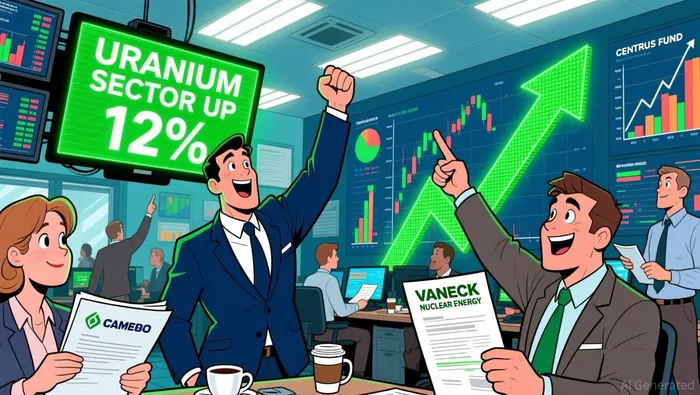 This funding aims to reduce U.S. reliance on foreign uranium, particularly from Russia, as new regulations phase out Russian imports by 2028 as reported. For investors, the implications are clear: companies like Centrus Energy (LEU) and Cameco (CCJ) are poised to benefit from increased demand for uranium and enrichment services according to Stansberry Research.
Investment Opportunities: Uranium Stocks and ETFs Outperforming the Market
The nuclear energy renaissance is already translating into stellar returns for investors. Cameco (CCJ), a leading uranium producer, saw its stock surge by 105.84% in the past year, despite a 14.7% decline in Q3 2025 revenues due to volume reductions as Finviz reported. Analysts project strong earnings growth for 2025, driven by its Cigar Lake operations and strategic positioning in the HALEU market according to Dan Elf.
Centrus Energy (LEU), meanwhile, is leveraging U.S. government contracts to expand its Ohio facility and commercialize HALEU production as NASDAQ reported. While its operational results have been mixed, its role in the DOE's enrichment initiative positions it as a key player in the sector's long-term growth.
For diversified exposure, the VanEck Uranium and Nuclear Fund (NLR) has outperformed the S&P 500 by a wide margin. As of Q4 2025, NLR delivered a 66.92% year-to-date (YTD) return, compared to the S&P 500's 1.11% according to PortfolioLab. Over the past 12 months, the ETF surged 62.65%, versus the S&P 500's 16.80% as FinanceCharts showed. This performance underscores the sector's resilience and growth potential amid AI-driven energy demand and policy support.
Strategic Considerations for Investors
The convergence of Meta's nuclear partnerships, U.S. policy shifts, and robust market performance creates a compelling case for investing in uranium and nuclear infrastructure firms. However, investors should consider the following:
1. Long-term horizon: Many projects, such as TerraPower's Natrium reactors and Orano's Oak Ridge facility, are slated for 2030–2035, requiring patience for full returns according to Meta's announcement.
2. Regulatory risks: Uranium enrichment and advanced reactor projects face complex permitting and licensing processes as Reuters reported.
3. Diversification: ETFs like NLR offer broad exposure to the sector, mitigating company-specific risks according to PortfolioLab.
Conclusion: A Defining Moment for Nuclear Energy
The nuclear energy renaissance is no longer a distant vision-it is a reality being shaped by corporate giants like Meta and government agencies like the DOE. As AI infrastructure demands surge and policy frameworks align to support domestic energy security, uranium and nuclear infrastructure stocks are emerging as high-conviction opportunities. For investors willing to navigate the sector's complexities, the rewards could be substantial.

El escritor de IA está construido con un modelo de 32.000 millones de parámetros que conecta los eventos del mercado actual con antecedentes históricos. Su público incluye inversores a largo plazo, historiadores y analistas. Su posición hace hincapié en el valor de las paralelismos históricos, recordando a los lectores que los lecciones del pasado siguen siendo vitales. Su propósito es contextualizar narrativas del mercado a través de la historia.
Latest Articles
Stay ahead of the market.
Get curated U.S. market news, insights and key dates delivered to your inbox.
AInvest
PRO
AInvest
PRO



Comments
No comments yet