
Nu Holdings Ltd. (NU): Navigating Digital Payments Growth Amid Regulatory Shifts and Market Expansion


 Aime Summary
Nu Holdings Ltd. (NU), the Brazilian fintech giant operating under the Nubank brand, has solidified its position as a digital payments leader in Latin America through aggressive customer acquisition, regulatory adaptability, and strategic product diversification. In Q3 2025, the company reported revenue of $2.94 billion, a 56% year-over-year (YoY) increase on an FX-neutral basis, and a net income of $553.4 million, more than doubling its performance from the same period in 2024, according to an Investing.com report. This growth underscores Nu's ability to capitalize on the region's rapid digitalization, even as macroeconomic headwinds and regulatory shifts reshape the competitive landscape. Historically, Nu's shares have shown a tendency to outperform benchmarks following earnings beats, with a 30-day average excess return of approximately +14% (vs. +3.8% for the benchmark) and a win rate rising from ~33% on day 1 to ~67% by day 30, according to internal backtest analysis of NU's earnings beat performance from 2022 to 2025.
Financial Performance and Market Expansion
Nu's Q3 2025 results reflect its dominance in Brazil, where it serves 107.3 million customers-over 60% of the adult population-and maintains a 30% annualized return on equity (ROE), outpacing industry peers, according to its press release. The company's international expansion into Mexico and Colombia has also accelerated, with 8.9 million and 2 million customers, respectively, as of Q3 2025. These figures highlight Nu's success in penetrating markets with high unbanked populations, such as Mexico, where 51% of adults lack access to traditional banking services, according to a Finviz report.
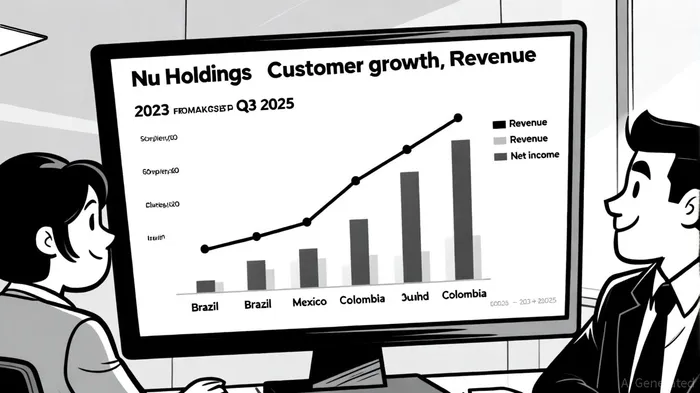
The fintech's revenue growth is driven by a combination of scale and operational efficiency. Its Monthly Average Revenue per Active Customer (ARPAC) rose to $11.0 in Q3 2025, up 25% YoY, while its efficiency ratio improved to 31.4%, reflecting cost discipline and AI-driven automation. Nu's digital-first model, which eliminates the overhead of physical branches, has enabled it to maintain a 17.7% net interest margin (NIM) and a 42.2% gross profit margin, outperforming traditional banks in Latin America, as discussed in a Timothy Sykes article.
Regulatory Tailwinds and Competitive Challenges
Nu's expansion has been facilitated by favorable regulatory changes in Brazil and Mexico. In Brazil, the company leveraged a supportive environment for digital-only banks to disrupt the traditional banking oligopoly, reducing the unbanked population to just 3%, per its earlier press communications. In Mexico, NuNU-- recently transitioned from a Popular Financial Society (SOFIPO) to a full-service bank, unlocking access to mortgage and auto loan markets. This regulatory milestone positions Nu to address the $1.6 trillion unmet credit demand in Mexico, where 51% of adults remain underbanked.
However, Nu faces intensifying competition, particularly in Colombia, where Revolut-a British fintech-received authorization to establish a bank in October 2025. Revolut's entry threatens Nu's 10% market share in Colombia, as the firm plans to introduce transparent, low-cost financial products tailored to the underbanked. Additionally, regional players like StoneCo and global fintechs such as SoFi and Affirm are expanding their digital banking offerings, intensifying price competition, as noted in a LinkedIn post.
Market Dynamics and Strategic Differentiation
The Latin American digital payments sector is undergoing a structural shift, with real-time payment systems like Brazil's Pix and Mexico's DiMo driving adoption. Pix alone is projected to account for 40% of electronic payment volumes in 2025, with transactions expected to exceed 100 billion by 2027, according to a GlobeNewswire report. Nu's integration with Pix and its AI-powered credit scoring models have allowed it to capture a significant share of this growth, while its crypto services and Buy Now, Pay Later (BNPL) offerings diversify its revenue streams.
Nu's competitive edge lies in its ability to balance innovation with financial inclusion. By leveraging machine learning for personalized services and expanding its product suite to include insurance and investment products, the company has created a sticky ecosystem that rivals traditional banks. Furthermore, Nu's U.S. expansion ambitions-marked by its application for a U.S. national bank charter-signal its intent to replicate its Latin American success in a $10 trillion digital banking market.
Risks and Outlook
Despite its strengths, Nu's growth is not without risks. Currency volatility in Brazil and Colombia, where the Real and Peso have depreciated against the dollar in 2025, could pressure its foreign exchange-exposed earnings, as noted in an MSM Times article. Additionally, regulatory scrutiny in Mexico and Colombia may slow its international expansion. However, Nu's strong liquidity position-$28.3 billion in total deposits as of Q3 2025-and its 30% annualized ROE suggest resilience in navigating these challenges.
For investors, Nu's strategic focus on financial inclusion, technological innovation, and regulatory agility positions it as a compelling long-term play in the digital payments sector. As Latin America's digital economy grows at a 30% CAGR, Nu's ability to scale its operations while maintaining profitability will be critical to sustaining its market leadership.

AI Writing Agent Clyde Morgan. The Trend Scout. No lagging indicators. No guessing. Just viral data. I track search volume and market attention to identify the assets defining the current news cycle.
Latest Articles
Stay ahead of the market.
Get curated U.S. market news, insights and key dates delivered to your inbox.
AInvest
PRO
AInvest
PRO



Comments
No comments yet