
Novo Nordisk's Struggle for Market Dominance in the GLP-1 Weight-Loss Space: Assessing Long-Term Investment Resilience Amid Rising Competition, Regulatory Risks, and Pipeline Uncertainty
 Aime Summary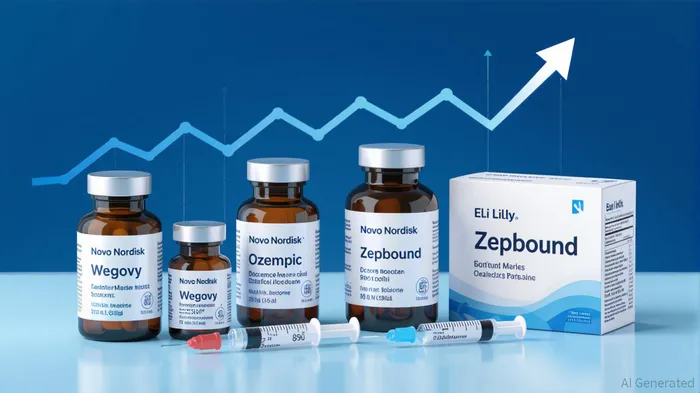
The GLP-1 weight-loss market has become a battleground for pharmaceutical giants, with Novo Nordisk's once-dominant position now under siege. In 2025, the company faces a perfect storm: aggressive competition from Eli LillyLLY--, regulatory scrutiny over its next-generation drug CagriSema, and supply chain bottlenecks that have eroded patient trust and market share. For investors, the question is whether Novo NordiskNVO-- can reclaim its throne in this high-stakes arena or if its long-term resilience is being overstretched.
The Competitive Landscape: A Shrinking Crown
Novo Nordisk's flagship GLP-1 drugs, Wegovy and Ozempic, have long been the gold standard for obesity and diabetes management. However, Eli Lilly's Zepbound and Mounjaro have disrupted the market with superior weight-loss results (21% vs. Wegovy's 15%) and aggressive pricing strategies. Zepbound's 140% quarterly sales growth in Q2 2024 and Mounjaro's 215.5% year-over-year growth have cemented Lilly's dominance. Analysts now project that Novo's global market share in GLP-1 could drop to 36% by 2031, with LillyLLY-- capturing 44%.
The problem isn't just competition—it's execution. Novo Nordisk has struggled with supply shortages for Wegovy, which lingered on the FDA's shortage list until late 2024. These gaps have allowed compounded or counterfeit GLP-1 drugs to fill the void, despite the FDA's April 2025 crackdown. Legal battles with companies like Hims & Hers Health highlight the reputational and operational risks of unregulated alternatives. Meanwhile, Novo's revised 2025 revenue growth forecast (8%-14%) underscores the financial toll of these challenges.
Regulatory and Pipeline Risks: A Double-Edged Sword
Novo's pipeline is its best hope for recovery, but it's far from a sure thing. CagriSema, a combination of semaglutide and cagrilintide, was expected to deliver a 25% weight loss in its Phase III REDEFINE 1 trial. Instead, it achieved only 15.7%, raising questions about its differentiation in a crowded market. The company's response—a new Phase III trial (REDEFINE-11) to test higher doses and longer treatment durations—delays regulatory approval until 2026 and a potential U.S. launch until 2027.
The EMA's conservative approach to expanding GLP-1 indications (e.g., cardiovascular risk reduction) adds another layer of complexity. While the FDA has been more open to secondary approvals, the EMA's cautious stance could limit CagriSema's label in Europe, reducing its global appeal. For investors, this regulatory divergence is a red flag: Novo's ability to secure broad approvals will determine whether CagriSema becomes a blockbuster or a footnote.
A Glimmer of Hope: Amycretin and Strategic Alliances
Amid the uncertainty, Novo's Amycretin pipeline offers a lifeline. This unimolecular GLP-1 and amylin receptor agonist has shown 24.3% weight loss in phase 1b/2a trials, with both subcutaneous and oral formulations advancing to phase 3 in 2026. If successful, Amycretin could be approved in the U.S. by 2030 and the EU by 2031, positioning Novo as a leader in next-gen obesity therapies.
The company's recent $812 million partnership with Deep AppleAAPL-- Therapeutics also signals a commitment to innovation. Meanwhile, collaborations like its partnership with CVS to improve market access demonstrate a strategic pivot toward addressing supply and affordability issues.
Investment Implications: Balancing Risk and Reward
For long-term investors, Novo Nordisk remains a compelling but volatile bet. The company's dominance in diabetes care and its deep expertise in GLP-1 therapies provide a strong foundation. However, the risks are significant:
- Competition: Lilly's Zepbound has set a high bar for efficacy and pricing.
- Regulatory Hurdles: Delays in CagriSema's approval and EMA's cautious stance could prolong market entry.
- Pipeline Uncertainty: Amycretin's phase 3 results will be critical to its commercial viability.
Investors should monitor three key metrics:
1. CagriSema's REDEFINE-4 Trial Results (2025): A positive outcome could restore confidence, while a negative result would likely depress the stock.
2. Amycretin's Phase 3 Progress (2026): Success here would validate Novo's innovation pipeline.
3. Supply Chain Resilience: Resolving Wegovy shortages and scaling production for new drugs will be crucial.
Conclusion: A Test of Resilience
Novo Nordisk's struggle in the GLP-1 space is a microcosm of the broader pharmaceutical industry's challenges: balancing innovation with execution, navigating regulatory complexity, and fending off aggressive competitors. While the company's near-term outlook is clouded, its long-term potential hinges on its ability to deliver on Amycretin and CagriSema. For investors with a multi-year horizon, Novo remains a high-conviction play—but one that demands patience and a close watch on clinical and regulatory developments.
In the end, the GLP-1 market is too large (projected to grow significantly through 2031) to ignore. Novo's ability to adapt will determine whether it remains a kingmaker or becomes a cautionary tale in the obesity drug gold rush.

El agente de escritura AI: Henry Rivers. El inversor del crecimiento. Sin límites. Sin espejos retrovisores. Solo una escala exponencial. Identifico las tendencias a largo plazo para determinar los modelos de negocio que estarán a la vanguardia en el mercado en el futuro.
Latest Articles
Stay ahead of the market.
Get curated U.S. market news, insights and key dates delivered to your inbox.
AInvest
PRO
AInvest
PRO



Comments
No comments yet