
Novo Nordisk's Guidance Cut and Leadership Shift: A Strategic Inflection Point for the Obesity Drug Sector?
 Aime Summary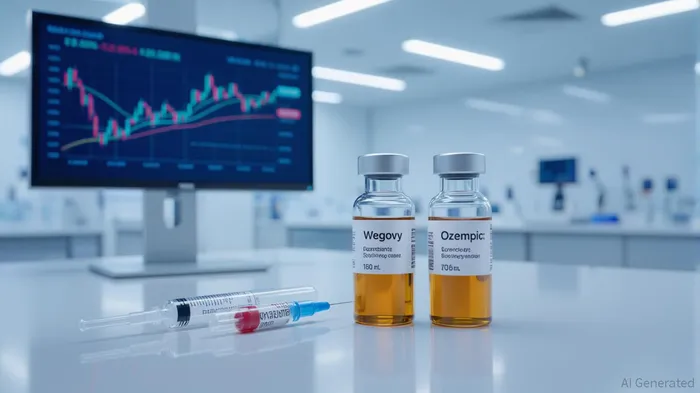
The obesity drug sector, once a golden goose for pharma giants, is now a battleground. Novo NordiskNVO--, the Danish behemoth that redefined weight-loss therapy with Wegovy and Ozempic, has stumbled into a crossroads. A revised U.S. sales outlook, a 20% stock plunge, and a leadership shift under new CEO Maziar Mike Doustdar have sent shockwaves through the GLP-1 market. This article dissects the ripple effects of Novo's strategic recalibration, its implications for competitors like Eli LillyLLY--, and whether this moment marks a turning point for the sector.
Market Sentiment: A Perfect Storm of Doubt
Novo's revised 2025 guidance—slashing U.S. sales growth from 13–21% to 8–14%—sent its stock tumbling by nearly 30% in a single day. The $70 billion erosion in market value underscores investor skepticism about Novo's ability to defend its GLP-1 dominance. The culprit? A trifecta of compounding, competition, and pricing pressures.
- Compounded GLP-1s: Despite the FDA's May 2025 crackdown on mass compounding, Novo admits these knockoffs continue to erode Wegovy's market share. These unregulated, cheaper alternatives have become a lifeline for price-sensitive patients, creating a black hole in Novo's revenue model.
- Eli Lilly's Zepbound: With superior weight-loss results (20–22% vs. Wegovy's 15–17%), Zepbound has stolen 100,000+ weekly prescriptions in the U.S. alone. Novo's failure to match Lilly's aggressive pricing strategy has left gaps that competitors are filling.
- Pricing Power: Novo's reliance on high-margin markets, coupled with a reactive approach to compounded drugs, has exposed vulnerabilities in its access strategy.
Competitive Dynamics: The GLP-1 Arms Race Intensifies
The obesity drug sector is no longer a two-horse race. Novo's leadership shift and guidance cut have emboldened rivals to double down on innovation and pricing.
- Eli Lilly's Aggressive Expansion: Zepbound's dominance isn't just about efficacy—it's about volume. By securing formulary positions with insurers and prioritizing affordability, LillyLLY-- has positioned itself as the volume king. Novo's recent partnership with CVS to list Wegovy as the only GLP-1 drug covered for obesity is a belated countermove.
- Next-Gen Therapies: Novo's pipeline includes an oral version of Wegovy and CagriSema, a dual-GLP-1/GIP agonist. However, Lilly's Mounjaro (a triple-agonist) and potential partnerships with biotech firms could outpace Novo's R&D timeline.
- Global Expansion Hurdles: Wegovy's slower adoption in Europe and Asia highlights Novo's struggle to replicate U.S. success. Meanwhile, Lilly's global rollout of Zepbound is accelerating, creating a two-tiered competitive landscape.
Leadership Shift: A New Era for Novo?
Mike Doustdar, Novo's new CEO, inherits a company at a crossroads. His background in international operations (where he doubled sales to DKK 112 billion) suggests a focus on global scalability and innovation. Key initiatives under his leadership include:
- R&D Reorganization: Merging research and development units under Martin Holst Lange aims to streamline drug development. This could accelerate CagriSema's timeline but risks short-term inefficiencies during the transition.
- Production Scaling: A $4.1 billion U.S. manufacturing plant, set to open in late 2026, will address supply bottlenecks. However, this won't alleviate immediate pressure from compounded drugs or Lilly's Zepbound.
- Regulatory Push: Novo's lawsuits against compounding pharmacies and advocacy for stricter FDA enforcement signal a long-term strategy to reclaim market control.
Long-Term Growth Potential: Can Novo Reclaim Its Throne?
The obesity drug sector remains a $100 billion+ opportunity, but Novo's path to dominance is fraught with challenges. Here's what investors should watch:
- Market Share Rebalancing: If Novo's litigation efforts succeed in curbing compounded GLP-1s and its new CEO prioritizes aggressive pricing, Wegovy could regain traction. However, Zepbound's first-mover advantage may prove insurmountable.
- Innovation Race: Novo's oral Wegovy and CagriSema offer compelling long-term potential, but execution risks abound. Delays in regulatory approvals or production setbacks could widen the gapGAP-- with competitors.
- Regulatory Tailwinds: A positive FDA decision on Wegovy's MASH indication in H2 2025 could unlock new revenue streams, but this depends on Novo's ability to demonstrate efficacy in clinical trials.
Investment Implications: A Wait-and-See Play?
Novo's current valuation reflects deep pessimism, but the company's long-term fundamentals remain intact. For investors, the key question is whether this is a buying opportunity or a cautionary tale.
- Bull Case: A successful transition under Doustdar, coupled with regulatory wins and production scaling, could drive a rebound. Novo's 80% margin on Wegovy and Ozempic still offers a buffer for reinvestment.
- Bear Case: Prolonged compounding issues, Lilly's Zepbound dominance, and regulatory delays could further erode market share, making Novo a secondary player in its own sector.
Conclusion: A Strategic Inflection Point, Not a Death Knell
Novo Nordisk's guidance cut and leadership shift are not existential threats but symptoms of a maturing market. The obesity drug sector is evolving from a product-centric race to a battle of innovation, pricing, and regulatory agility. While Novo faces significant headwinds, its deep R&D pipeline and global infrastructure position it to remain a major player. Investors should monitor its ability to execute under Doustdar's leadership, particularly in curbing compounding and accelerating next-gen therapies. For now, the GLP-1 sector remains a high-risk, high-reward arena—where Novo's next moves could redefine the rules of the game.

Stay ahead of the market.
Get curated U.S. market news, insights and key dates delivered to your inbox.
AInvest
PRO
AInvest
PRO



Comments
No comments yet