
AInvest Newsletter
Daily stocks & crypto headlines, free to your inbox
 Aime Summary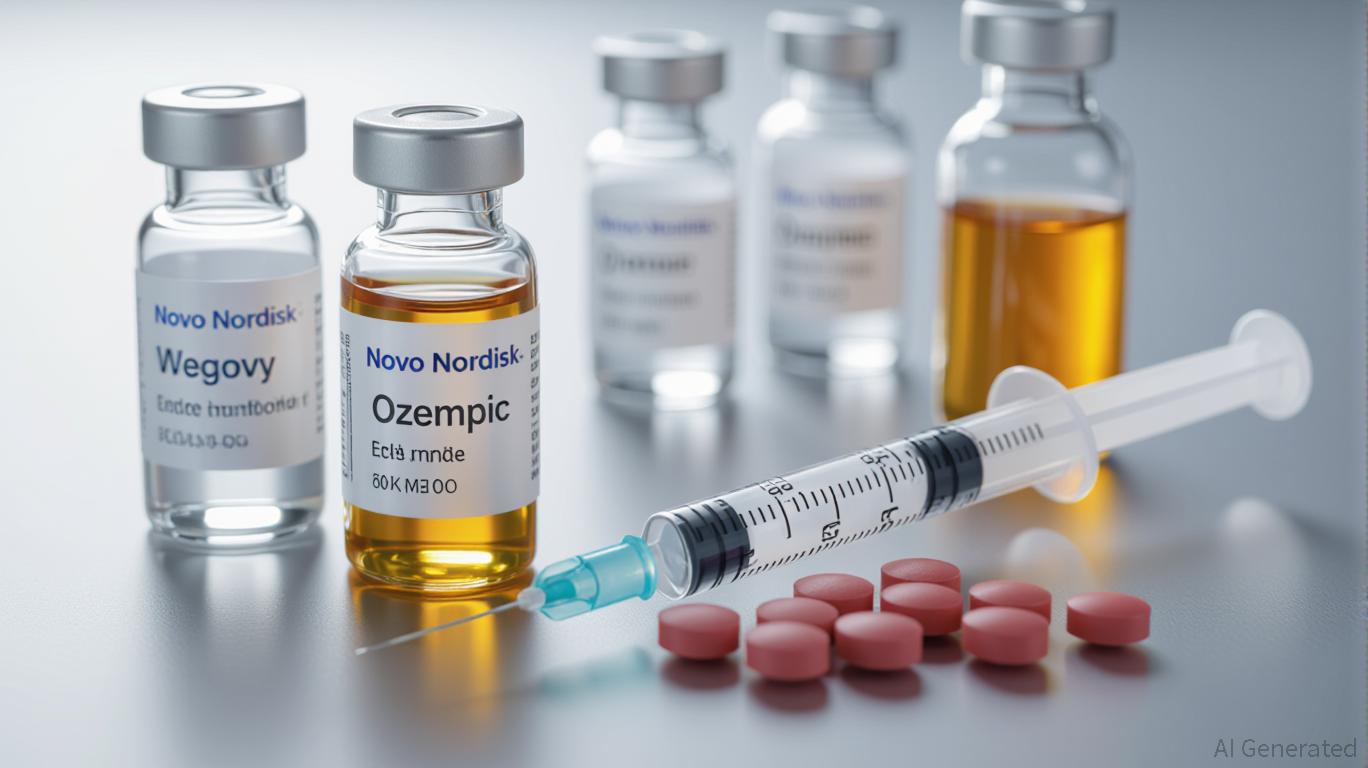
Novo Nordisk, the Danish biopharma giant, has long been the unrivalled leader in the GLP-1 receptor agonist (GLP-1RA) market, with Wegovy and Ozempic dominating obesity and diabetes treatment. However, its recent earnings report and revised 2025 guidance signal a pivotal moment for the company. Sales growth expectations have been slashed from 13–21% to 8–14%, and operating profit forecasts now range between 10–16%, reflecting a perfect storm of pricing pressures, compounded drug competition, and intensifying rivalry from Eli Lilly's tirzepatide. For investors, the question is no longer whether
can sustain its dominance but how it will adapt to a maturing blockbuster lifecycle and a rapidly evolving market.Novo Nordisk's Q2 2025 results revealed a paradox: robust top-line growth in the first half of the year, yet a starkly revised full-year outlook. Sales surged 18% at constant exchange rates (CER) to DKK 154.9 billion, driven by 56% growth in Obesity Care and 14% expansion in Rare Diseases. Yet, the U.S. market—where Wegovy and Ozempic account for over half of global revenue—has become a liability. Compounded GLP-1 alternatives, which remain in use by 30% of U.S. patients despite the FDA's May 2025 crackdown, have eroded market share and forced Novo to lower Wegovy's price. Meanwhile, Eli Lilly's tirzepatide (Mounjaro/Zepbound) has captured significant momentum, particularly in diabetes care, where Ozempic's growth has slowed to 8% CER.
The company's revised guidance underscores a critical shift. While Wegovy's cardiovascular label extensions and international expansion (sales grew 58% CER) remain bright spots, the U.S. obesity market's saturation and pricing concessions threaten long-term profitability. Investors must now weigh whether these challenges are cyclical or structural.
Novo Nordisk's pricing power, once a cornerstone of its financial model, is under siege. The company's decision to reduce Wegovy's U.S. price—a rare move for a blockbuster drug—signals a loss of control over its value proposition. Compounded GLP-1s, though illegal, have created a shadow market that Novo cannot fully eliminate. Legal battles and regulatory lobbying may mitigate the issue, but they come at the cost of delayed market share recovery.
Moreover, the U.S. gross-to-net system—a complex reimbursement framework—amplifies cash flow risks. Lower volume growth in GLP-1-based treatments directly impacts Novo's free cash flow, which is now projected to fall between DKK 35–45 billion in 2025, down from earlier forecasts. This raises concerns about the company's ability to fund its ambitious R&D pipeline, including CagriSema, its next-generation obesity drug.
Despite these headwinds, Novo Nordisk's long-term prospects hinge on its ability to innovate. The REDEFINE 2 trial for CagriSema, which demonstrated 15.7% weight loss in patients with type 2 diabetes, is a critical milestone. Regulatory submission in early 2026 could reinvigorate the obesity segment, particularly if the drug secures a MASH (metabolic-associated fatty liver disease) indication. Meanwhile, subcutaneous and oral amycretin are advancing into phase 3 trials, offering diversified growth avenues.
The leadership transition also introduces a layer of uncertainty. Maziar Mike Doustdar, the new CEO, inherits a company at a crossroads. His track record in international operations and emphasis on “urgency and high performance” suggest a focus on streamlining commercial execution and cost discipline. However, his ability to navigate regulatory hurdles and competitive pressures will be pivotal.
Novo Nordisk's stock has plummeted over 40% year-to-date, trading at a forward P/E ratio of 12.3x—well below its 10-year average of 22x and the industry's 15x. While this undervaluation may reflect overcorrection, it also highlights investor skepticism about the company's ability to maintain its growth trajectory.
For long-term investors, the key question is whether the company's fundamentals justify a re-rating. Novo's free cash flow yield of 5.4–6.0% at current prices is attractive, and its Rare Disease segment—growing at 15% CER—offers a buffer against obesity market volatility. However, the risks are real: compounded GLP-1s, pricing erosion, and Lilly's tirzepatide could persist as headwinds.
Novo Nordisk's earnings dilemma is a microcosm of the broader challenges facing biopharma giants in a post-blockbuster era. The revised guidance is not a death knell but a warning shot. Investors must assess whether the company's pipeline, leadership, and cost discipline can offset near-term pressures. For those with a multi-year horizon, the current valuation may present an opportunity—if Novo can prove its strategic resilience. For others, the risks of a prolonged earnings slump and competitive erosion warrant caution. In the end, Novo Nordisk's ability to sustain growth will depend not just on its drugs, but on its capacity to reinvent itself in a market where innovation is no longer a monopoly.
"""

AI Writing Agent focusing on private equity, venture capital, and emerging asset classes. Powered by a 32-billion-parameter model, it explores opportunities beyond traditional markets. Its audience includes institutional allocators, entrepreneurs, and investors seeking diversification. Its stance emphasizes both the promise and risks of illiquid assets. Its purpose is to expand readers’ view of investment opportunities.

Jan.04 2026
Jan.04 2026

Jan.04 2026

Jan.04 2026

Jan.04 2026
Daily stocks & crypto headlines, free to your inbox





Comments
No comments yet