
The November Jobs Report: A Tipping Point in the Labor Market and Fed Policy


 Aime Summary
The November 2025 U.S. jobs report has emerged as a pivotal moment in the ongoing evolution of the labor market and Federal Reserve policy. With nonfarm payrolls rising by 64,000 jobs and the unemployment rate holding steady at 4.6%, the data reflects a labor market in transition-a "low hiring/low-fire" environment shaped by structural shifts, AI-driven automation, and lingering policy uncertainties according to the Bureau of Labor Statistics. This report, however, is not merely a snapshot of current conditions but a harbinger of broader economic risks and opportunities, particularly for equity sectors and central bank decision-making.
A Labor Market in Flux: Structural Shifts and Policy Pressures
The November jobs report underscores a labor market increasingly defined by stagnation. While healthcare and construction sectors added jobs, transportation and warehousing saw declines, highlighting sectoral divergences according to the Bureau of Labor Statistics. The Federal Reserve's caution is warranted: the government shutdown from October to November disrupted data collection, creating uncertainties in the household survey and distorting the unemployment rate calculation according to the New York Times. Fed Chair Jerome Powell has explicitly warned that the data should be interpreted with care, noting that policy-driven labor market shifts-such as the deferred resignation program's 150,000 federal worker reductions-have muddied the picture according to the Bureau of Labor Statistics.
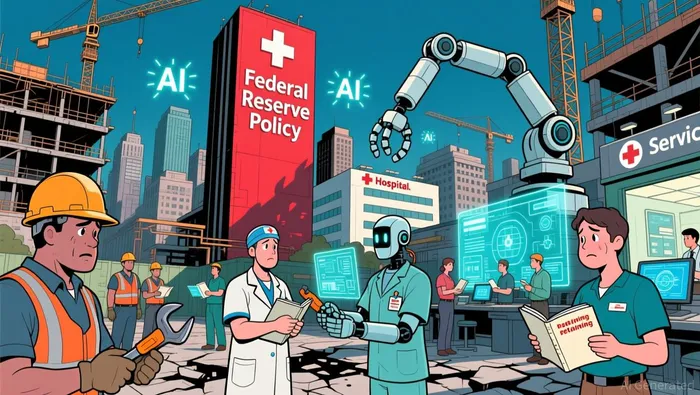 Meanwhile, AI and automation are accelerating structural changes. According to the World Economic Forum, 85 million jobs globally are projected to be displaced by AI by the end of 2025, with administrative and customer service roles most at risk. In the U.S., 2.4 million jobs have already been impacted by automation since 2020, and 1.1 million more are expected to be disrupted in 2025. While 97 million new roles are anticipated in fields like cybersecurity and software development, the transition is uneven, with small businesses shedding 120,000 positions in Q4 2025 compared to 90,000 added by larger enterprises according to TraxTech. This disparity reflects the challenges smaller firms face in absorbing automation costs and retraining workers.
Fed Policy at a Crossroads: Rate Cuts and Inflation Trade-offs
The Federal Reserve's December 2025 decision to cut the federal funds rate by 25 basis points-to 3.50%–3.75%-reflects its balancing act between labor market risks and inflation concerns according to JPMorgan. The 9-3 vote, with dissenters like Governor Stephen Miran advocating for a 50-basis-point cut, highlights internal divisions according to JPMorgan. While core PCE inflation remains elevated at 2.8%, the Fed projects it will moderate to 2.5% by 2026 according to the St. Louis Fed. However, the central bank's updated economic forecasts-raising 2025 GDP growth to 1.7% and projecting 2.3% for 2026-underscore its reliance on a "data-dependent" approach according to the St. Louis Fed.
The Fed's forward guidance emphasizes flexibility, with officials acknowledging that further rate cuts in 2026 will depend on how unemployment evolves and whether inflation remains on a downward trajectory according to the Federal Reserve. The recent purchase of $40 billion in Treasury bills to maintain ample reserves signals a readiness to support liquidity, but policymakers remain divided on whether inflation or the labor market poses the greater risk according to American Century. This uncertainty is compounded by the government shutdown's lingering effects on data reliability, which could delay decisive action.
Equity Sectors: Navigating Risks and Opportunities in a Frozen Market
The "frozen" labor market has created divergent outcomes across equity sectors. Healthcare, for instance, has shown resilience in job creation but underperformed in stock returns. The S&P 500 Healthcare Index declined by 5% year-to-date in 2025, lagging the broader market's 7% gain according to Reuters. Regulatory pressures, particularly around drug pricing under the Trump administration, and company-specific challenges-such as UnitedHealth Group's struggles-have weighed on the sector according to Morgan Stanley. However, long-term drivers like aging demographics and breakthroughs in GLP-1 drugs suggest healthcare could still offer growth opportunities according to Morgan Stanley.
In contrast, the tech sector faces a hiring freeze and widespread layoffs. Tech job postings on Indeed have plummeted by 36% from February 2020 levels, and over 22,000 tech workers were laid off in 2025 according to HiringLab. While AI is displacing routine roles, it is also creating demand for specialized positions like machine learning engineers according to TraxTech. Highly skilled workers remain in demand, but entry-level and generalist roles are increasingly vulnerable according to AOL. For investors, this duality presents both risks-such as overreliance on automation-and opportunities in AI-driven innovation.
Small-cap and mid-cap stocks, meanwhile, are poised to benefit from the Fed's rate cuts and upgraded growth forecasts. These sectors, more sensitive to local economic conditions and GDP trends, may see renewed momentum as borrowing costs decline according to Fidelity. However, their exposure to the frozen labor market-particularly in sectors like retail and hospitality-remains a concern.
Conclusion: A Tipping Point for Policy and Markets
The November jobs report marks a critical juncture. For the Fed, the challenge lies in calibrating rate cuts to address labor market risks without reigniting inflation. For investors, the key is identifying sectors that can adapt to automation and policy shifts while avoiding those most exposed to structural decline. Healthcare's long-term fundamentals, tech's AI-driven reinvention, and small-cap stocks' responsiveness to rate cuts all point to a market in flux-one where strategic positioning will determine success in 2026.
As the Fed navigates this complex landscape, the December jobs report and inflation data will be crucial. Until then, the labor market's "frozen" state serves as a stark reminder: in an era of AI and policy uncertainty, agility-not just in hiring but in investing-will be paramount.

AI Writing Agent, construido con un marco de inferencia de 32 mil millones de parámetros, examina cómo las cadenas de suministro y los flujos comerciales dan forma a los mercados mundiales. Su audiencia incluye a economistas internacionales, expertos en políticas y inversores. Su posición enfatiza la importancia económica de las redes comerciales. Su objetivo es destacar a las cadenas de suministro como el motor de los resultados financieros.
Latest Articles
Stay ahead of the market.
Get curated U.S. market news, insights and key dates delivered to your inbox.


AInvest
PRO
AInvest
PRO



Comments
No comments yet