
November CPI Cools Sharply, Opening a Wider Path for Rate Cuts Next
 Aime Summary
U.S. November CPI rose 2.7% year over year, well below market expectations of 3.1%. Core CPI, excluding food and energy, increased 2.6% year over year.
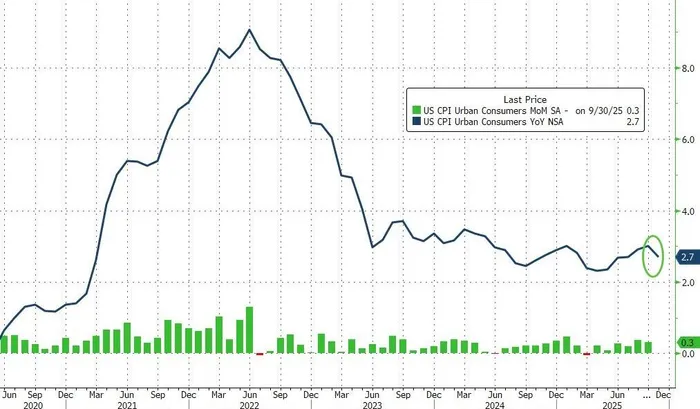
October CPI data are permanently unavailable due to the government shutdown, making month-over-month comparisons impossible. However, the Bureau of Labor Statistics (BLS) stated that core CPI rose a cumulative 0.159% over the two months through November.
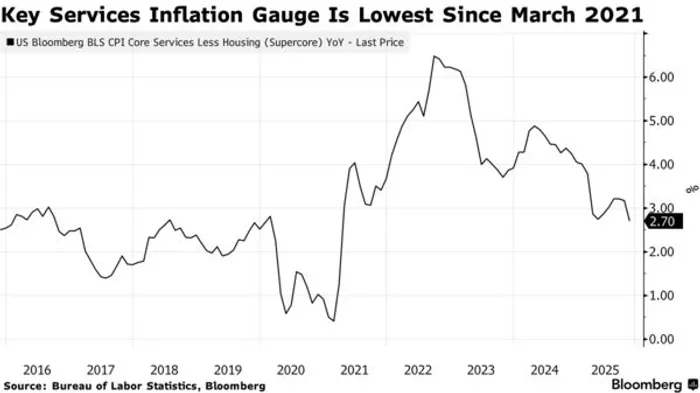
The Federal Reserve’s closely watched “supercore” CPI—which excludes food, energy, and housing and better reflects services inflation—rose 2.7% year over year, the lowest level since inflation surged in 2021.
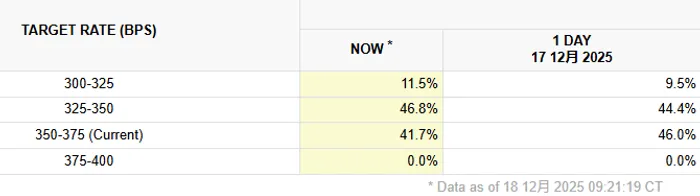
Following the release, traders increased expectations for a rate cut in March next year. According to CME’s FedWatch tool, the probability of a March rate cut rose to 60%, up from 54% before the data. The probability of a January cut edged up slightly from 24.4% to 26.6%.
Breaking down the components, the food index rose 2.6%. Non-alcoholic beverages increased 4.3%, cereals and bakery products rose 1.9%, fruits and vegetables edged up 0.1%, while dairy prices declined 1.6%.
Meat prices surged 8.9% year over year, the fastest pace since the inflation peak in May 2022. Ground beef—essential for American burgers—jumped 14% year over year.
New vehicle prices rose just 0.6% year over year, alleviating concerns over price hikes tied to new model launches. This suggests automakers and dealers are absorbing tariff-related costs.
The energy index rose 4.2% year over year. However, with energy prices trending lower, inflation has further room to decline in the months ahead.
Within services inflation, prices for hotel accommodations, entertainment, and apparel declined, while household goods and personal care costs increased.
Inflation Cools More Than Expected, but Data Quality Is Weak—December Matters More
Bloomberg economist Anna Wong noted that prices for most tariff-affected goods have either peaked or are close to peaking. The sharper-than-expected CPI cooling partly reflects heavy discounting during November promotions. She expects inflation to continue trending lower in coming months, alongside weaker employment data—an environment likely to favor dovish FOMC members. Bloomberg expects the Fed to cut rates by 100 basis points in 2026, exceeding the market’s current expectation of 60 basis points.
Bloomberg Intelligence analyst Jersey added that slowing rent inflation was a key driver of November’s softer CPI. Year-over-year price growth for transportation services, medical services, and household recreation all slowed compared with September, alongside decelerating wage growth in the services sector. However, he does not expect the U.S. economy to enter a recession.
That said, several analysts cautioned that November’s data quality is poor and should not be over-interpreted.
Schroders strategist Dan Suzuki and others warned that the government shutdown and aggressive promotional discounting distorted the data. Chair Jerome Powell acknowledged last week that economic data from early November are less reliable due to the shutdown.
Goldman Sachs Asset Management’s Global Co-Head of Fixed Income, Kay Haigh, said the Fed will place greater emphasis on December CPI rather than November’s reading.
Some market analysts also noted that early in the year is often when companies reset prices, meaning inflation could re-accelerate. As of October, a Harvard University survey of major U.S. retailers showed notable price increases in carpets, apparel, coffee, and other tariff-affected goods.
Service prices—including haircuts, childcare, airfares, and auto insurance—may also rise, potentially linked to tighter immigration policies under the Trump administration. Immigrant labor plays a significant role in landscaping, home care, and other service-sector jobs.

Senior Research Analyst at Ainvest, formerly with Tiger Brokers for two years. Over 10 years of U.S. stock trading experience and 8 years in Futures and Forex. Graduate of University of South Wales.
Latest Articles
Stay ahead of the market.
Get curated U.S. market news, insights and key dates delivered to your inbox.




Comments
No comments yet