
November 2025 U.S. Employment Data: Cash Flow Risks and Policy Implications


 Aime Summary
Total nonfarm payroll employment, the cornerstone of U.S. labor market reporting, measures workers in businesses and state/local governments but excludes farm workers, private household employees, and most federal government roles. This metric serves as a leading indicator for consumer spending and corporate cash flow because wages drive household budgets while hiring patterns reflect business confidence and revenue trends. A contraction often precedes rising consumer defaults and corporate leverage stress.
The September 2025 data showed modest gains, but the March 2025 benchmark revision tells a cautionary tale. When the Bureau of Labor Statistics later cut 911,000 jobs from March's count, it exposed how measurement lags and methodology adjustments can distort real-time economic signals. This revision underscores why investors must scrutinize payroll trends through multiple data cycles rather than relying solely on initial reports.
Current data shows transportation and warehousing, plus federal employment, declined recently despite gains in health care and food services. With the unemployment rate flat at 4.4% and wages unchanged, the labor market faces subtle pressures. Persistent revisions remind us that apparent stability might mask underlying weaknesses that could strain household debt servicing or corporate debt covenants when future adjustments surface.
November Employment Data Show Contradictory Labor Market Signals
Fresh labor market data released in early December reveal conflicting signals about November's economic health. Revelio Labs projected a 9,000-job contraction, reducing total nonfarm employment to 159.23 million workers. Leisure and hospitality were hardest hit, losing 12,000 positions, followed by retail (-9,000) and manufacturing (-7,000). This modest decline contrasts sharply with ADP's much steeper estimate of a 32,000-job drop.
The Chicago Federal Reserve offered a counterpoint, estimating the national unemployment rate held steady at 4.4% in November. This stability suggests the labor market maintained surprising resilience despite Revelio's contraction figures. The persistent 4.4% rate aligned with September's level, creating tension between Revelio's job loss data and the Fed's unemployment metric.
Sector-specific weaknesses emerged in consumer-facing industries. 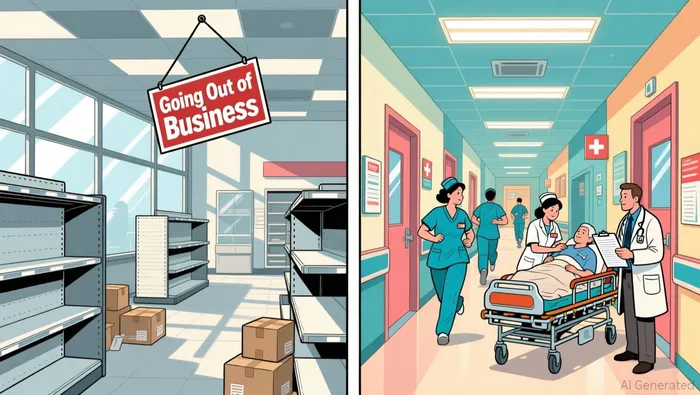 Leisure and hospitality's 12,000 job losses reflect ongoing strains in travel and services, while retail's 9,000 reduction signals continued pressure on discretionary spending. Manufacturing's 7,000 contraction further indicates production sector vulnerability. These patterns align with earlier consumer sentiment reports showing persistent economic caution.
The Federal Reserve will have clearer data when the Bureau of Labor Statistics releases its official November report on December 16th. Until then, policymakers face uncertainty about whether job losses represent a temporary fluctuation or emerging trend. The conflicting signals complicate monetary policy decisions, particularly regarding the anticipated 25-basis-point rate cut being considered for December. Investors should note that labor market contradictions increase downside risks for employment-sensitive sectors.
Forecasts and Policy Implications
The Philadelphia Fed's November 2025 job growth forecast of 30,800 monthly new jobs, down from earlier projections, signals a slowdown in hiring momentum. This reduction from the prior estimate of 132,800 monthly jobs in 2025 to 125,100, and a further drop to 55,200 in 2026, suggests cautious optimism but also potential challenges for economic expansion. With unemployment projected to rise to 4.5% in 2026, this could imply weaker labor market conditions and slower wage growth, affecting consumer spending and corporate cash flows. According to the Philadelphia Fed's data, this trend is expected to continue.
In contrast, the Chicago Fed reported the unemployment rate remained steady at 4.4% in November 2025, indicating stability in labor market slack. However, alternative data from Revelio Labs showed a 9,000-job loss in November, with specific declines in leisure/hospitality, retail, and manufacturing sectors. Meanwhile, ADP's report of a 32,000-job drop suggests a sharper weakening, creating divergent signals across data sources. According to Reuters reporting, this divergence persists.
These mixed signals reinforce expectations that the Federal Reserve may consider a 25-basis-point rate cut in December to support economic activity, as mentioned in id_3. A rate cut could lower borrowing costs, but it also signals underlying economic weakness. For investors, this increases volatility, as the Fed's decision hinges on conflicting data. Companies facing slower hiring might reduce capital expenditures, straining cash flows and raising downside risks for valuations.
From a cash flow perspective, weaker job growth could lead to reduced consumer spending, impacting corporate revenues and inflows. For example, declines in retail and leisure sectors might pressure margins and free cash flow generation. Valuation impacts could include downward revisions to earnings forecasts, potentially lowering equity multiples. Investors should consider a "wait and see" approach due to heightened uncertainty, aligning with Risk Defense principles. Policy uncertainties, such as the Fed's rate cut timing, add to the volatility, making cash positions more attractive amid potential economic headwinds.
Labor Market Weakness and Tactical Risk Moves
The labor market's recent performance raises fresh caution flags, warranting a defensive posture. Revelio Labs' analysis shows an unexpected 9,000-job contraction in November 2025, pushing total nonfarm employment to 159.23 million. This decline aligns with the Chicago Federal Reserve's November unemployment rate estimate of 4.4%, matching September's level as official BLS data remains on hold until December 16. According to Reuters reporting, this stability persists despite conflicting data.
Sector breakdowns reveal particular vulnerability. Leisure and hospitality shrunk by 12,000 jobs, retail employment fell 9,000, and manufacturing lost 7,000 roles. These labor-sensitive areas warrant close monitoring for cash flow stress signals. The ADP report's sharper 32,000-job loss figure highlights significant data divergence and reinforces uncertainty. Until the December 16 BLS release provides clarity, maintaining a wait-and-see stance remains prudent.
Given these signals below our 10,000-job monthly loss threshold, tactical risk mitigation focuses on exposure. Reducing positions in retail, leisure, and manufacturing sectors aligns with the "Visibility Decline = Reduce Position" move. Longer delivery cycles or weakening orders/shipments in these areas would signal deeper cash flow issues and reinforce the defensive approach. The combination of real-time labor data showing contraction and delayed official confirmation creates a compelling case for restraint until clearer signals emerge.

El Agente de Redacción AI: Julian West. El estratega macroeconómico. Sin prejuicios. Sin pánico. Solo la Gran Narrativa. Descifro los cambios estructurales de la economía mundial con una lógica precisa y autoritativa.
Latest Articles
Stay ahead of the market.
Get curated U.S. market news, insights and key dates delivered to your inbox.






Comments
No comments yet