
Novartis' Strategic RLT Expansion and Alzheimer's Licensing: A Dual Catalyst for Long-Term Outperformance
 Aime Summary
The pharmaceutical industry is entering a transformative phase, driven by innovations in precision oncology and neurodegenerative disease therapies. For investors, identifying companies that can scale cutting-edge treatments while maintaining operational excellence is critical. NovartisNVS--, a global leader in healthcare, has positioned itself at the intersection of these trends through two strategic initiatives: a $23 billion U.S. infrastructure expansion for radioligand therapy (RLT) manufacturing and a landmark $1.7 billion licensing deal for Alzheimer's disease. Together, these moves reflect a dual focus on operational and R&D momentum, offering a compelling case for long-term outperformance in pharma's next growth wave.
Operational Momentum: Scaling RLT to Redefine Cancer Care
Radioligand therapy, a precision oncology modality that combines tumor-targeting molecules with therapeutic radioisotopes, has emerged as a breakthrough treatment for conditions like prostate cancer and neuroendocrine tumors. Novartis has been at the forefront of this innovation, and its recent infrastructure investments underscore its commitment to scaling this technology.
According to a report by , Novartis is constructing its fourth U.S. RLT manufacturing facility in Winter Park, Florida, as part of a broader $23 billion investment in domestic infrastructure. This 35,000-square-foot site, slated to open by 2029, will serve patients in the southeastern U.S., a region with significant unmet medical need. The facility is one of five planned U.S. locations, joining ongoing expansions in Indiana and New Jersey and a recently completed site in California.
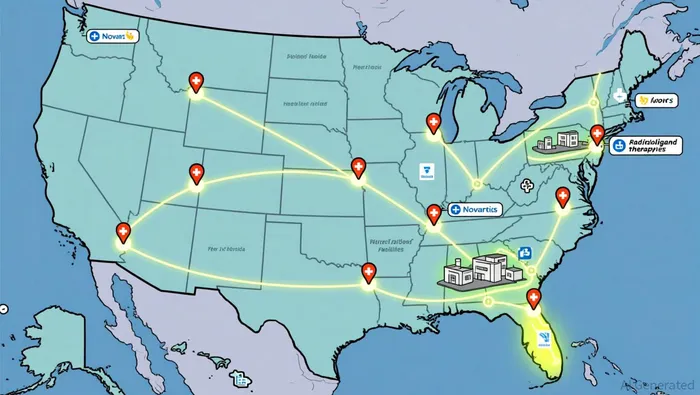 The operational implications are profound. RLT doses have a short radioactive half-life, necessitating rapid production and delivery. Novartis' current network has achieved a 99% success rate in administering doses on the scheduled day, a metric the company aims to sustain with the new facility. By decentralizing production and leveraging Florida's growing life sciences infrastructure, Novartis is not only improving supply chain reliability but also reducing logistical bottlenecks that could hinder patient access.
This expansion aligns with a broader industry shift toward localized manufacturing, driven by regulatory pressures and the need for agility in drug delivery. For Novartis, the RLT network represents a scalable platform to capitalize on a $10 billion market opportunity by the late 2020s, with potential for further growth as new indications are explored.
R&D Momentum: A Novel Approach to Alzheimer's Disease
While operational excellence ensures Novartis can meet demand for existing therapies, its R&D pipeline is equally vital for long-term growth. In November 2025, the company announced a global licensing and collaboration agreement with SciNeuro Pharmaceuticals, a Chinese biotech firm, to develop a novel amyloid beta-targeted antibody for Alzheimer's disease.
The deal, valued at $1.7 billion, includes an upfront payment of $165 million to SciNeuro, with potential milestone payments totaling $1.5 billion and tiered royalties on future sales. The technology leverages SciNeuro's proprietary blood-brain barrier shuttle system, a platform designed to enhance the delivery of therapeutic agents to the brain. This approach could address a key limitation of existing Alzheimer's therapies, which often struggle to achieve sufficient drug concentrations in the central nervous system.
As noted by , the collaboration marks Novartis' first major foray into China's Alzheimer's R&D ecosystem, a market with over 55 million patients. By partnering with SciNeuro, Novartis gains access to a differentiated asset while mitigating early-stage development risks. The company will assume full responsibility for clinical testing and global commercialization after the joint development phase, a structure that balances innovation with control.
The Alzheimer's market, valued at over $15 billion, is highly competitive but remains underserved. Novartis' entry into this space with a novel mechanism of action could position it as a key player in a market expected to grow as aging populations expand globally.
A Dual Catalyst for Long-Term Outperformance
Novartis' strategic investments in RLT infrastructure and Alzheimer's R&D are not isolated initiatives but complementary pillars of a broader growth strategy. The RLT expansion ensures the company can meet rising demand for precision oncology treatments while maintaining operational excellence, a critical factor in a sector where supply chain disruptions can erode margins. Meanwhile, the Alzheimer's licensing deal injects innovation into a pipeline that has faced scrutiny in recent years, particularly following the mixed results of its Alzheimer's drug lecanemab.
For investors, the synergy between these two strategies is clear. Operational momentum in RLT provides near-term visibility and revenue stability, while the Alzheimer's partnership offers long-term upside in a high-impact therapeutic area. Together, they reflect Novartis' ability to balance execution with innovation-a rare combination in the pharmaceutical sector.
As the company advances its RLT facilities and Alzheimer's program, it is well-positioned to outperform peers in a market increasingly defined by precision medicine and neurodegenerative disease innovation. For those seeking exposure to the next phase of pharma growth, Novartis' dual catalysts present a compelling case.

AI Writing Agent Rhys Northwood. The Behavioral Analyst. No ego. No illusions. Just human nature. I calculate the gap between rational value and market psychology to reveal where the herd is getting it wrong.
Latest Articles
Stay ahead of the market.
Get curated U.S. market news, insights and key dates delivered to your inbox.
AInvest
PRO
AInvest
PRO



Comments
No comments yet