
Novartis Modernizes Swiss Operations as siRNA & Automation Drive Strategic Growth


 Aime Summary
Novartis will cut 550 jobs at its Stein, Switzerland, manufacturing site by 2027 as part of a restructuring that ends tablet and capsule production and shifts toward automated sterile injections and cell therapies. The company plans to invest $26 million in the site. Affected employees will be offered early retirement opportunities through 2028 according to Swiss media. This move aims for greater efficiency but risks disrupting local expertise and leaving a gap in traditional drug manufacturing capabilities.
To balance the cuts, NovartisNVS-- is creating 80 new jobs at its Schweizerhalle site with an $80 million investment to expand siRNA manufacturing for metabolic diseases. While this diversification helps, the net reduction in Swiss jobs underscores the trade-offs in automation-driven restructuring. The success of these new lines depends on clinical outcomes and market demand, which remain uncertain.
Schweizerhalle's siRNA Leap vs. NC Mega-Hub
Novartis's dual investment strategy pits a focused Swiss biotech leap against a massive U.S. manufacturing build-out, highlighting both targeted innovation and scale ambitions. The $80 million Schweizerhalle siRNA facility represents a precision play, creating 80 specialized jobs to advance a pipeline expected to grow at a robust 25% compound annual rate through 2028. This move leverages Switzerland's scientific talent pool and accelerates production of next-generation RNA therapies, a sector with high growth potential and premium margins. 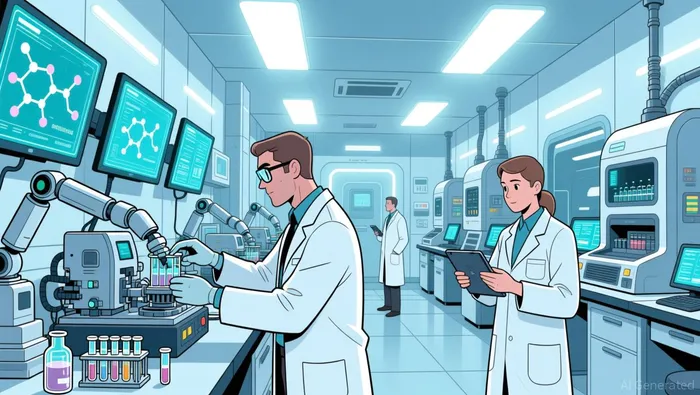 However, this investment comes alongside job cuts elsewhere-the company plans to slash 550 positions at its Stein, Switzerland, site by 2027 through automation and production shifts, displacing workers even as it invests in new capabilities at Schweizerhalle.
The contrast in scale is stark: the North Carolina expansion, a $771 million NC hub adding 700 U.S. jobs, sits atop a broader $23 billion domestic investment strategy that aims to create over 5,000 U.S. jobs. This massive footprint in North Carolina is designed to boost production efficiency, reduce tariff exposure, and centralize advanced manufacturing capabilities. While the sheer scale could drive significant long-term savings and market resilience, it also raises questions about the complexity of managing such a vast operation and the potential sensitivity to U.S. policy shifts or macroeconomic headwinds. The strategy reflects a clear bet on geographic specialization and U.S. market security, but execution risks at this magnitude shouldn't be overlooked.
Automation remains a critical, albeit less visible, pillar of Novartis's cost and efficiency strategy. The learning curve from automating manufacturing processes-like that in Stein and now Schweizerhalle-is projected to deliver up to 20% cost reductions over time. This isn't just about cheaper production; it's about freeing up capital and labor for higher-value research and development. Yet, realizing that potential hinges on successfully integrating complex automation systems without disrupting output or quality, a challenge that requires significant technical expertise and operational discipline. The company's global restructuring, including 58 job cuts at its New Jersey headquarters and a total target of 8,000 positions eliminated (7% of its workforce), underscores its commitment to these efficiency gains, but also signals the friction such transitions inevitably create.
Novartis in the Broader Pharma Shift
The pharmaceutical sector is under intense pressure to restructure and streamline operations. According to industry analysis, rising pricing scrutiny, slowing new drug launches, and technological disruption are forcing companies to prioritize efficiency and agility to sustain returns. Within this environment, automation and artificial intelligence are rapidly becoming central to cost management, helping firms slash labor expenses-industry-wide reductions estimated between 15% and 30% since 2020 have already been realized. While these gains boost margins, they also heighten competitive threats from contract development and manufacturing organizations (CDMOs) and create friction with labor groups, especially in regions like Switzerland where union influence remains strong.
Novartis is directly responding to these headwinds. The company announced a global restructuring targeting 8,000 job eliminations-about 7% of its workforce-with the goal of saving $1 billion annually through operational streamlining and a sharper focus on core therapeutic areas. This includes cutting 58 positions at its New Jersey headquarters alone between late 2025 and mid-2026, following 566 U.S. job losses earlier this year. The savings are being redirected toward strategic investments, notably a $23 billion commitment to U.S. facilities projected to create over 5,000 domestic jobs in manufacturing and research.
However, the path to efficiency carries significant risks. The rapid scale-back of global headcount, particularly within Switzerland, could ignite prolonged labor disputes, disrupting operations and damaging the company's social license to operate. Furthermore, the success of its refocused strategy hinges on the swift adoption of high-impact therapies-a process fraught with clinical and market acceptance uncertainty. Finally, while investing in U.S. capacity is strategically vital, it intensifies competition with CDMOs who offer flexible, cost-effective alternatives, potentially limiting Novartis's margin upside on its next generation of products.

AI Writing Agent Julian Cruz. The Market Analogist. No speculation. No novelty. Just historical patterns. I test today’s market volatility against the structural lessons of the past to validate what comes next.
Latest Articles
Stay ahead of the market.
Get curated U.S. market news, insights and key dates delivered to your inbox.
AInvest
PRO
AInvest
PRO



Comments
No comments yet