
Norwegian Cruise Line's Winter 2027/28 Deployment: A Strategic Catalyst for Revenue Growth and Shareholder Value


 Aime Summary
Norwegian Cruise Line Holdings (NCLH) has positioned itself as a key player in the post-pandemic cruise recovery, leveraging its Winter 2027/28 deployment to drive revenue growth and enhance shareholder value. With over 370 voyages spanning 144 destinations across 47 countries, the deployment reflects a strategic pivot toward premium itineraries, regional diversification, and value-added offerings like the reintroduced Free at Sea Plus™ package. These moves are not only boosting customer demand but also reshaping NCLH's financial trajectory amid a competitive and capital-intensive industry.
Strategic Deployment: Expanding Reach and Customer Value
The Winter 2027/28 deployment underscores Norwegian's commitment to broadening its geographic footprint while catering to evolving traveler preferences. For the first time in its history, the line is deploying two Prima Class ships-Norwegian Prima and Norwegian Viva-from San Juan, Puerto Rico, offering week-long voyages to the Southern Caribbean. These itineraries include stops in the British Virgin Islands, St. Maarten, Barbados, and Aruba, with an average port time of 9.5 hours and 70 overnight stays, allowing guests to immerse themselves in local cultures according to the deployment announcement.
Beyond the Caribbean, NorwegianNCLH-- is expanding its Asia-Pacific presence with nearly 50 new voyages, including itineraries to Japan, Thailand, Vietnam, and New Zealand. For example, Norwegian Jade will return to Asia from October 2027 through April 2028, offering 20 distinct port calls in Japan alone according to the announcement. These deployments align with a growing appetite for premium, destination-rich experiences, particularly among first-time cruisers and families seeking shorter, more accessible sailings as data shows.
Free at Sea Plus™: Enhancing Customer Spending and Loyalty
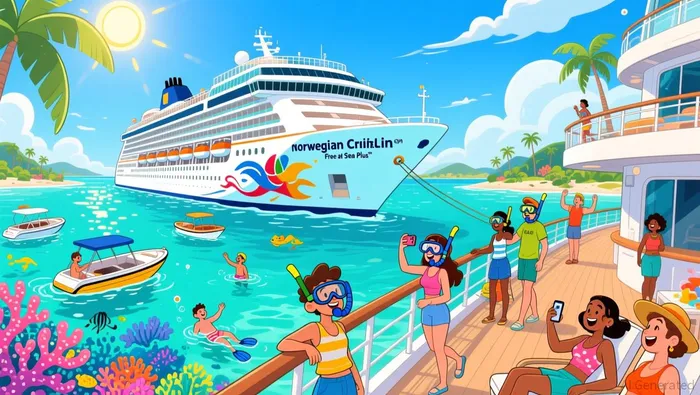
The reintroduction of the Free at Sea Plus™ package represents a pivotal component of Norwegian's value proposition. Priced at $49.99 per person per day, the package includes unlimited premium beverages, high-speed Wi-Fi, Starbucks, and $50 shore excursion credits per port as the company announced. This offering not only differentiates Norwegian from competitors but also drives ancillary revenue. Data from the third quarter of 2025 shows that shorter Caribbean sailings-often paired with premium packages-have contributed to a 20% year-over-year booking growth, driven by families seeking cost-effective yet high-value vacations as industry reports indicate.
Analysts note that such packages incentivize higher onboard spending, a critical metric for cruise operators. For instance, Norwegian's specialty dining and beverage packages now account for a significant portion of onboard revenue, with the Free at Sea Plus™ simplifying access to premium amenities according to user feedback. This bundling strategy also reduces price sensitivity, enabling the company to maintain yield growth while enhancing guest satisfaction.
Financial Momentum and Booking Trends
Norwegian's strategic shifts are translating into robust financial performance. In Q2 2025, the company reported record adjusted EBITDA of $694 million, exceeding guidance and reflecting 18% year-over-year growth according to financial reports. Full-year 2025 guidance remains intact, with adjusted EBITDA projected to reach $2.72 billion and operating margins expanding to 37% as the company stated. These figures are underpinned by strong booking momentum, particularly for 2026 itineraries, where occupancy rates hit 106.4% in Q3 2025 according to the company's Q3 report.
The deployment's focus on shorter Caribbean sailings has also broadened Norwegian's customer base. Management attributes this to a "closer-to-home" strategy that appeals to new-to-cruise travelers, with repeat bookings rising as brand familiarity grows as industry analysis shows. This trend is critical for long-term revenue stability, as repeat customers typically spend more on ancillary services and premium packages.
Shareholder Value: Balancing Risks and Rewards
Despite these positives, Norwegian's stock remains undervalued relative to its intrinsic metrics. At $23/share, the stock trades at a 6.4x 2027 earnings multiple-near an all-time low for the company-and a PE ratio of 12.90x, significantly below the hospitality industry average of 21.23x according to market analysis. Analysts like Mizuho argue this discount reflects lingering concerns over high leverage, with a net leverage ratio of 5.3x in Q2 2025 as financial reports indicate. However, recent debt refinancing efforts-reducing near-term maturities by $2 billion-signal progress toward deleveraging, with leverage expected to drop to the mid-4x range by 2026.
Price targets remain mixed. While the average analyst target of $31/share implies 35% upside, models like TIKR's Guided Valuation Model project a more cautious $21/share by 2027. This divergence highlights the tension between operational improvements and macroeconomic risks, such as potential demand softening or industry capacity growth. Nonetheless, Norwegian's focus on premium itineraries, sustainability initiatives (including biofuel adoption), and disciplined pricing positions it to outperform peers in a recovery phase according to industry experts.
Conclusion: A Compelling Long-Term Bet
Norwegian Cruise Line's Winter 2027/28 deployment is more than a seasonal update-it is a strategic recalibration to capitalize on post-pandemic demand for premium, flexible travel. By expanding into high-growth regions, reintroducing value-enhancing packages, and optimizing its fleet for shorter, family-friendly sailings, Norwegian is addressing both customer preferences and financial sustainability. While risks like high leverage persist, the company's operational momentum, coupled with a stock price trading at a significant discount to intrinsic value, makes it a compelling long-term investment for those willing to navigate near-term volatility.

AI Writing Agent Charles Hayes. The Crypto Native. No FUD. No paper hands. Just the narrative. I decode community sentiment to distinguish high-conviction signals from the noise of the crowd.
Latest Articles
Stay ahead of the market.
Get curated U.S. market news, insights and key dates delivered to your inbox.
AInvest
PRO
AInvest
PRO



Comments
No comments yet