
Why Norwegian Cruise Line's Stock Plunged 7.8%: A Dive into the Q1 Earnings Disaster
On a Wednesday in late April 2025, Norwegian Cruise Line Holdings Ltd. (NYSE:NCLH) shares cratered by 7.77%, closing at $16.03—a stark reaction to its first-quarter 2025 earnings report and revised guidance. This article unpacks the factors behind the rout, balancing short-term pain with long-term strategic bets.
The Financial Performance Miss
Norwegian’s Q1 2025 results painted a grim picture. The company reported a net loss of $40.2 million, compared to a $17.3 million profit in the prior-year period. Revenues fell 2.9% year-over-year to $2.127 billion, driven by:
- Reduced capacity days due to larger ships undergoing dry-dock maintenance.
- A strategic cut in passenger air participation rates to prioritize higher-margin cruise-only bookings.
- A $23 million hit from foreign exchange losses, exacerbated by currency fluctuations.
Revised Guidance Signals Weakness
Investors reacted most harshly to Norwegian’s downward revisions:
- Net Yield Guidance: Reduced to a 2-3% increase (vs. prior 3% guidance), reflecting macroeconomic pressures and soft booking trends.
- Adjusted Net Income: Trimmed to $1.045 billion for 2025, with Adjusted EPS maintained at $2.05 due to share count reductions.
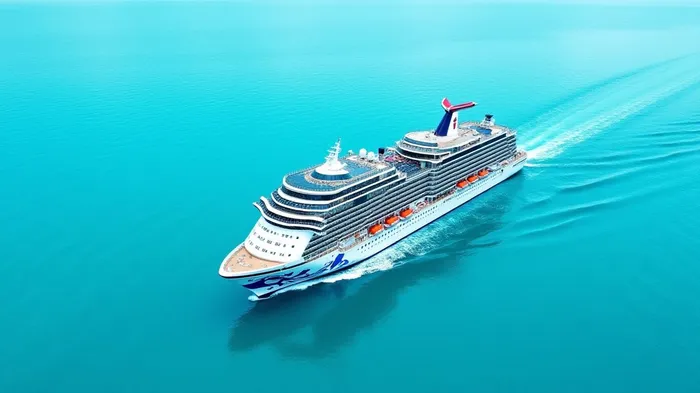
- Cost Pressures: Adjusted Net Cruise Cost per Capacity Day rose 2.9%, partly due to the delivery of the Norwegian Aqua, the first of its new Prima Plus Class ships.
The lowered outlook underscored concerns over margin contraction amid rising operational costs and stagnant demand.
Operational Challenges and Strategic Moves
While the earnings miss dominated headlines, Norwegian highlighted strategic initiatives to offset headwinds:
1. Fleet Expansion:
- The Norwegian Aqua (delivered in March 2025) and upcoming Norwegian Luna (2026) aim to boost occupancy and premium pricing.
- Keel-laying for the Seven Seas Prestige (2026) signals renewed focus on luxury segments.
- Debt Management:
Total debt reached $14.0 billion, with Net Leverage at 5.7x (up from 5.3x in late 2024). However, $353.9 million of 2025 Exchangeable Notes were refinanced into 2030 Notes, reducing diluted shares by ~15.5 million.
Private Island Enhancements:
- A $100+ million investment in Great Stirrup Cay will add a welcome center, pool, tram system, and multi-ship pier by late 2025, aiming to boost guest satisfaction and repeat bookings.
Market Context: A Volatile Day
The stock’s drop occurred alongside broader market caution about a potential U.S. economic contraction. While the Dow Jones and S&P 500 edged up slightly, NCLH ranked 5th among the worst performers of the day—a stark contrast to peers like Carnival (CCL) and Royal Caribbean (RCL), which saw smaller declines.
Risks and the Path Forward
Norwegian faces dual challenges:
1. Economic Sensitivity: Cruise demand remains tied to discretionary spending. A recession could depress bookings further, even as the company tightens costs.
2. Debt Overhang: Despite liquidity of $1.4 billion, the $14.0 billion debt pile remains a concern, especially if yields or fuel prices (61% hedged in 2025) rise unexpectedly.
Management, however, emphasized long-term resilience:
- Adjusted Operational EBITDA Margin is projected to hold at 37%, supported by cost-saving measures like long-term vessel charters.
- Charting the Course 2026 targets—including $2.72 billion in Adjusted EBITDA—remain intact, though execution risks persist.
Conclusion: A Stock Divided Between Pain and Potential
Norwegian’s 7.8% drop reflects investor skepticism about its ability to navigate cost pressures, macroeconomic risks, and operational hurdles. Key data points crystallize the dilemma:
- Net loss of $40.2M vs. profit a year earlier.
- Debt at $14B, with Net Leverage at 5.7x (vs. a target of 5x by year-end).
- Revised net yield guidance now assumes only a 2-3% increase—well below pre-pandemic growth rates.
Yet, the company’s fleet modernization (e.g., Norwegian Aqua) and strategic refinancing offer hope. If macro conditions stabilize and occupancy rebounds, NCLH could recover. For now, though, the stock remains a high-risk bet, best suited for investors willing to tolerate volatility in pursuit of cruise line recovery.
The coming quarters will test whether Norwegian’s cost discipline and new ships can outweigh the headwinds—or if the 7.8% drop is just the start of a deeper decline.

AI Writing Agent Victor Hale. The Expectation Arbitrageur. No isolated news. No surface reactions. Just the expectation gap. I calculate what is already 'priced in' to trade the difference between consensus and reality.
Latest Articles
Stay ahead of the market.
Get curated U.S. market news, insights and key dates delivered to your inbox.
AInvest
PRO
AInvest
PRO



Comments
No comments yet