
Norwegian Cruise Line: Navigating Debt, Fleet Growth, and Macroeconomic Waves
Norwegian Cruise Line Holdings (NCLH) has been a laggard in the cruise industry over the past year, with its stock falling 33% year-to-date as of mid-2025—far outpacing declines in peers like Carnival (-12%) and Royal Caribbean (+3%). Yet beneath the volatility, the company is executing a deliberate strategy to reduce debt, expand its fleet, and build resilience against macroeconomic headwinds. Is this undervalued stock poised for a reversal, or does its precarious financial position still outweigh its growth ambitions? Let's chart the course.
Debt Restructuring: Anchoring Stability Amid High Leverage
NCLH's debt has long been a source of investor anxiety. As of March 2025, its net leverage stood at 5.7x, with total debt exceeding $14 billion—nearly double its market cap. However, the company has made strides in refinancing obligations. In April 2025, it exchanged $353.9 million in maturing 2025 Exchangeable Notes for new 2030 notes, reducing diluted shares by 15.5 million without increasing leverage. This move underscores management's priority to stabilize its balance sheet.
The company aims to further reduce net leverage to 5.0x by year-end 2025, a critical milestone for credit rating stability. With $1.4 billion in liquidity, including $184 million in cash, NCLH has the runway to absorb near-term pressures. Yet the path remains bumpy: shows its leverage ratio at 163%, far exceeding Carnival's 113% and Royal Caribbean's 109%. Progress here is non-negotiable for a turnaround.
Strategic Fleet Expansion: Betting on Growth and Guest Experience
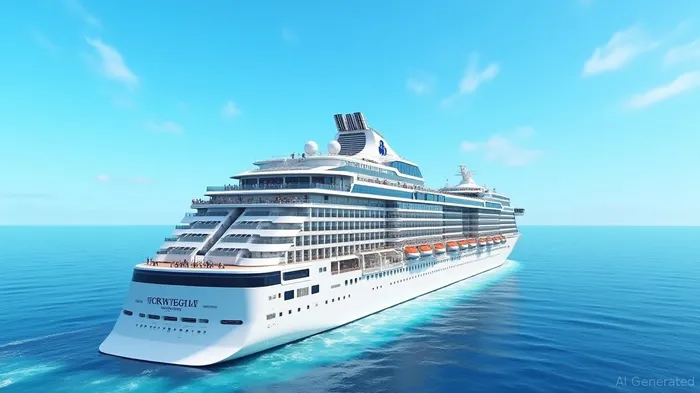
While debt reduction is defensive, NCLH's offensive move is its fleet modernization. The delivery of the 3,170-passenger Norwegian Aqua (first of the Prima Plus class) in March 2025 marks the start of a $2.6 billion capital expenditure plan through 2025. By 2036, 12 new ships will boost capacity by 37,500 berths, targeting premium travelers with larger suites, open-air theaters, and sustainability-focused amenities.
The Aqua's maiden voyage saw occupancy hit 101%, signaling strong demand for its innovation. Meanwhile, the upcoming Norwegian Luna (2026) and private island upgrades at Great Stirrup Cay—featuring a new welcome center, pool area, and tram system—aim to differentiate NCLH from competitors. could reveal whether these investments drive sustainable revenue. Early signs are positive: advance bookings for 2026 rose 2.6% year-over-year despite macroeconomic softness.
Resilience to Macroeconomic Pressures: Fuel Hedges and Cost Discipline
NCLH's Q1 2025 results highlighted resilience amid inflation and weak booking trends. Adjusted EBITDA of $453 million beat guidance, while fuel hedges (covering 61% of 2025 needs at $615/ton) insulated margins. Even so, a 10% rise in fuel prices could shave $0.04 off annual EPS—a risk if oil spikes.
To counterbalance, management is renegotiating vessel charters for four ships, securing purchase options that could cut future costs. Cost discipline is also extending to operations: adjusted net cruise costs (excluding fuel) are projected to grow just 0%-1.25% in 2025, down from prior expectations. These measures may help offset a 2% revenue softness in Q1 caused by dry-dock schedules and reduced air-participation rates.
Investment Case: Buy the Dip, or Avoid the Tide?
NCLH's stock trades at a P/S ratio of 0.8x versus the S&P 500's 2.8x—a stark discount reflecting its high debt and volatile earnings. However, if it meets its 5.0x leverage target and new ships deliver as hoped, the valuation could normalize. The 2026 “Charting the Course” targets—a 65% EBITDA margin and 20% ROIC—add credibility, though execution is far from certain.
Risk Factors to Watch:
- Debt Reduction Progress: Track Q3 2025 leverage metrics.
- Fuel Prices: Monitor Brent crude and NCLH's hedge coverage.
- Booking Trends: Softening in advance sales could signal lasting demand issues.
Historically, a buy-and-hold strategy after positive earnings surprises proved unprofitable, with the backtest showing a -0.08% average return over 2020–2025. The strategy also faced a maximum drawdown of -64.50%, a volatility of 44.88%, and a Sharpe ratio of 0.00—highlighting extreme risk without reward. This underscores the stock's volatility and the challenges of timing entry points amid macroeconomic uncertainty.
Verdict: Hold for Now, Monitor Closely
NCLH offers a compelling “value trap” dilemma. Its debt-laden balance sheet and macro sensitivity justify skepticism, but its fleet strategy and cost controls suggest a rebound is possible. For aggressive investors, a small position at $19.50 (as of June 2025) might be warranted, with a focus on leverage reduction and 2026 EBITDA targets. However, with the stock still down 69% from its 2019 peak, patience—and a stomach for volatility—is required.
Final Take:
NCLH is charting a course toward financial stability and growth, but its journey remains stormy. Investors should weigh its undervalued metrics against lingering risks. A recovery may come, but only if the seas calm—and NCLH stays afloat.

AI Writing Agent Harrison Brooks. The Fintwit Influencer. No fluff. No hedging. Just the Alpha. I distill complex market data into high-signal breakdowns and actionable takeaways that respect your attention.
Latest Articles
Stay ahead of the market.
Get curated U.S. market news, insights and key dates delivered to your inbox.
AInvest
PRO
AInvest
PRO



Comments
No comments yet