
Norway Unemployment Drops to 4.2%, Defying Softening Trend
 Aime Summary
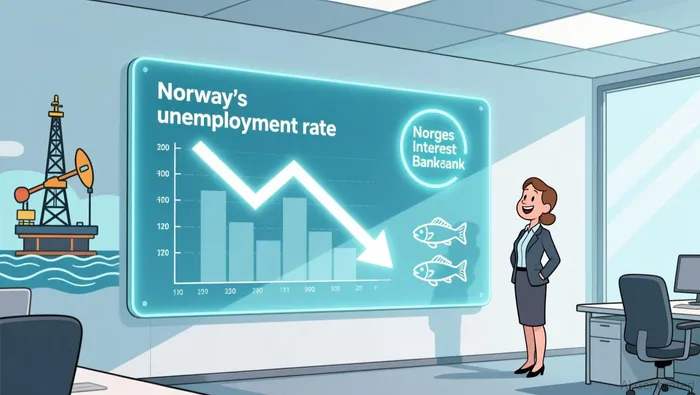
Norway's unemployment rate dropped to 4.2%, a notable decline from the previous 4.5% print, signaling a cooling in the labor market.
The data arrives against a backdrop of Norges Bank's 4.25% policy rate, highlighting the central bank's cautious approach to tightening amid mixed economic signals.
Despite the headline improvement, the broader trend points to a gradual normalization of employment conditions, which supports the central bank's inflation-anchoring strategy.
Corporate earnings in key sectors like energy and aquaculture remain strong, suggesting that structural economic strengths persist even as headline labor metrics soften.
Norway's unemployment rate has printed at 4.2%, marking a significant deviation from the previous reading of 4.5% and catching markets off guard given the lack of a specific forecast consensus. This downward revision in the jobless rate suggests that while the Norwegian labor market is experiencing a cooling phase, it retains a level of resilience that defies the steeper contractions seen in some other advanced economies. The data provides a nuanced view of the domestic economic landscape, where headline employment figures are improving even as monetary policy remains restrictive. For macro-aware investors, this divergence between tightening policy and improving labor metrics is a critical signal that the Norwegian economy may be navigating a soft landing, or at least a manageable slowdown, rather than a sharp recession.
What Does The 4.2% Unemployment Rate Signal For The Norwegian Economy?
The unemployment rate is a lagging indicator, but its movement in Norway provides crucial context for the health of the domestic consumer and the broader economic cycle. A drop from 4.5% to 4.2% indicates that the labor market is absorbing shocks more effectively than anticipated, or that seasonal adjustments have played out in favor of employment growth. Historically, a rate below 5% in Norway is considered indicative of a tight labor market, which typically exerts upward pressure on wages and, by extension, inflation. However, the direction of the move—from higher to lower—is unusual in a tightening cycle and suggests that structural factors, such as immigration or sector-specific labor demands, may be influencing the data alongside cyclical trends.
This improvement in employment metrics does not necessarily contradict the need for monetary restraint. Norges Bank has maintained a policy rate of 4.25% since May 2026, a decision driven by the need to anchor inflation expectations while monitoring the lagging effects of previous rate hikes on household consumption and business investment. The OECD Economic Surveys for Norway 2026 highlight that while the labor market shows signs of weakening, it has maintained overall stability. This resilience suggests that the economy can absorb the shift in demand without severe contraction, allowing the central bank to focus on price stability without triggering an immediate crisis in employment. The 4.2% figure, therefore, should be interpreted as a sign of structural strength rather than an invitation to loosen policy prematurely.
Why Are Investors Watching Norges Bank Policy Amid Mixed Data?
The intersection of falling unemployment and restrictive monetary policy creates a complex environment for asset allocators. Norges Bank's decision to raise rates to 4.25% was a decisive tightening move aimed at managing inflationary pressures, even as it acknowledged the softening in labor dynamics. For investors, the key question is whether the central bank will view the drop to 4.2% as a signal that the economy is stabilizing enough to hold rates steady, or if underlying inflationary risks from a still-tight labor market necessitate further caution.
The corporate sector provides a counter-narrative to the macro softening. TotalEnergies, for instance, is expanding its exploration footprint in Norway, appointing a new manager in Stavanger to capitalize on the country's role as Europe's primary gas supplier. This move underscores the strategic importance of the Norwegian continental shelf, which meets approximately 30% of the European Union's gas demand. With geopolitical disruptions in the Middle East and a political consensus in Europe against returning Russian gas, Norwegian energy assets remain highly valued. Similarly, SalMar reported a doubling of second-quarter operational earnings to 1.24 billion NOK, driven by record harvest volumes that offset seasonal price declines. These corporate successes suggest that while the broader labor market may be cooling, specific export-oriented and resource-rich sectors continue to perform robustly, supporting the broader economy.
Furthermore, the electronics manufacturing sector, represented by Kitron, has revised its full-year 2026 revenue outlook upwards to EUR 1.05–1.15 billion, citing improved supply chain visibility and strong customer demand. This divergence between the macro labor data and micro corporate performance highlights the importance of sectoral analysis in Norway. Investors should not view the 4.2% unemployment rate as a blanket indicator of economic weakness, but rather as part of a broader tapestry where energy and manufacturing strengths are offsetting softer domestic labor trends. The central bank's challenge is to calibrate policy that does not inadvertently harm these high-performing sectors while still addressing potential inflationary pressures from a resilient consumer base. As the year progresses, the focus will remain on whether this labor market normalization continues or if external shocks, such as energy price volatility or global demand shifts, will alter the trajectory. For now, the data supports a narrative of cautious stability, with Norges Bank likely to maintain its current restrictive stance until inflation trends are more definitively aligned with its 2% target.

Stay ahead of the market.
Get curated U.S. market news, insights and key dates delivered to your inbox.


AInvest
PRO
AInvest
PRO




Comments
No comments yet