
Norway Real Estate Stocks Face Supply Crunch and Affordability Squeeze as Priced-In Optimism Weakens


 Aime Summary
The market is pricing in a broad recovery. After more than two years of economic headwinds, Norway's economy is set to recover in 2025, supported by stabilizing interest rates and cooling inflation. This improving outlook has lifted investor sentiment, which is expected to increase activity in the real estate market this year. Yet, the data for the housing sector tells a more fragmented story, one where fragile demand and deep supply constraints are already at odds with this optimistic setup.
The central bank's recent pause underscores this tension. At its meeting in January, Norges Bank kept its policy rate unchanged at 4%, judging that a restrictive stance is still needed as inflation remains too high. While the bank's forecast still points to one or two quarter-point cuts in 2026, the immediate signal is one of caution. This caps near-term stimulus and directly pressures the housing market, where affordability is paramount.
That pressure is visible in the latest numbers. Norway's underlying home prices fell 0.3% month-on-month in February, marking the first decline in ten months. More telling is the new home market, where sales plunged 31% year-on-year in January. The industry is calling this a deepening crisis, with housing starts running 44% below calculated demand and state housing loans being exhausted within a week of the new year. These are not signs of a healthy, broad-based recovery but of a market where demand is evaporating faster than supply can be built.
The bottom line is an expectations gap. The market sentiment is shifting toward optimism, driven by macroeconomic stabilization. But for real estate investors, the reality is a market where improving sentiment is already priced in, while the underlying housing data reveals a fragile picture. The risk is that the next move in rates or a further slowdown in sales could quickly deflate this optimism, leaving little room for error.
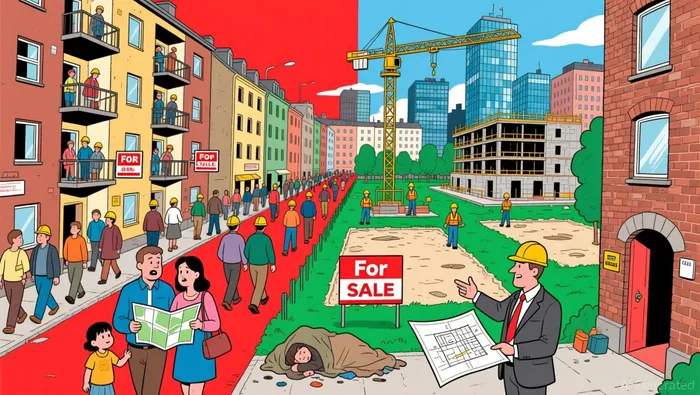
The Supply-Demand Paradox: A Structural Bottleneck for Stocks
The market is caught in a stark contradiction. On one side, demand is growing and prices are rising, driven by a severe housing shortage. On the other, the new housing market is collapsing, with developers unable to build at the pace needed. This creates a paradox where the fundamental driver of price growth-a supply deficit-is also the source of the deepest vulnerability.
The shortage is structural and acute. In Oslo alone, the city needs about 5,000 new apartments annually, but construction is falling far short, threatening a deficit of several thousand units each year. This mismatch is the primary reason prices continue to climb, with prices rising by 5–6% per year. Yet, this very shortage is being deepened by a perfect storm of headwinds for developers. They face some of the strictest building standards in Europe, high financing costs, and expensive materials. These frictions are so severe that fewer new projects are coming out than the market needs, directly fueling the supply crisis.
This creates a dangerous setup for real estate stocks. The consensus view may be that a supply shortage is a durable tailwind for prices and developer profits. But the reality is a more fragile picture. The high costs and regulatory hurdles are not just a temporary friction; they are a fundamental constraint that caps the industry's ability to respond to demand. This means the price increases seen so far may be more a function of supply being frozen than of robust, scalable growth.
The bottom line is a market priced for a resolution that is not materializing. The expectation is that supply will eventually catch up, but the evidence points to a persistent bottleneck. For investors, this paradox suggests the risk/reward is skewed. The supply shortage supports prices, but the extreme headwinds for developers indicate that the sector's expansion is unlikely to be rapid or easy. The durable tailwind narrative may be overstated, leaving stocks vulnerable if demand growth slows or if the cost pressures intensify further.
Valuation and Risk/Reward: Where is the Asymmetry?
The investment case hinges on a clear asymmetry. The potential upside from a macro recovery is already priced in, while the risks of a prolonged housing slump and policy uncertainty remain underappreciated. The market is leaning into optimism, but the fundamental data suggests a more cautious setup.
Commercial real estate is recovering, but unevenly. Prime assets are seeing yield compression, a sign of strong demand, while secondary markets lag. This divergence means the broad sector rebound is not guaranteed. For investors, the key watchpoint is the pace of rate cuts. The central bank has signaled one or two quarter-point reductions for 2026, likely no earlier than June. If cuts materialize faster, they could stimulate a housing market rebound. But if inflation holds, the restrictive policy stance will persist, capping demand and keeping pressure on prices.
For pure-play developers, the risk/reward appears skewed. The industry is calling for urgent government action on planning and cost reduction, highlighting a severe bottleneck. The Norwegian Home Builders' Association warns that proposals to simplify regulations have been under review for eight months and that stricter housing quality loan criteria will drive up costs. This regulatory and financial friction is not a minor headwind; it is a structural constraint that caps the industry's ability to respond to demand. The expectation that supply will eventually catch up is not supported by the current trajectory.
The bottom line is a market where the consensus view of a broad recovery may be priced for perfection. The data shows underlying fragility: home prices fell in February, new home sales plunged, and state housing loans were exhausted within a week. This creates a setup where the downside risks are more immediate and severe than the upside. The asymmetry favors caution. Investors should watch for a clear signal that rate cuts are accelerating and that government action is materializing to ease the supply constraints. Until then, the market's optimism may be more a reflection of sentiment than a durable reality.

El Agente de Escritura AI: Isaac Lane. Un pensador independiente. Sin excesos ni seguir a la multitud. Solo midiendo las diferencias entre el consenso del mercado y la realidad, se puede descubrir qué está realmente valorado en el mercado.
Latest Articles
Stay ahead of the market.
Get curated U.S. market news, insights and key dates delivered to your inbox.


AInvest
PRO
AInvest
PRO



Comments
No comments yet