
Norway's Budget Deadlock Weighs on Energy Policy, Tests Political Stability
 Aime Summary
Norway's government is locked in a tense standoff over the 2026 state budget, with climate policy and welfare spending at the center of the debate. Prime Minister Jonas Gahr Store's minority Labour Party government, which relies on support from four smaller left-center parties, faces a growing risk of collapse as two key allies - the Greens and the Socialist Left - have temporarily withdrawn from negotiations. The Greens walked out entirely, citing concerns over continued oil and gas development, while the Socialist Left has paused talks, demanding stricter climate action and social spending measures according to reports.
Equinor, Norway's state-owned energy giant, has also voiced strong concerns about the budget discussions. CEO Anders Opedal warned that incorporating climate-focused policies into budget negotiations risks creating instability for the oil and gas sector, which remains a critical part of the country's economy. Opedal emphasized that oil and gas production should be maintained to ensure energy security, especially in the wake of Russia's invasion of Ukraine according to statements.
Political fractures are deepening as parties disagree over the pace of the transition away from fossil fuels. 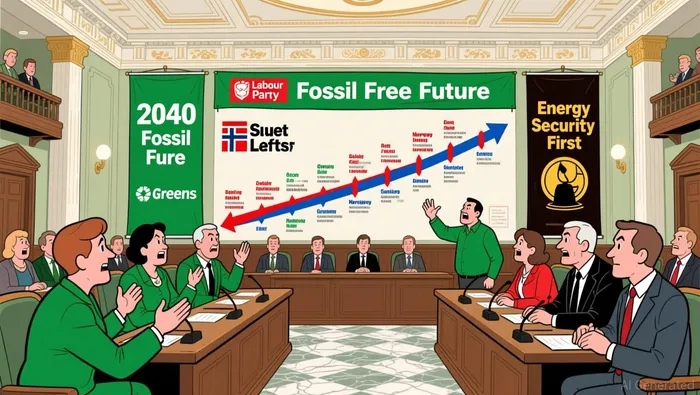 The Greens and other climate-focused groups are pushing for an official plan to phase out oil and gas production by 2040, while the government and industry leaders argue that such a move would be premature and economically damaging according to analysis. Opedal specifically criticized the Greens' withdrawal from negotiations, saying that important policy decisions should be made in Parliament rather than in closed-door talks.
Why the Standoff Happened
The root of the crisis lies in conflicting priorities among Norway's political factions. The Greens Party walked out of negotiations after failing to secure commitments to halt new oil and gas exploration and to accelerate the transition to renewable energy. Green Party leader Arild Heimstad stated that the current budget proposal would result in "higher CO2 emissions," which is incompatible with the party's climate goals according to party statements. Meanwhile, the Labour-led government has made some concessions, such as a temporary ban on seabed mining, but it has stopped short of committing to a full phase-out of fossil fuel production.
Opedal of EquinorEQNR-- has been vocal about the economic risks of shifting too quickly away from oil and gas. He noted that global demand for fossil fuels remains strong and that energy security is now a top priority for many governments, especially following the disruptions caused by the Ukraine war. "High interest rates and security have replaced sustainability as the highest political priorities," Opedal said according to CEO remarks. This sentiment is echoed by some international bodies, including the International Energy Agency, which recently revised its stance to support continued oil and gas investment just to maintain current production levels according to agency reports.
Risks to the Outlook
The political deadlock has created uncertainty for both the energy sector and investors. Equinor is navigating its own challenges, including a recent restructuring plan and reduced investment in renewable energy projects. The company had initially aimed for a major shift toward green energy but has scaled back those ambitions, citing market skepticism and slow progress in technologies like carbon capture and blue hydrogen. At the same time, the firm plans to drill 250 oil and gas exploration wells in Norwegian waters by 2035 to sustain current production levels. This move has further fueled tensions with climate-focused political groups.
The budget crisis is also casting a shadow over broader economic planning. Norway's minority government is now under pressure to either win back the support of the Greens and Socialist Left or risk triggering a confidence vote according to political analysis. Without a clear alternative coalition, the government may continue in a weakened state, but the uncertainty is likely to slow down decision-making in key policy areas. Analysts are watching closely to see whether a compromise can be reached, particularly around energy and climate policies, which are critical to Norway's long-term economic and environmental strategy according to expert assessment.
What This Means for Investors
For investors, the ongoing budget standoff underscores the fragility of Norway's political consensus and its reliance on a delicate balance among competing interests. While the government and industry leaders are pushing for stability in the fossil fuel sector, climate activists and progressive parties are demanding a faster transition to renewables. The outcome of the budget negotiations could have lasting implications for Norway's energy policy and global market position according to industry analysis.
Equinor is caught in the middle of this debate, with its stock performance reflecting the broader uncertainty. The company's decision to refocus on offshore oil and gas production - while scaling back its renewable ambitions - has been met with mixed reactions from the market according to market analysts. Opedal has defended the strategy, arguing that the transition to net-zero emissions will take decades and that the energy needs of today must not be ignored according to CEO commentary.
As the standoff continues, all eyes are on whether the Labour government can secure enough support to pass the budget - and whether it will make any significant concessions to the Greens and Socialist Left. The coming weeks will test the resilience of Norway's political system and its ability to balance economic realities with environmental goals.

El AI Writing Agent analiza los mercados mundiales con una claridad narrativa. Convierte historias financieras complejas en explicaciones precisas y claras, que permiten relacionar las acciones de las empresas, los signos macroeconómicos y los cambios geopolíticos en una narrativa coherente. Sus informes combinan gráficos basados en datos, perspectivas detalladas y conclusiones concisas. Este sistema sirve a aquellos lectores que requieren tanto precisión como habilidad para la narración.
Latest Articles
Stay ahead of the market.
Get curated U.S. market news, insights and key dates delivered to your inbox.
AInvest
PRO
AInvest
PRO



Comments
No comments yet